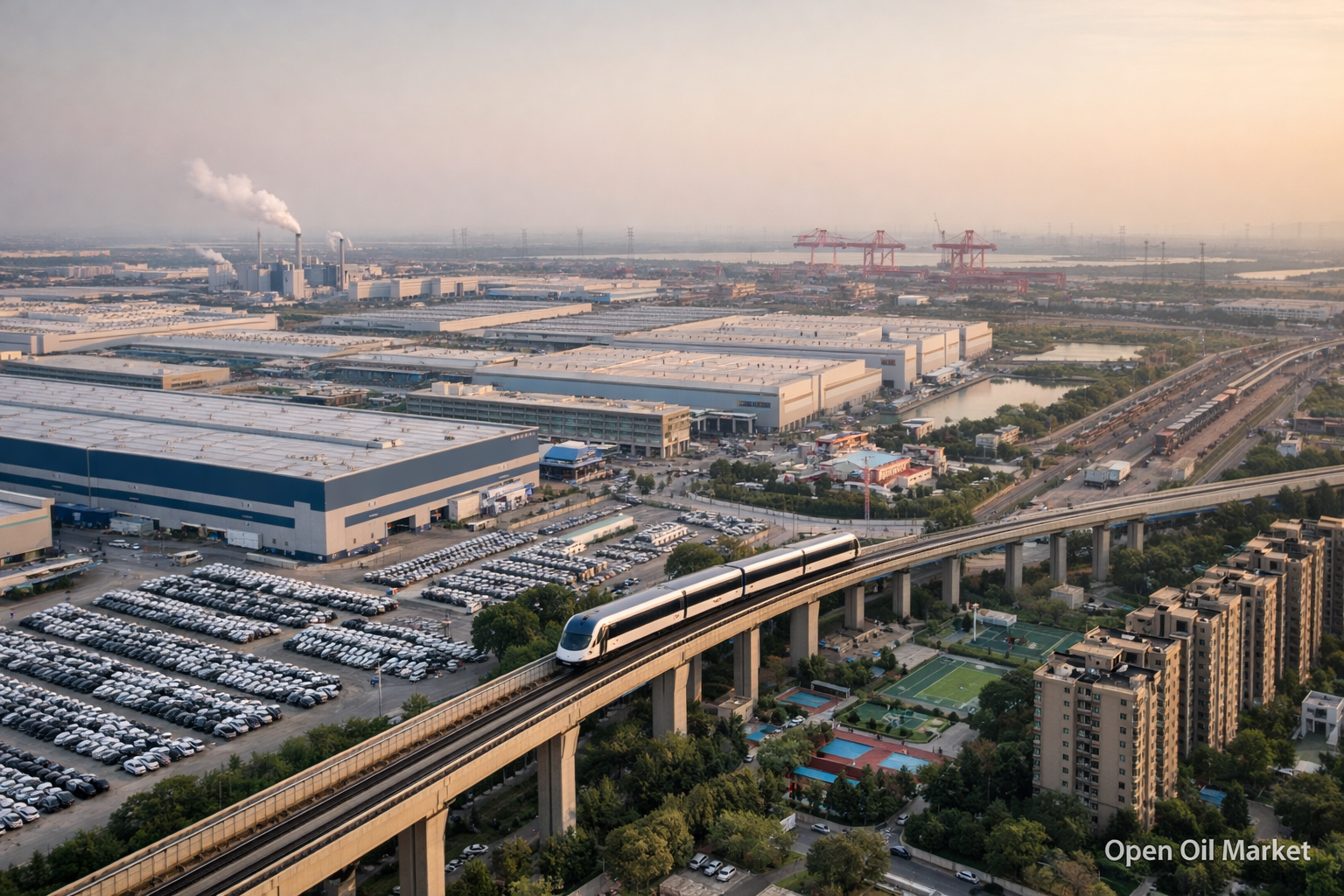
BYD's Gigantic Factory in Zhengzhou: One of the World's Largest Industrial Projects. Analyzing Scale, Production Economics, and Its Significance for the Global Electric Vehicle Market and Investors.
Project Scale: Where Viral Numbers End and Measurable Facts Begin
The story of "the BYD factory being larger than San Francisco, Paris, or Barcelona" went viral due to its perfect metaphor: electric vehicle manufacturing is transforming into a new city-level industrial infrastructure. In practice, what matters more to investors is not the comparison with megacities, but operational metrics: the current area of the production site, expansion dynamics, workforce numbers, actual output, and projected capacity.
According to public evaluations based on satellite imagery, the manufacturing footprint at the Zhengzhou site spans tens of square kilometers, while claims of 130 km² often reflect the extended area of the industrial zone/cluster and development plans. The same applies to workforce numbers: media recaps often mention "100,000 employees," but for investment analysis, confirmed benchmarks for employment and personnel recruitment, as well as labor productivity, are crucial.
Electric Vehicle Production as an Industrial Platform: Economies of Scale and Cost Structure
BYD builds its competitive advantage not just through its product line, but also through the industrial economics of scale. For the EV market, this is critical: the cost of batteries, power electronics, and assembly directly defines the price corridor within which the company can engage in price competition without harming margins. The "city-factory" in Zhengzhou is an attempt to lock in a low per-unit cost of electric vehicle production over the next several years.
- Reduction in unit costs: large volumes facilitate more favorable procurement of materials and components, factory line utilization, and capex amortization.
- Speed of output: with stable logistics and refined automation, the cycle of "components → vehicle" shortens.
- Flexibility of product range: a large base is better positioned to handle the launch of new models, distributing risks among platforms and segments.
BYD's Vertical Integration: Batteries, Components, and Supply Chain Control
For investors, BYD's vertical integration is a central element of the case. In electric vehicles, the cost of batteries and power components remains dominant, which means that control over battery lines, modules, and key components serves to both protect margins and secure against supply chain disruptions.
Zhengzhou is significant as a hub where electric vehicle manufacturing and component base development mutually reinforce each other: the expansion of battery component capabilities enhances the site's autonomy and reduces dependence on external suppliers during price shocks or technology export restrictions.
Real Volumes and Growth Trajectory: Why "1 Million Cars a Year" is Not Just Marketing
The market is closely watching Zhengzhou, as the site demonstrates a rarity in the automotive industry: the speed of scaling up production. Growth of hundreds of thousands of vehicles per year is possible only through a combination of capex, automation, talent reserves, and a local industrial cluster. Public data indicates production targets of around hundreds of thousands of vehicles per year and plans to increase capacity to over "one million" with subsequent expansion phases.
- Actual output: important as an indicator of line utilization and production system maturity.
- Projected capacity: critical as a revenue scenario, but investors need to discount timelines and entry risks.
- Workforce dynamics: hiring tens of thousands signals a commitment to accelerating the introduction of new lines and R&D frameworks.
Logistics and Export: Zhengzhou as an "Internal Port" for Global Sales
For global investors, BYD's factory in Zhengzhou represents not only assembly but also logistical design. Chinese electric vehicle manufacturers gain advantages when export channels are integrated into the industrial geography: rail routes, multimodal hubs, and proximity to suppliers reduce lead times and free up working capital.
Looking towards 2026, the significance of exports is growing: BYD is publicly ramping up ambitions for sales beyond China, balancing efforts between Europe, North America, and ASEAN countries. For assessing the resilience of the strategy, it is crucial for investors to monitor how quickly the company scales up supply and localizes assembly in regions facing tariff barriers.
Competition: Pressure on Tesla, European Brands, and the Price Architecture of the EV Market
Scaling BYD's production base intensifies competition on two fronts. First, price: a reduction in production costs enables market share expansion in the mass electric vehicle and hybrid segment. Second, speed: quicker model launches and faster adaptations to regional requirements.
- Europe: sensitive to price and localization; BYD's increased presence heightens pressure on traditional automakers' margins.
- USA and North America: characterized by high barriers and policies; here, partnership strategies, local assembly, and compliance with regulations are more critical.
- ASEAN and the Middle East: growth markets where a combination of price and supply can yield rapid market share gains.
Investor Risks: Tariffs, Regulation, Demand Cyclicality, and the "Capex Race"
The larger the "city-factory," the higher the stakes in maintaining continuous utilization. In the EV segment, this entails increased sensitivity to four key risks: external trade barriers, regulatory changes, price wars, and consumer demand volatility.
- Tariff and non-tariff measures: can shift export economics and accelerate the need for localization in Europe and other regions.
- Price competition in China: with overheated capacities, the market may pressure margins, especially in the mass segment.
- Capex and payback period: large expansion phases require discipline—from timelines to working capital management.
- Technology race: batteries, power electronics, software; falling behind rapidly translates into discounts and lower customer LTV.
Practical Checklist: What to Monitor in 2026
If you are considering BYD and the entire electric vehicle sector as an investment theme, viewing "the megafactory in Zhengzhou" as a dashboard is useful: it indicates how capable the company is of scaling electric vehicle production and supply chains simultaneously.
- Actual capacity utilization and growth rates at the Zhengzhou site.
- Hiring dynamics (production, R&D, quality) and labor productivity amid automation.
- Battery cost structure and the stability of material supply for key positions.
- Export mix: share of Europe, North America, and ASEAN; speed of dealer network and service infrastructure expansion.
- Capex profile: signs of investment slowdown/acceleration and their connection to margins.
Why BYD's "City-Factory" is a Signal of a New Industrial Norm
There is much buzz around BYD in Zhengzhou—from comparisons of its area with cities to impressive visuals of the infrastructure "for living." For investors, however, the main point is different: it visualizes a new norm in the automotive industry, where leadership is defined by industrial scalability, vertical integration, and supply chain control. If BYD maintains its expansion pace without compromising quality and margins, the "megafactory" will become not merely a symbol, but a source of sustainable advantage in the global EV market.