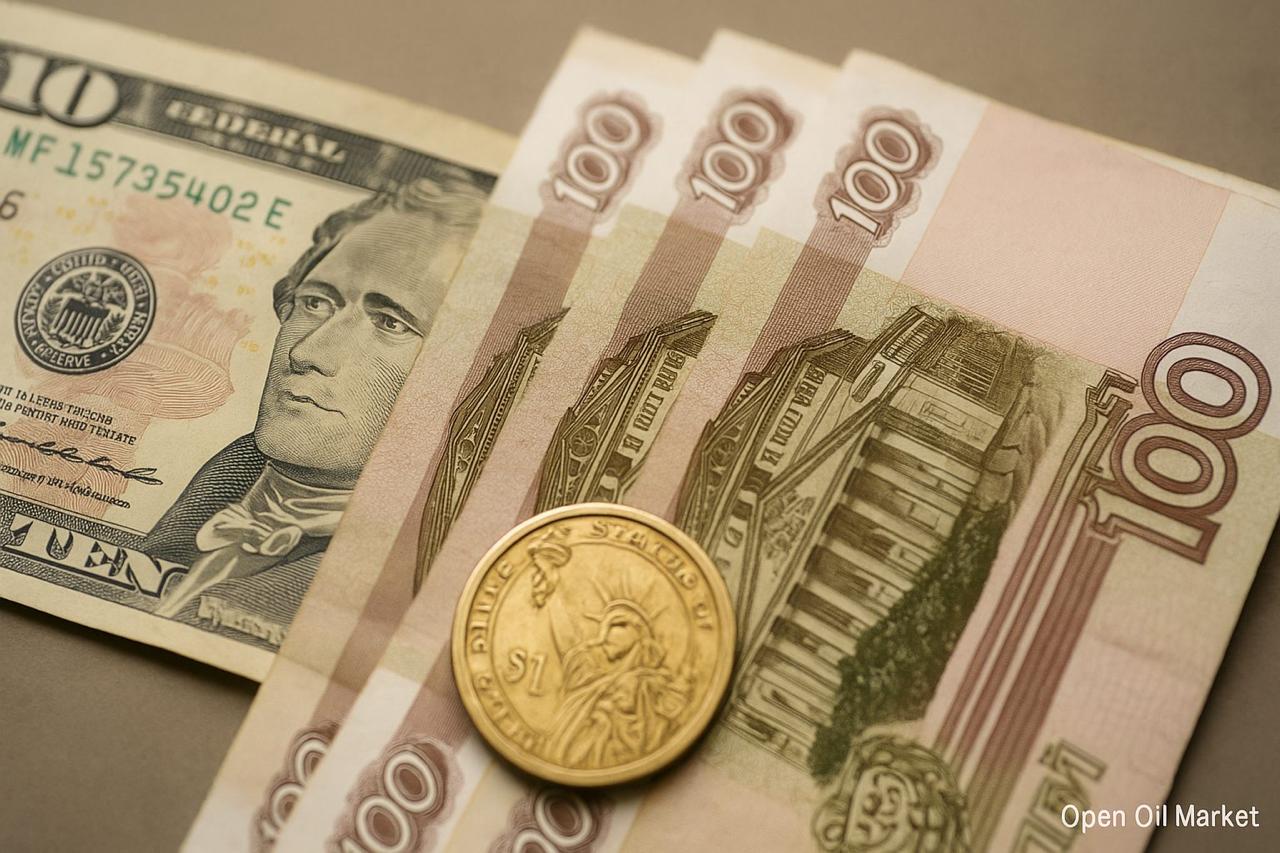
Why the Ruble is Strengthening While Searches for "Dollar Depreciation" Reach Record Highs: Macroeconomic Reasons, the Influence of the Central Bank of Russia's Policy, and What It Means for Investors in 2025
Unexpectedly Strong Ruble at Year-End
By the end of 2025, the Russian ruble is demonstrating unexpected strength. The exchange rates of major foreign currencies have noticeably declined: the US dollar has fallen to about 75–77 rubles, and the euro to 90 rubles, marking the lowest values in the last two and a half years. Such a rapid rise of the ruble has attracted widespread public attention: according to Google, the number of search queries regarding “dollar depreciation” has soared to an all-time quarterly high. Typically, by December, the ruble weakens (due to a rise in imports before the holidays and government spending), but the current situation breaks stereotypes. Investors and ordinary citizens are concerned as they try to understand what is behind the strengthening of the national currency, and if now is the right time to rush to exchange offices for dollars.
Trade Surplus and Import Restrictions
One of the fundamental reasons for the strengthening of the ruble is the substantial positive trade balance of Russia. Exports significantly exceed imports, ensuring a stable inflow of foreign currency into the country:
- High Export Revenues. Due to energy exports and other goods, Russia continues to receive a considerable volume of revenue in foreign currency. Even considering sanctions and declining oil prices, export volumes remain substantial. Furthermore, non-energy exports have recently shown growth as well, increasing the inflow of currency.
- Decline in Imports. Imports into Russia remain relatively low. This is influenced by sanctions and government measures, such as increased recycling fees and other restrictions that hamper the import of foreign goods (cars, equipment, etc.). The import substitution strategy creates additional barriers for foreign products. Additionally, domestic demand has weakened: economic growth has slowed, real incomes are rising modestly, and an increase in VAT is forthcoming—this all limits purchasing power and the demand for imported goods. As a result, demand from importers for foreign currency remains low.
- Dedollarization of Payments. The share of transactions in national currencies has grown. Russia and its trading partners are increasingly switching to rubles, yuan, and other “alternative” currencies in foreign trade. Many transactions for exported goods are now conducted without the involvement of dollars or euros. This reduces direct demand for reserve currencies in the domestic market. Simultaneously, the country's dependency on fluctuations in oil prices has decreased due to the budget rule mechanism.
- Cryptocurrency as a “Hidden Export.” A new factor has emerged: some international transactions are being conducted through cryptocurrencies. According to officials' estimates, significant amounts for imported supplies may be paid in cryptocurrency. In effect, this means that Russian exporters, such as energy suppliers, receive not goods or dollars in exchange, but digital assets that can then be converted. Such hidden exports provide additional currency revenue and decrease the need for official dollars to pay for imports. All of this contributes to the strengthening of the ruble.
Monetary Policy and Financial Factors
Another group of reasons is linked to the financial system and the regulators' policy. Tight monetary conditions within the country significantly support the ruble:
- High Interest Rates of the Central Bank of Russia. The key rate of the Bank of Russia is at a double-digit level (around 17% per annum). Such high rates have made ruble instruments extremely attractive for investors and depositors. Banks offer deposits with annual rates of 15–20%, reliable bonds provide high coupons—all of this encourages saving in rubles rather than in foreign currencies. Both the population and businesses are less interested in purchasing dollars or euros, which do not yield income when significant profits can be made in rubles.
- Inflow of Rubles from Exporters. Exporters, receiving revenue in foreign currency, sell a significant portion of it in the domestic market. Partly this is a legislative requirement, partly a rational decision: to convert dollars to rubles to place them under high-interest rates or finance domestic expenses. In a high-rate environment, even the exporters themselves are keen to quickly exchange currency for rubles and earn interest rather than keep funds in “depreciating” dollars.
- Reduction of Capital Outflow. The financial market in Russia has become more “closed.” After 2022, the country's and corporations' external debt has significantly decreased, and access to external capital markets has been closed off. Foreign investors have largely exited the Russian market. Consequently, the demand for currency for servicing external debts or transferring funds abroad has noticeably diminished. Strict restrictions on capital movement (albeit recently relaxed for individuals) also play a role: rubles tend to remain within the country. The exchange rate is now mainly formed by the balance between exporters and importers, without the previous pressure from financial speculators or panic sentiments among the public.
- Currency Interventions Following the Budget Rule. An additional factor has been the policies of the Ministry of Finance and the Central Bank in the currency market. In recent months, the government has been actively selling foreign currency from the National Wealth Fund through the “mirror” operations of the budget rule. Since December 5, the volume of currency sales has markedly increased—according to the Ministry of Finance, to the equivalent of around 14.5 billion rubles per day, roughly 1.5 times higher than in autumn. In essence, the regulator is daily throwing a significant portion of dollars and euros into the market, purchasing rubles in exchange. This creates an excess supply of currency and prevents the dollar exchange rate from rising, thereby supporting the strength of the ruble.
- Weakness of the Dollar in the Global Market. The ruble's strengthening does not occur in a vacuum—it is also influenced by external factors. The US dollar has globally weakened by the end of 2025: investors are anticipating a quick reduction in the US Federal Reserve's borrowing rate and a softening of monetary policy. The DXY index (the dollar against major world currencies) has declined to minimal levels in recent years. The dollar is depreciating against many currencies, and the ruble is no exception. Additionally, the anticipated transition in the US administration towards a weaker dollar (as analysts suggest the new financial authorities may adopt such a direction) is putting pressure on the American currency. Thus, external factors are also working in favor of the ruble.
- Geopolitical Expectations. Finally, market sentiment is influenced by geopolitics. By year-end, cautious hopes for a reduction in international tensions have emerged—partly thanks to diplomatic signals. Although there are no specific peace agreements yet, some market participants have begun to price in a more favorable future scenario. This has reduced the hoarding demand for currency "for a rainy day" among the population and businesses. Any positive news (for instance, the expansion of cooperation with major partners like India or hints at possible negotiations to resolve the conflict) supports the ruble. However, experts emphasize that the geopolitical factor is more psychological—it may have accelerated the current strengthening, but it cannot sustain the ruble in the long term without support from other fundamental factors.
Pros and Cons of a Strong Ruble for the Economy
Such a sharp strengthening of the national currency has a dual effect on the economy—there are both winners and losers from a strong ruble.
- Advantages for Citizens and Importers: The strengthening of the ruble slows down inflation. Prices for imported goods (electronics, cars, clothing, fruits, etc.) either cease to rise or decrease in ruble terms. This supports the real purchasing power of the population and reduces costs for importing companies for raw materials and components. Trips abroad and payments for services in foreign currency (tourism, education, foreign services) become cheaper for Russians. A strong ruble overall increases trust in the national currency and financial stability—savings in rubles depreciate more slowly, which positively affects domestic consumption.
- Disadvantages for the Budget and Exporters: The Russian economy is historically export-oriented, so an overly expensive ruble hits exporters. Companies selling their goods abroad for dollars or euros (oil and gas, metallurgy, chemicals, etc.) receive fewer rubles upon conversion of their revenue. Their profitability decreases, which may lead to a reduction in investments, development expenses, and even a decrease in extraction/production volumes. The state budget receives reduced ruble revenues from export duties and taxes: oil and gas revenues in rubles have sharply decreased as the ruble has strengthened, exacerbating budget deficits. As a result, an overly strong ruble poses a challenge for economic growth: export-oriented sectors, which are driving the economy, lose profitability. If the situation persists, negative consequences are possible for employment in these sectors and for treasury revenues. The government effectively has to balance between the goal of suppressing inflation (where a strong ruble helps) and supporting export-oriented sectors (which need a weaker ruble for comfortable operation).
How Authorities Are Reacting to the Strengthening Ruble
The unusual currency dynamics have not gone unnoticed by the country's leadership. Russian authorities openly acknowledge that an excessively strong ruble creates problems. The head of the Ministry of Economic Development, Maxim Reshetnikov, has described the current ruble strengthening—almost a quarter since the beginning of the year—as one of the main challenges for the economy and noted that “a strong ruble is a new reality that must be taken into account.” A discussion has unfolded in business circles and among government officials about whether a currency corridor or other measures are needed to weaken the ruble, yet the Ministry of Finance has opposed direct currency management. Finance Minister Anton Siluanov stated that the floating rate under current conditions reflects the balance of supply and demand and approximately corresponds to the parameters of the balance of payments. In simple terms, the authorities do not plan to artificially revert to a fixed exchange rate— the economy is encouraged to adapt to a strong ruble.
However, indirect measures are being taken to regulate the situation. As noted, since December, the Ministry of Finance has increased currency sales from reserves in an attempt to smooth out exchange fluctuations and partially compensate for the seasonal growth in demand for foreign currency by year-end. Simultaneously, the Central Bank has begun to gradually soften previously introduced currency restrictions. As of December 8, the regulator lifted the remaining limits on foreign currency transfers abroad for Russian citizens and "friendly" non-residents. Previously, individuals could send no more than $1 million abroad per month—this restriction has now been lifted. The Central Bank explained the decision by the stability of the currency market. Some experts believe that lifting limits is a step towards more market-driven currency formation: it increases the flexibility of transactions, reduces the incentive to use gray capital outflow schemes, and crucially allows "steam" to be released from the overheated currency market, slightly increasing capital outflow.
Additionally, discussions are ongoing about stimulating imports. M. Oreshkin, the economic assistant to the president, noted that to return to a weaker ruble in the long term, the government may need to pursue an aggressive policy to increase imports in certain segments—thus intentionally increasing demand for foreign currency. So far, official statements express confidence that the situation is under control. Regulators indicate that they have sufficient tools to prevent excessive strengthening or sharp volatility of the ruble if necessary. Overall, the policy aims to smooth extreme fluctuations in the exchange rate while not interfering with market trends: a strong ruble is seen as an ally in the fight against inflation, but authorities strive to prevent the scenario where the exchange rate becomes "too good to be true" and harms the budget.
Outlook: How Long Will the Ruble Remain Strong?
The primary question for investors and businesses is whether the current rate around 75–80 rubles per dollar will persist for an extended period. The consensus among most analysts is that in the short term, until the end of the year, the ruble will remain relatively strong unless external shocks occur. All the noted factors—from export revenues to the Central Bank policy—contribute to this. Many investment companies have adjusted their forecasts and now expect the year to end with an exchange rate in the range of 75–78 ₽ per $ and 90 ± 5 ₽ per €. It is possible that just before the New Year holidays, the ruble may weaken slightly due to seasonal increases in consumer and corporate spending (including on imported goods) and capital outflows abroad, but significant deviations are not predicted. The regulator will continue selling foreign currency to mitigate increased demand, so sharp fluctuations in the exchange rate are unlikely.
In 2026, experts expect a gradual weakening of the ruble. Keeping the national currency this strong constantly is challenging and disadvantageous for the economy. The baseline scenario from major banks and analytical centers anticipates a return of the dollar exchange rate to around 85–95 rubles within the year. Some projections for the end of 2026 indicate a range of about 90–100 rubles per dollar. The reasons include changes in the very factors that currently support the ruble. Firstly, monetary policy is expected to soften: if inflation in Russia continues to decelerate, the Bank of Russia may start gradually lowering the key interest rate. Predictions suggest that by the first half of 2026, the rate could drop from its current highs (17%) to 14–15%. The reduction in ruble credit costs and lower deposit rates will diminish the appeal of the ruble for speculative operations and again increase the likelihood of businesses and households purchasing foreign currencies.
Secondly, the scale of currency interventions will decrease. The Ministry of Finance does not plan to sell foreign currency indefinitely: sales volumes under the budget rule are likely to be reduced in the new year, particularly if oil prices recover somewhat. This will remove some of the support that the ruble is currently receiving from the government. Thirdly, there may be a rise in imports. The economy cannot sustainably meet all demand solely through domestic production—sooner or later, companies will begin to acquire more equipment, components, and goods from abroad, especially as they adapt to sanctions. Moreover, the VAT increase from January 1, 2026, may prompt businesses to procure imported goods in advance, thereby increasing demand for foreign currency. Additionally, citizens traditionally spend more during the winter holiday season, including travel abroad, temporarily boosting demand for dollars and euros.
Finally, geopolitical factors should not be discounted. In the event of a détente—such as the hypothetical conclusion of peace agreements followed by the partial lifting of sanctions—the ruble may receive another impulse for strengthening. Some optimistic forecasts allow for the possibility that under favorable conditions, the exchange rate could briefly return to 70–75 ₽ per $ in the first quarter of 2026. However, even the authors of such scenarios caution that this would be a one-time, emotional strengthening: in the long term, fundamental economic factors will prevail, and an overly strong ruble will still recede. Conversely, if the external political situation remains tense or deteriorates—new sanctions, risks for exports—this will accelerate the ruble's weakening.
Overall, the consensus is that the current super-strong ruble is a phenomenon supported by a combination of unique factors, and it is unlikely to persist throughout the next year unchanged. Most likely, the ruble exchange rate will gradually shift to a more "comfortable" range for the economy. Experts do not anticipate a sharp collapse of the national currency—unless unforeseen events occur, the ruble's weakening will be gradual. In other words, a dollar at 100 rubles might return, but not as a sudden spike tomorrow, rather as a result of a gradual process throughout 2026. Additionally, a return to extremely low values (50–60 ₽ per $, as it was a few years ago) is not anticipated—too much has changed in the economy. Most likely, relative stability for the ruble is expected in winter, with moderate depreciation towards spring and summer 2026.
Should You Buy Dollars Now: Recommendations for Investors
The main practical question that concerns many is whether to rush and buy dollars (or euros) now, taking advantage of their "low" price? The answer depends on your goals, but panic purchases of currency now are unlikely to be justified. Here are several considerations for individual investors and deposit holders:
- Do not rely on currency as a quick way to make money. In recent months, the ruble has strengthened, and those who bought dollars earlier at their peak have incurred losses. For instance, purchasing $1,000 at the end of 2024 would have cost more than 100,000 rubles, while today those dollars are worth about 75–80 thousand. The loss in value amounts to about 25%. Additionally, during this period, the potential profit from investing the same money in a ruble deposit at a high interest rate has been missed. It turns out that savings in foreign currency are underperforming against ruble instruments as the ruble grows. There are no guarantees that the situation will abruptly reverse in the upcoming weeks. Therefore, buying dollars “in hopes of a rise in exchange rate” now appears speculative and risky.
- Ruble assets are yielding high returns now. Thanks to high deposit and bond rates, you can achieve double-digit returns in rubles. This yield already compensates for any potential weakening of the ruble in the future by several percentage points. Simply put, even if in a year the dollar rises from 75 to 90 rubles (up 20%), a deposit yielding 20% per annum will bring comparable profit, offsetting the exchange rate growth. If the rate remains close to current levels, the benefits of ruble instruments will be obvious. Given this, most financial advisors do not recommend keeping all savings in foreign currency—ruble instruments have become too attractive.
- Buying foreign currency makes sense for specific needs. If you have planned expenses in dollars or euros—traveling abroad, paying for education, purchasing imported goods—the current exchange rate indeed offers an opportunity for cost savings. Currency has become cheaper, and you can save money. In such cases, it is prudent to purchase the necessary amount gradually, in portions, to mitigate the risks of exchange fluctuations. For example, if the trip is in a couple of months, you can buy currency bit by bit each week. This way, the average purchase rate will be comfortable.
- Dollars as a “safety net”—only as part of diversification. It is always prudent to keep part of your savings in various assets. If you are concerned about the long-term stability of the ruble, there is nothing preventing you from allocating a portion of currency as a precaution. However, approach this without haste: allocate a reasonable share to dollars—one you are willing to lose to hedge against the worst-case scenario. At the same time, do not rush to sell all ruble investments. The optimal strategy is to diversify your capital: for example, part in rubles in deposits/OFCs, part in cash or foreign currency accounts, part in other assets (precious metals, stocks, etc.). This diversification will allow you to feel confident no matter how the situation unfolds.
- If you already hold foreign currency. Many Russians have savings partially kept in dollars or euros from previous times. Now that dollars have depreciated, the question arises—what to do with them? Financial experts advise against keeping all your eggs in one basket. It makes sense to utilize the strong ruble and rebalance your portfolio: for example, you could convert some of your foreign currency savings back into rubles and place them under high interest. This will increase your overall capital returns. The remaining part of the currency could stay as a long-term hedge. In the future, you can gradually adjust proportions based on market conditions.
Conclusion: The current situation in the currency market calls for calm and measured actions rather than a rush. The ruble is strong now for objective reasons. It is not advisable to rush to exchange all ruble savings for dollars in fear of “missing the moment”—there is a significant risk of incurring losses or missing out on profit later. On the other hand, completely rejecting currency is also unnecessary: it still plays a role as a protective asset against unforeseen shocks. The optimal approach for a broad range of investors is to coolly assess their needs and horizons. Use the strong ruble to maximize benefits (high rates, cheap imports) while simultaneously adhering to the principle of diversification, keeping a moderate share of savings in reliable foreign currency. This approach will allow you to feel confident regardless of the ruble's exchange rate.