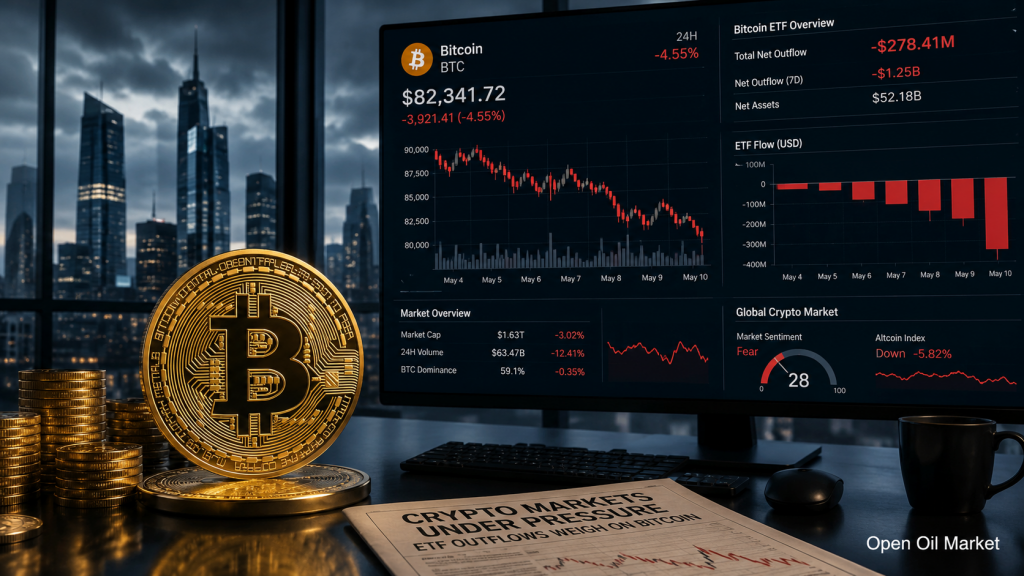
Cryptocurrency News for Thursday, July 2, 2026: Bitcoin Under Pressure from ETF Outflows, Ethereum Losing Momentum, Regulation in the EU and UK Tightening, and Stablecoins Becoming the Main Arena for Global Investors
The cryptocurrency market enters Thursday, July 2, 2026, in a noticeably more cautious state compared to a month ago. Following a period of heightened interest in digital assets, investors are now refocusing on three key themes: the dynamics of Bitcoin and Ethereum, capital flows into cryptocurrency ETFs, and the tightening of regulation in the USA, UK, and European Union. For a global audience of investors, the crypto market increasingly resembles not merely a separate speculative niche but a part of the broader financial system where liquidity, compliance, macroeconomics, and institutional demand are crucial.
The main theme of the day is the cooling demand for the largest cryptocurrencies. Bitcoin remains in a zone of heightened volatility after dropping below $60,000, while Ethereum is also under pressure as major fund managers reassess their expectations for the digital asset market. Concurrently, competition in the stablecoin sector is intensifying: major tech and financial companies are expanding their presence in the infrastructure surrounding the digital dollar. This is shifting the balance of power between traditional crypto exchanges, payment systems, stablecoin issuers, and institutional investors.
Bitcoin Remains the Main Indicator of Risk in the Crypto Market
Bitcoin continues to set the tone for the entire cryptocurrency market. For investors, BTC remains a fundamental asset through which risk appetite, liquidity expectations, and trust in the digital asset sector are assessed. However, at the beginning of July 2026, the picture has become less straightforward: after a decrease in quotations, market participants are no longer discussing an unequivocal continuation of the bull cycle, but rather increasingly contemplating a scenario of prolonged consolidation.
Several factors are exerting pressure on Bitcoin:
- outflows of capital from spot Bitcoin ETFs;
- strengthening of the dollar during certain trading periods;
- decrease in speculative interest in risk assets;
- concerns over a potential recession in developed economies;
- regulatory uncertainty surrounding the structure of the crypto market in the USA.
For long-term investors, the key question now is not just the price of Bitcoin but also the quality of demand. If in 2024-2025 the driver of the market was the anticipation of mass institutional entry through ETFs, in 2026, investors are assessing the sustainability of that demand. In the absence of stable inflows into Bitcoin funds, BTC may remain in a broad sideways range, where each macroeconomic event will amplify volatility.
Ethereum Losing Momentum but Retaining Infrastructure Importance
Ethereum remains the second-largest cryptocurrency and the foundational platform for smart contracts, DeFi, asset tokenization, and part of the stablecoin market. However, in the current market phase, ETH is not showing convincing leading growth. Investors cautiously evaluate Ethereum’s prospects amid weak ETF dynamics, competition from faster blockchains, and a general decline in interest for altcoins.
Nevertheless, Ethereum cannot be viewed solely as a speculative asset. Its role in cryptocurrency infrastructure remains systemic: the network facilitates operations for decentralized applications, the issuance of tokenized assets, part of settlements in stablecoins, and interactions with Layer-2 solutions. For institutional players, Ethereum is significant as a technological platform rather than just as an ETH coin.
Ethereum’s weakness in the short term may be linked to investors requiring clearer sources of yield. If an asset does not demonstrate strong price growth, the market begins to compare it with traditional instruments: bonds, tech stocks, and money market funds. Therefore, to rekindle interest, ETH needs either new inflows into ETFs, an increase in network activity, or an acceleration in real-world tokenization applications.
ETFs as the Main Channel for Institutional Demand
Cryptocurrency exchange-traded funds remain the central mechanism for institutional capital entry into digital assets. It is through ETFs that large investors, family offices, funds, and advisors gain regulated access to Bitcoin and Ethereum without the necessity of directly holding the cryptocurrency. Thus, the dynamics of inflows and outflows from ETFs have become one of the primary indicators of market state.
In June and early July of 2026, the market faced deteriorating ETF statistics. Outflows from Bitcoin funds intensified pressure on BTC prices and signaled that institutional demand is no longer one-sided. If earlier ETFs were seen as a continual source of new capital, now investors recognize that this channel can also operate in reverse.
For the market, this means several important conclusions:
- Bitcoin is becoming sensitive to the behavior of asset managers.
- Cryptocurrency ETFs enhance the connection between digital assets and the traditional stock market.
- Outflows from funds can accelerate corrections faster than retail selling.
- Future ETFs on Solana, XRP, or other assets may spark local interest, but do not guarantee sustainable growth for the entire market.
Investors must monitor not only the price of Bitcoin and Ethereum but also daily flows into ETFs. These flows indicate whether the market is buying cryptocurrencies as a long-term asset class or temporarily reducing risk.
Regulation in the EU and UK Changing the Global Crypto Market
One of the main events for the cryptocurrency market has been the tightening of regulation in Europe. New requirements under MiCA effectively divide companies into those that can legally serve clients in the European Union and those that must limit or cease operations without a license. For investors, this represents a significant structural shift: the European cryptocurrency market is becoming less fragmented but more demanding in terms of capital, reporting, and customer protection.
Similar trends are observed in the UK. The British regulator is preparing broader rules for crypto companies, including capital requirements, stress testing, and risk management. This brings the cryptocurrency sector closer to the standards of the traditional financial market. For large players, this process may become an advantage, as they possess the resources for compliance. For smaller exchanges and services, the new rules may present a barrier to operations.
Globally, cryptocurrency regulation is evolving towards market consolidation. Stricter rules may reduce the risk of fraud but simultaneously decrease the number of independent players. Investors should recognize that future crypto market leaders will be determined not only by technology and liquidity but also by their ability to comply with regulatory requirements in the USA, EU, UK, Asia, and the Middle East.
Stablecoins at the Centre of Competition Between Banks, Big Tech, and Crypto Companies
Stablecoins are taking centre stage in 2026. While Bitcoin remains a digital equivalent of a risky macro asset and Ethereum serves as a technological platform, stablecoins are becoming the transactional infrastructure. They are utilized in trading, DeFi, cross-border payments, asset tokenization, and corporate settlements. As a result, major financial and tech companies are increasingly entering this sector.
The launch of new digital dollar projects is intensifying pressure on existing market leaders, including USDT and USDC. For investors, this implies that competition in stablecoins will shift from crypto exchanges to payment infrastructure, bank regulation, and corporate partnerships.
Key directions for sector development include:
- increased role of regulated dollar stablecoins;
- integration of stablecoins into payment systems;
- competition between USDT, USDC, and new corporate projects;
- increased requirements for reserves and disclosure;
- use of stablecoins in the tokenization of real assets.
However, it is important for investors to remember that stablecoins are not risk-free instruments. Their resilience depends on the quality of reserves, regulation, liquidity, and trust in the issuer. As the sector expands, central banks and international financial organizations are paying closer scrutiny.
Altcoins: Solana, XRP, BNB, and Cardano Depend on Liquidity
The altcoin market remains heterogeneous. Solana, XRP, BNB, Cardano, Dogecoin, and other major cryptocurrencies continue to attract investor attention, but their dynamics increasingly depend on overall liquidity and regulatory news. In times of declining risk appetite, altcoins typically experience more pressure than Bitcoin.
Solana maintains interest due to its high network performance, developer activity, and expectations of new investment products. XRP remains linked to cross-border payment themes and regulation. BNB depends on the positioning of the Binance ecosystem and demand for BNB Chain infrastructure. Cardano continues to hold a strong community, but for institutional capital, real metrics of network utilization become more vital.
For investors, altcoins in 2026 represent more than just a bet on the overall cryptocurrency market growth. Each asset requires a separate analysis:
- whether there is real network application;
- whether user activity is increasing;
- whether there are institutional investment products;
- how clear the token's regulatory status is;
- whether liquidity is sufficient for large investors.
Top 10 Most Popular Cryptocurrencies for Investors
As of July 2, 2026, the focus of global investors remains on the largest and most liquid cryptocurrencies by market capitalization, infrastructural role, and recognizability. The top 10 most popular cryptocurrencies are as follows:
- Bitcoin (BTC) — the largest cryptocurrency and the primary indicator of the digital asset market state.
- Ethereum (ETH) — the leading platform for smart contracts, DeFi, and tokenization.
- Tether (USDT) — the largest dollar stablecoin, actively used in global crypto trading.
- BNB (BNB) — the token of the Binance ecosystem and BNB Chain.
- USD Coin (USDC) — a regulated stablecoin essential for institutional settlements.
- XRP (XRP) — a token associated with cross-border payments and payment infrastructure.
- Solana (SOL) — a high-performance blockchain for applications, DeFi, and consumer crypto services.
- TRON (TRX) — a network widely used for stablecoin transfers and settlements.
- Dogecoin (DOGE) — the largest meme cryptocurrency noted for its high recognizability and volatility.
- Cardano (ADA) — a blockchain platform emphasizing an academic approach and long-term development.
For investors, this list is important not as a buying recommendation but as a liquidity map of the crypto market. These assets most frequently form indices, ETF observations, retail demand, and institutional strategies.
What Investors Should Focus on July 2, 2026
The cryptocurrency market remains high-risk, but its structure is becoming more mature. The focus is no longer solely on rapid price increases but also on regulation, infrastructure resilience, the quality of stablecoin reserves, ETF investor behavior, and competition between blockchains.
Investors should keep an eye on the following factors:
- ETF flows: persistent outflows from Bitcoin and Ethereum ETFs may continue to exert pressure on the market.
- Regulation: MiCA in the EU and new FCA rules in the UK could accelerate the consolidation of the crypto business.
- Stablecoins: intensified competition in the digital dollar may alter the power dynamics between USDT, USDC, and new issuers.
- Macroeconomics: interest rates, dollar liquidity, and recession risks remain critically important for Bitcoin and altcoins.
- Altcoins: Solana, XRP, BNB, Cardano, and Dogecoin may show sharp movements but require separate risk assessment.
The key takeaway as of July 2, 2026: the crypto market is transitioning from the expectation phase to the sustainability assessment phase. Bitcoin remains the market's focal point, Ethereum retains its infrastructural significance, stablecoins become the central area of competition, and regulation acts as a determining factor for future winners. For investors, this underscores the need for stricter risk management, diversification, and analysis beyond just price, but also including the fundamental drivers of digital assets.