Crypto News 3 June 2026: Bitcoin and Ethereum Under Pressure from ETF Outflows, Stablecoins Rise, and Regulated Derivatives Reshape the Market
Crypto Market Enters a New Phase of the Institutional Cycle
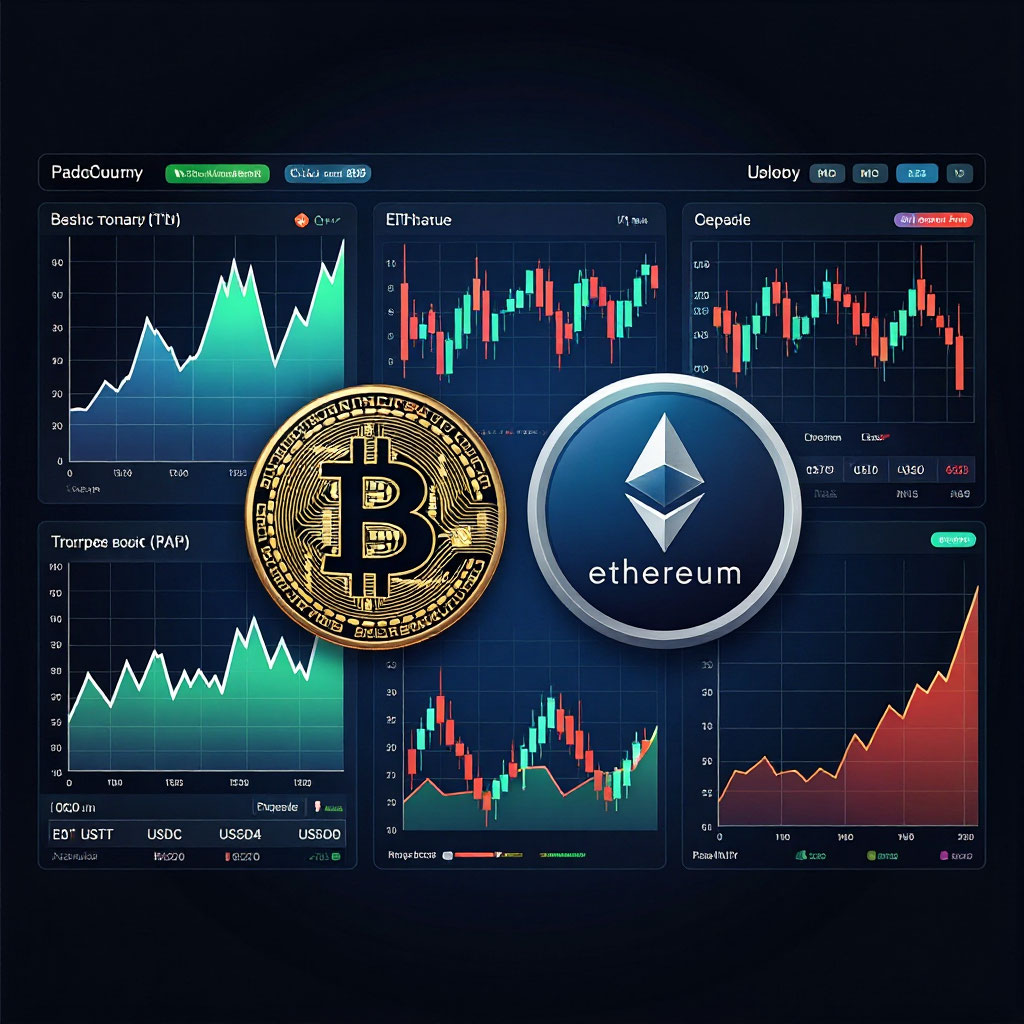
On 3 June 2026, the cryptocurrency market remains under heavy selling pressure. However, what is unfolding cannot be explained by a typical post-rally correction. In recent months, digital assets have become increasingly integrated into the traditional financial system, meaning Bitcoin and Ethereum prices are now influenced not only by crypto traders but also by funds, pension managers, ETF providers, banks, and regulators.
That is why the main event at the start of June is not the price movement itself, but the shift in demand structure. While investors debate the decline in Bitcoin and Ethereum, institutional capital is being redistributed among ETFs, stablecoins, derivatives, and select altcoin segments. At the same time, the United States is finalising a regulated infrastructure for perpetual futures, and the stablecoin market is gradually evolving into a fully-fledged global payments layer.
To understand the situation, it is essential to look beyond asset prices and focus on capital flows. These are today the primary indicator of sentiment in the crypto market.
Bitcoin: Why ETF Outflows Remain the Market’s Biggest Risk
Bitcoin enters 3 June in a state of prolonged correction from its all-time highs in late 2025. While the previous cycle was largely defined by fresh capital inflows through spot ETFs, the current phase is characterised by the reverse process: institutional investors are partially taking profits and reducing positions.
The key question market participants are asking today is simple: does the series of ETF outflows signal the start of a full-blown bear market? For now, most analysts answer no. The decline resembles a deep correction within a long-term upward cycle, but the scale of outflows is forcing investors to closely monitor the behaviour of the largest funds.
Special attention is focused on products from BlackRock, Fidelity, and Grayscale. These instruments channel the bulk of institutional demand for Bitcoin. When funds record negative flows for several consecutive days, the market interprets this as a signal of reduced risk appetite among large players.
An additional pressure factor is the decline in corporate buying activity. In previous years, public companies regularly increasing their Bitcoin reserves provided substantial market support. Now, the pace of such purchases has slowed markedly, making the market more sensitive to ETF investor actions.
However, Bitcoin retains strong fundamental arguments. Supply remains limited, the volume of new coins continues to fall post-halving, and interest from sovereign wealth funds and institutional investors has not completely vanished.
Which Indicators Investors Track Daily
Beyond ETF flows, the market closely monitors the behaviour of long-term holders, the volume of coins on exchanges, miner dynamics, and the state of the derivatives market. Together, these factors help assess whether the current decline is a routine correction or signals a more serious trend reversal.
Ethereum: Strong Ecosystem, Weak Price Momentum
If Bitcoin is under pressure from declining institutional demand, Ethereum faces several challenges simultaneously. The price of ETH continues to lag behind other major digital assets, and a series of outflows from Ethereum ETFs raises increasing questions about the asset’s short-term prospects.
Yet the fundamental picture looks significantly better than the market dynamics. Ethereum remains the largest platform for decentralised finance, tokenisation of real-world assets, stablecoin issuance, and Layer‑2 solutions.
A paradox emerges that has become one of the key investment questions of 2026. If the network’s role continues to grow, why is the asset itself showing weakness? The answer lies in investors increasingly separating infrastructure utility from token investment appeal.
Competition Among Blockchain Ecosystems Intensifies
Solana, BNB Chain, TRON, and other networks are gradually capturing market share from Ethereum in certain segments. This does not mean Ethereum is losing its lead, but it forces the market to reassess earlier valuations of the network’s future growth.
Spot ETFs Have Become the Crypto Market’s Leading Indicator
Just a few years ago, the market primarily tracked crypto exchange activity and on-chain data. Today, the main indicator is capital flows through ETFs.
ETFs are used not only by professional traders but also by pension funds, family offices, insurance companies, and conservative asset managers. As a result, daily inflows and outflows now reflect the sentiment of the largest participants in the financial system.
For the market, this means a shift from a speculative model to one where price is increasingly determined by capital allocation between different asset classes.
Stablecoins Become a New Financial Infrastructure
While Bitcoin and Ethereum undergo a correction, the stablecoin segment continues to expand. This contradiction best illustrates the current state of the industry.
In the early stages of the crypto market, stablecoins were seen purely as a trading tool. Today, they serve a completely different function. Millions of users employ them for savings, international transfers, and corporate settlements.
This trend is particularly visible in developing countries. For many users, a dollar-pegged stablecoin offers a more accessible way to preserve purchasing power than a traditional bank account.
The Battle for the Digital Dollar Market
Competition among USDT, USDC, FDUSD, RLUSD, and other projects is increasingly moving beyond the cryptocurrency industry. More and more banks, payment systems, and government bodies view digital dollar assets as part of the future financial infrastructure.
If the trend continues, the stablecoin market could become one of the largest segments of the global financial system within the next few years.
Regulated Perpetual Futures Open a New Era
One of the most underappreciated events of recent months is the launch of regulated perpetual futures in the United States.
For many years, the perpetual futures market developed largely outside US jurisdiction. The bulk of volumes flowed through offshore exchanges, and access for large institutional players remained limited.
For institutional investors, the emergence of a regulated infrastructure means they can use familiar instruments without having to operate through offshore platforms.
Why the Derivatives Market Matters More Than the Spot Market
It is through derivatives that large participants hedge risks, build arbitrage strategies, and manage liquidity. Therefore, changes in the regulation of this segment can have a long-term impact on the entire crypto market.
How the Top 10 Digital Assets Have Changed
The composition of the largest cryptocurrencies in 2026 shows just how much the industry has transformed in recent years.
Bitcoin remains the digital analogue of a reserve asset. Ethereum holds a central place in smart contract infrastructure. USDT and USDC have become the backbone of the crypto market’s settlement system. XRP maintains its position in international payments. Solana continues to develop an ecosystem of high-performance applications.
The ranking itself increasingly resembles a map of the future digital financial system rather than a list of cryptocurrencies.
Altcoins Become a Market of Individual Stories
One of the most important features of 2026 is the disappearance of a single altseason in its classic sense.
Investors are increasingly evaluating individual projects on fundamental metrics: protocol revenue, user numbers, tokenomics sustainability, and ecosystem quality.
This makes the market more mature and moves it closer to the model of a traditional stock market.
Macroeconomics Remains the Key External Factor
The cryptocurrency market is increasingly tied to the global financial system. Therefore, digital asset analysis cannot be conducted without considering macroeconomic factors.
Investors closely watch the policies of the US Federal Reserve, the dynamics of government bond yields, and the behaviour of the US dollar index.
A strong dollar traditionally puts pressure on cryptocurrencies and other risk assets. Rising bond yields make conservative investments more attractive.
What Will Drive the Market in the Second Half of 2026
Key drivers remain Fed policy, ETF flow dynamics, stablecoin market development, derivatives regulation, and the pace of real-world asset tokenisation. It is the combination of these factors that will determine the direction of the cryptocurrency market through the end of the year.
What Matters for Investors on 3 June 2026
The main takeaway at the start of June is that the crypto market is experiencing not a crisis, but a phase of structural recalibration. ETF outflows are weighing on Bitcoin and Ethereum, yet stablecoins continue to grow, derivatives infrastructure is developing, and institutional presence is expanding.
For short-term participants, the key indicators remain ETF flows, derivatives data, and macroeconomic statistics. For long-term investors, fundamental changes matter far more: the growth of tokenisation, the development of digital payments, and the integration of cryptocurrencies into the global financial system.
The events of 3 June 2026 show that the industry is gradually moving beyond the experimental stage and transforming into a full-fledged segment of the global financial market.
A Long-Term View of the Industry
Even amid a correction, the market continues to build infrastructure that seemed experimental just a few years ago. ETFs have become a standard investment vehicle, stablecoins are used by millions, and asset tokenisation is gradually attracting the world’s largest banks. That is why many analysts view the current period as a phase of industry maturation, not the end of its growth.
Looking at the industry’s development over a five- to ten-year horizon, the main battle will not be between individual cryptocurrencies, but between different financial infrastructures. Stablecoins will compete with bank deposits, tokenised assets with traditional securities, and blockchain platforms for the role of the global settlement layer for the digital economy.
For this reason, investors increasingly have to analyse not only an asset’s price, but also its place in the future financial architecture. The ability to generate sustainable demand and deliver real economic functions has become the primary factor in valuing digital assets in 2026.
Institutionalisation as the Decade’s Dominant Trend
One of the most significant changes in recent years is the gradual blurring of the line between traditional finance and digital assets. Banks are launching crypto custody solutions, asset managers are including ETFs in their product lines, and the largest payment systems are testing blockchain infrastructure integration. All of this creates demand that differs from the speculative interest of previous cycles.
At the same time, the market for tokenised assets is developing. Government bonds, money market funds, corporate securities, and other financial instruments are gradually gaining digital counterparts. For the crypto industry, this means the emergence of a vast new market that could multiply the size of the current digital asset segment many times over.
That is why the events of June 2026 matter not only for traders tracking daily price moves. They reflect a larger process of transformation in the global financial system, where blockchain is gradually becoming one of the foundational technology layers.