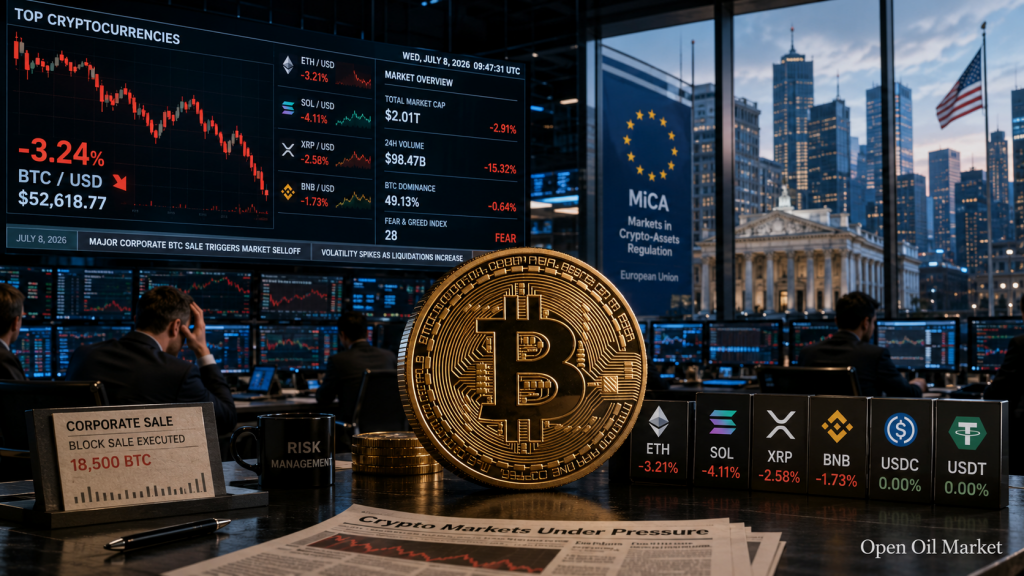
Cryptocurrency Market Update: July 8, 2026 - Bitcoin Under Pressure After Corporate BTC Selloff, Ethereum and Solana in Investor Spotlight, MiCA Reshaping the Crypto Landscape, and Top 10 Cryptocurrencies Remain Key Reference Points for Global Investors
The cryptocurrency market enters Wednesday, July 8, 2026, in a cautious recovery mode, lacking a full return to aggressive risk-taking. For investors, key events of the day include not just the dynamics of Bitcoin and Ethereum, but also changes in demand structures: corporate treasuries are reassessing their BTC storage policies, the European market transitions fully into MiCA, and the U.S. continues to seek a balance between political support for digital assets and legal uncertainties.
The global outlook for cryptocurrencies remains mixed. On one hand, Bitcoin maintains its status as a fundamental indicator of risk appetite, while Ethereum is rekindling interest among institutional investors, and Solana, XRP, and BNB remain key altcoins. On the flip side, the digital asset market is not solely focused on halving narratives or ETF expectations anymore. Liquidity, regulation, the quality of company balance sheets, and the ability of blockchain ecosystems to generate real economic activity are now coming to the forefront.
Main Topic of the Day: Market Tests Bitcoin's Resilience After Strategy's BTC Sale
The key nerve of the crypto market is investor reaction to the sale of a portion of Bitcoin by Strategy, a company previously regarded as one of the largest corporate symbols of long-term BTC accumulation. This represents an important psychological moment for the market: if major corporate holders begin to use Bitcoin as a source of liquidity, investors will reassess how they evaluate treasury strategies.
In the short term, this creates several implications:
- Increased focus on corporate balance sheets of companies related to Bitcoin;
- Heightened sensitivity of BTC to news regarding large-scale sell-offs;
- Investors beginning to differentiate between "strategic holding" and forced monetization of assets;
- Shares of companies with cryptocurrency reserves may exhibit higher volatility than Bitcoin itself.
For global investors, this signals that Bitcoin remains the primary digital asset, but corporate demand can no longer be assumed to be one-dimensional. The market will pay closer attention to the debt burdens, dividend obligations, and cost of capital of public companies that hold cryptocurrencies on their balance sheets.
Bitcoin: The Core Asset of the Crypto Market Remains at the Centre of Institutional Attention
Bitcoin continues to serve as the main benchmark for the entire cryptocurrency market. Its performance influences sentiment across Ethereum, Solana, XRP, BNB, DeFi tokens, and meme coins. However, the current recovery of BTC appears to be more cautious compared to the classic impulse rallies of previous cycles.
Investors are evaluating three key factors:
- Demand via ETFs. Inflows into spot Bitcoin ETFs remain one of the primary indicators of institutional interest.
- Behaviour of major holders. Corporate reserve sell-offs can temporarily increase market pressure.
- The macroeconomic backdrop. US liquidity, bond yields, and interest rate expectations directly impact demand for risk assets.
For investors, Bitcoin now acts not just as "digital gold," but also as a highly liquid risk asset, sensitive to institutional flows, political statements, and the condition of global capital markets.
Ethereum: Focus Shifts to Infrastructure, Staking, and Asset Tokenization
Ethereum remains the second systemic asset in the cryptocurrency market and the principal blockchain for smart contracts, DeFi, tokenization, and infrastructure solutions. Unlike Bitcoin, Ethereum’s investment case is built not only on supply scarcity but also on network utility.
Key themes for Ethereum as of July 8, 2026 include:
- Rising interest in tokenized real assets;
- Competition with Solana and other high-performance networks;
- Staking yield as a factor of institutional demand;
- The role of Ethereum in DeFi infrastructure and corporate blockchain products.
For long-term investors, Ethereum remains the asset through which the market assesses the prospects of Web3 infrastructure. However, sustained growth in ETH requires confirmation of real demand for the network, rather than mere movement following Bitcoin.
MiCA Reshaping the European Crypto Market: Licences Become New Competitive Edge
Europe represents a prime example of how the cryptocurrency market is transitioning from a phase of rapid growth to one of regulated infrastructure. Following the MiCA transitional period, companies operating with clients in the European Economic Area will either have to obtain licenses or cease offering regulated crypto services.
For investors, this represents a significant structural shift. MiCA regulation could lead to market consolidation: strong licensed players gain an edge, while smaller or non-compliant platforms lose access to European clients. The following points become particularly significant:
- Regulated custodianship of digital assets;
- Transparency of operations with customer funds;
- Oversight of stablecoins and payment tokens;
- Uniform rules for crypto services within the EU.
Globally, this enhances the significance of jurisdictions with clear rules. For major funds, banks, and fintech companies, obtaining a license is no longer merely a formality but a prerequisite for scaling their businesses.
The U.S.: Strategic Bitcoin Reserve Remains a Political Factor but Not a Market Guarantee
The American agenda regarding digital assets remains one of the key drivers of cryptocurrency news. The concept of the U.S. holding a strategic Bitcoin reserve supports a long-term political narrative around BTC. However, legal and bureaucratic questions indicate that the path from announcement to operational government infrastructure may be lengthy.
For the market, it is essential not only to have the initiative itself but also to consider the details:
- Which agency will manage the reserve;
- Will assets be merely held or also replenished;
- What will the reporting regime be;
- Which digital assets apart from Bitcoin might enter the state portfolio.
While uncertainty remains, investors will perceive this issue more as an additional political catalyst rather than a fully-fledged fundamental support for Bitcoin's price.
Top 10 Most Popular Cryptocurrencies for Investors
As of July 8, 2026, the global market remains focused on the largest and most liquid cryptocurrencies. For investors, not only market capitalization and throughput are important, but also the role of each asset within the crypto economy.
- Bitcoin (BTC) — the foundational digital asset and the primary indicator of institutional demand.
- Ethereum (ETH) — the infrastructural platform for DeFi, tokenization, and smart contracts.
- Tether (USDT) — the largest dollar stablecoin and a key liquidity instrument.
- BNB (BNB) — an asset of the Binance ecosystem and one of the largest exchange tokens.
- USD Coin (USDC) — a regulated stablecoin important for institutional transactions.
- XRP (XRP) — a token of the payment infrastructure, sensitive to regulatory news.
- Solana (SOL) — a high-performance network for DeFi, meme coins, NFTs, and consumer applications.
- TRON (TRX) — a blockchain actively used for stablecoin transfers.
- Hyperliquid (HYPE) — a rapidly growing asset tied to decentralized trading infrastructure.
- WhiteBIT Coin (WBT) — an exchange token reflecting interest in centralized crypto platforms.
It is also important to highlight Dogecoin, Cardano, Chainlink, Avalanche, Litecoin, and Toncoin: even if they do not always rank within the current top ten by market capitalization, these assets maintain high recognizability among retail and professional investors.
Stablecoins and Tokenization: The Most Practical Segment of the Crypto Economy
Stablecoins remain a systemic part of the crypto market. USDT and USDC are used for transactions, liquidity storage, arbitrage, DeFi operations, and international transfers. In 2026, this segment increasingly converges with traditional finance: banks, payment companies, and fintech platforms are viewing stablecoins as infrastructure for fast payments.
An important trend is the tokenization of real assets. Financial market instruments such as money market tools, bonds, funds, commodities, and settlement products are gradually transitioning to blockchain. For investors, this signifies the expansion of the crypto market beyond speculative trading: digital assets are becoming a technological layer for financial markets.
What Matters for Investors on July 8, 2026
Cryptocurrencies remain a highly volatile asset class, but the market is maturing. Quality of infrastructure, regulation, liquidity, and transparency of balance sheets are coming to the forefront. For investors, this means the necessity to look beyond just the Bitcoin chart and consider a broader set of indicators.
Main Points of Focus for the Day:
- The dynamics of Bitcoin following news of BTC sales by large corporate holders;
- Inflows into spot ETFs as an indicator of institutional demand;
- The response of Ethereum and Solana to a recovery in risk appetite;
- The implications of MiCA for European exchanges and crypto services;
- Updates on the U.S. strategic Bitcoin reserve;
- Liquidity of stablecoins and activity in the DeFi sector.
The fundamental conclusion for Wednesday, July 8, 2026, is that the crypto market remains in a recovery phase, but this recovery needs confirmation. Should ETF inflows improve, and pressure from major sellers ease, Bitcoin and Ethereum may retain their status as market leaders. Conversely, if corporate BTC sales continue and regulatory uncertainties in the U.S. escalate, investors may revert to a more defensive posture.
For the global audience, the key thesis is clear: cryptocurrencies are no longer an isolated enthusiasts' market. They are an integral part of the global financial system, where Bitcoin competes with gold and risk assets, Ethereum with capital market infrastructure, stablecoins with payment systems, and regulation serves as the principal filter between strong and weak players.