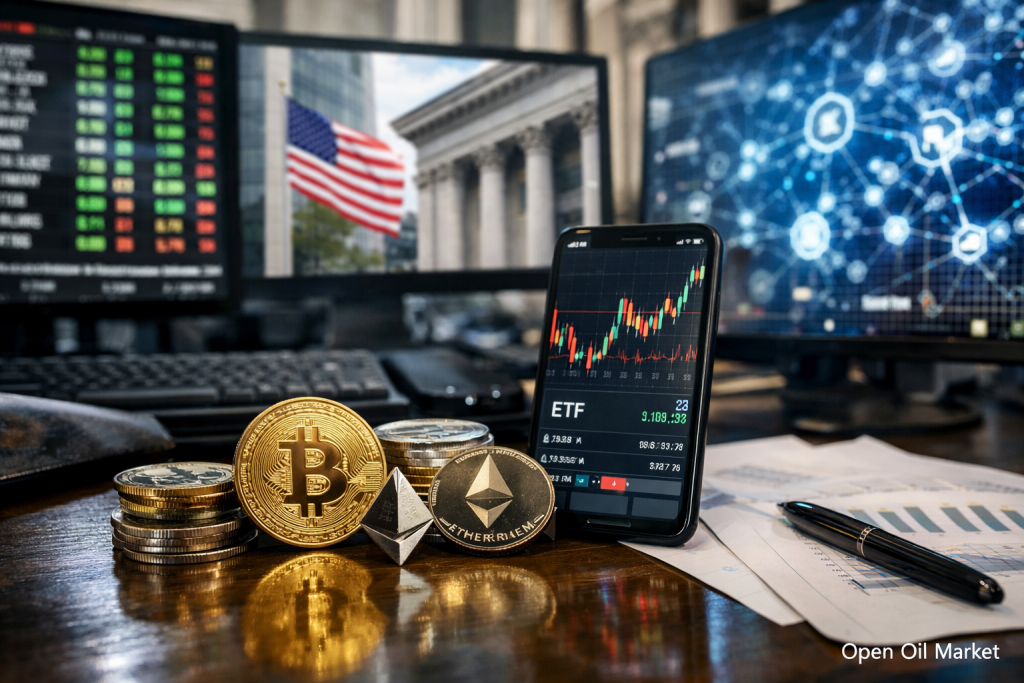
Current Cryptocurrency News as of April 6, 2026: Including Analysis of Bitcoin, Ethereum, Regulation, and Dynamics of Top 10 Cryptoassets
At the beginning of a new week, the cryptocurrency market approaches a state of cautious equilibrium. On one hand, Bitcoin maintains its status as the main indicator of risk appetite, while the institutional infrastructure surrounding digital assets continues to strengthen. On the other hand, the market remains sensitive to macroeconomic expectations, decreasing liquidity during certain trading periods, and the pace of legislative changes in the USA. For global investors, this means one significant thing: cryptocurrencies are once again becoming not only speculative assets but also part of a broader financial architecture.
Main Topic of the Day: Cryptocurrencies Enter a New Institutional Phase
The primary narrative at the start of April is the strengthening role of regulated infrastructure. For the market, this is more important than short-term price fluctuations, as the infrastructure determines how quickly large capital can enter the sector. When cryptocurrencies obtain clearer rules for custody, settlements, and asset classification, the market moves closer to traditional financial standards.
- Institutional investors are gaining a more predictable environment for their operations;
- Cryptocurrency exchanges and custodial services are strengthening their positions in the competition for corporate clients;
- Stablecoins and tokenized assets are transitioning from the experimental stage to systemic application.
For investors, this signifies a gradual shift from a narrative centered on 'hype' to one focused on quality infrastructure, regulation, and real capital flow distribution.
Bitcoin: Not an Impulsive Surge, but a Test of Resilience
Bitcoin maintains its leadership in terms of market capitalization and influence over the entire cryptocurrency market. Currently, BTC's behavior appears less like a classic rally and more like a phase of resilience testing following the high volatility of previous months. For the global market, this is an important signal: even with continuing interest in digital assets, investors have become considerably more selective.
This week, Bitcoin remains the primary benchmark for assessing whether the market is ready to move higher or prefers consolidation. For professional participants, not only price and volumes are crucial, but also how ETF flows, derivatives, and large wallets are behaving.
- If BTC holds its position amidst a neutral news backdrop, this supports the entire sector.
- If liquidity weakens, the market quickly becomes more jittery.
- If institutional demand returns, Bitcoin once again becomes the main beneficiary.
That is why Bitcoin in early April is not just the number one cryptocurrency but a barometer of global attitude toward risk assets.
Ethereum: The Market Expects Growth in Network Utility Rather Than Slogans
Ethereum remains the second most significant asset in the industry, but market expectations for it are currently higher than for most altcoins. While Bitcoin is perceived as a macro asset and a digital analog of limited supply, Ethereum is evaluated based on network practical capacity, application activity, stablecoins, tokenization, and transaction fees.
This creates a more complex investment landscape. Investors are no longer willing to buy ETH based solely on expectations of technological leadership. They need to see an increase in practical utility. This is why the theme of the Ethereum ecosystem remains crucial for the cryptocurrency market in April 2026.
- The growth of the tokenization segment plays in favor of Ethereum;
- The expansion of stablecoin circulation supports the fundamental demand for infrastructure;
- Weak user activity continues to limit the upward reassessment of the asset.
For global investors, Ethereum remains a strategic asset, but not without its uncertainties in the current market phase.
Top 10 Most Popular Cryptocurrencies: Who Forms the Core of the Market
At the start of the week, the core of the crypto market is represented by the largest and most liquid digital assets. These assets dictate the direction of capital flows, determine the demand structure, and remain the primary benchmarks for global investors.
- Bitcoin (BTC) — the main reserve asset of the crypto market.
- Ethereum (ETH) — the foundational infrastructure for applications, DeFi, and tokenization.
- Tether (USDT) — the key dollar stablecoin for global liquidity.
- BNB — a major exchange and ecosystem asset.
- XRP — one of the most notable payment and infrastructure tokens in the market.
- USD Coin (USDC) — an important regulated stablecoin for the institutional segment.
- Solana (SOL) — one of the main beneficiaries of interest in fast blockchains and trading activity.
- TRON (TRX) — a significant player in cross-border transactions and stablecoin circulation.
- Dogecoin (DOGE) — a meme asset that retains liquidity and media influence.
- Cardano (ADA) — a major platform with a strong global investor community.
This top ten illustrates an important feature of the cryptocurrency market: capital is distributed not only among technological platforms but also between stablecoins, transactional tokens, and high-media-inertia assets.
XRP, Solana, and TRON: Why Major Altcoins Are Back in Focus
While Bitcoin and Ethereum set the overall tone for the market, XRP, Solana, and TRON reflect more practical growth scenarios. XRP remains an important bet on payment infrastructure and broader integration of cryptocurrencies into cross-border transactions. Solana continues to attract attention due to its speed, liquidity, and interest from the more active segment of the market. TRON is strengthening its position where high stablecoin circulation and cost-effective transfers are crucial.
For investors, this is an important signal. Altcoins are no longer perceived as a single risk group. The market distinguishes them based on their functions:
- Payment and settlement solutions;
- Infrastructure blockchains;
- Speculative media assets;
- Stablecoin-oriented ecosystems and capital circulation.
That is why capital in 2026 is moving within the sector more selectively than in previous cycles.
Stablecoins: The Quiet Centre of Power in the Entire Crypto Market
One of the most underrated topics at this stage is the growing significance of stablecoins. For retail investors, they often appear as a neutral capital parking tool. However, for the professional market, they are already an infrastructural layer upon which settlements, liquidity, and access to tokenized operations are built.
USDT and USDC remain key elements of this architecture. A significant portion of market capital movements flows through them, and legislative initiatives surrounding such instruments effectively shape the future model of digital finances.
The clearer the rules for stablecoins, the higher the likelihood that the cryptocurrency market will be perceived as a legitimate part of the global financial system, rather than as a separate speculative niche.
Cryptocurrency Regulation: A Growth Driver and the Main Source of Reevaluation
The new phase of regulation in the USA remains a crucial factor for the market. For investors, the significance lies not only in the discussions of laws but also in the increasing consideration of digital assets in terms understood by traditional capital: commodity, investment contract, payment tool, reserve asset, custodial product.
This creates a dual effect. In the short term, the market may react nervously to delays and political disputes. However, in the medium term, the process of institutionalization remains a positive influence.
- A clearer classification of assets reduces legal uncertainty.
- The development of custodial infrastructure facilitates the entry of major players.
- The normalization of rules for stablecoins enhances trust in the industry.
For the global cryptocurrency market, this stands as one of the main investment narratives of 2026.
What Matters for Investors on April 6, 2026
At the start of a new week, investors should focus not only on individual cryptocurrencies but also on the overall market structure. Three signal blocks are particularly vital at this moment:
- The dynamics of Bitcoin as an indicator of overall risk appetite;
- The status of Ethereum and major altcoins as a test of market breadth;
- The news about regulation, ETFs, custodial services, and stablecoins as a fundamental driver for sector reevaluation.
The conclusion at the start of April appears to be this: the cryptocurrency market no longer operates purely on emotions. The rules of the game, institutional capital channels, and the ability of major assets to maintain trust in a more mature and demanding market are now at the center of attention. For investors around the globe, this makes the sector both more complex and more interesting. The growth potential remains, but success in this phase will belong to those who can distinguish between noise and fundamentals.