Current Cryptocurrency News for Tuesday, 25th November 2025: Bitcoin and Altcoin Dynamics, Market Analysis, Trends, Forecasts, and Overview of the Top 10 Cryptocurrencies for Investors.
Cryptocurrency Market Overview
Following a sharp rise in the first half of 2025, the cryptocurrency market has entered a phase of correction and high volatility. The market capitalization of the segment is approximately $3 trillion, sufficient for several months of records and subsequent rebounds: as of 24th November, it is nearing $2.96 trillion. Over the past two weeks, leading coins have notably lost value – Bitcoin has dropped to about $85–90 thousand, and many altcoins are down by 20–30%. Investors note that the sell-off was triggered by a combination of profit-taking and a generally pessimistic market sentiment.
- Bitcoin surpassed the $100,000 mark for the first time in the summer of this year, after which it fell back below $90,000, a decline of approximately 25% from peak values.
- Bitcoin's share of total capitalization dropped to about 55–60%, while trading volumes shifted to altcoins: they now account for about 60% of the market, indicating a reallocation of capital.
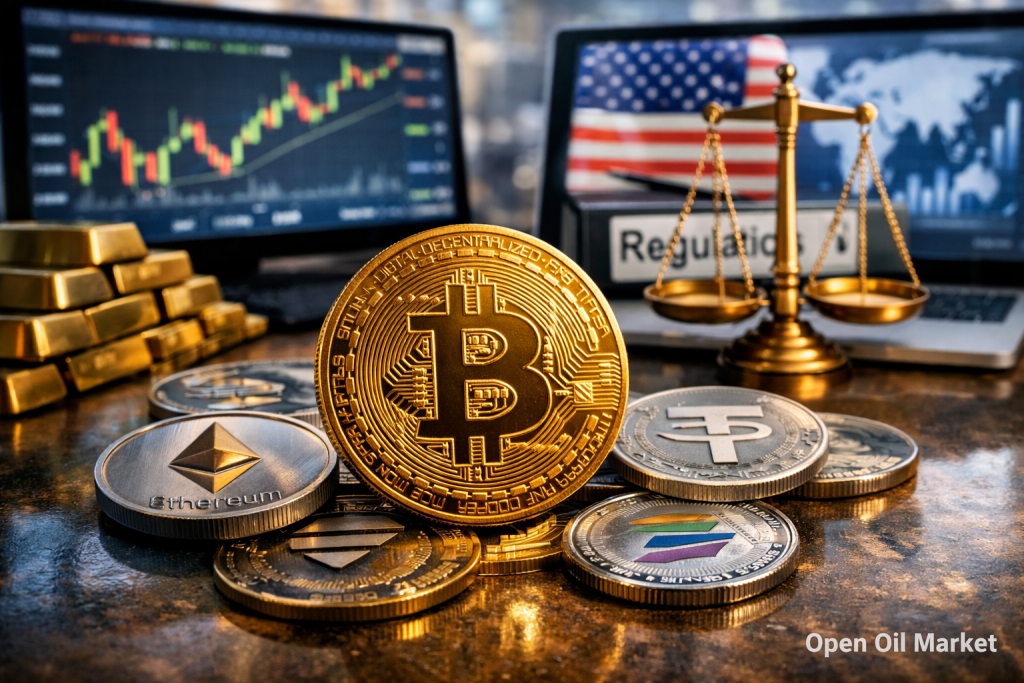
- The top 10 cryptocurrencies by market capitalization include: Bitcoin (BTC), Ethereum (ETH), major stablecoins (Tether and USDC), and leading altcoins – XRP, BNB, Solana, Tron, Dogecoin, Cardano.
- Technical indicators show market oversold conditions: for instance, Bitcoin's RSI index is approaching its lowest levels in the last two years, which typically signals a local reversal.
- The U.S. Federal Reserve may begin lowering interest rates soon – New York Fed President J. Williams announced "ample space" for monetary policy easing. This has supported risk assets and partly limited the decline of cryptocurrencies.
- Regulatory trends: from 25th November, the European Union introduces a ban on any operations with the Ruble stablecoin A7A5 (created by Russian entities) due to new sanctions. Simultaneously, the European Central Bank has warned of potential threats of stablecoins (USDT, USDC) to the banking system and financial stability as a whole.
Despite the recent downturn, experts expect that by early December, the cryptocurrency market may stabilize. The macroeconomic background (inflation, interest rate dynamics, and regulators' attitudes towards crypto assets) and the emergence of new news triggers (for example, the launch of Ethereum ETFs or the adoption of additional regulations) will be crucial. Overall, the global stock and crypto markets are currently showing signs of stabilization, and many investors view current prices as an opportunity for long-term investments.
Bitcoin (BTC)
The leading cryptocurrency continues to be a key market indicator. In 2025, Bitcoin reached unprecedented heights: in October, its price exceeded $120,000 due to the approval of spot Bitcoin ETFs in the U.S. However, by the end of November, BTC corrected to around $85,000 – a decline of a quarter from the peaks. Analysts attribute this to widespread profit-taking and deteriorating sentiment in traditional markets. Despite the correction, Bitcoin retains strong fundamentals: institutional investors continue to increase their positions (hundreds of thousands of BTC have been accumulated on the balance sheets of major companies and funds), and in some countries (e.g., El Salvador), Bitcoin has been established as a recognized means of payment.
From a technical analysis perspective, BTC is currently considered oversold: the RSI is at levels not seen since late 2023, and the nearest key support is around $80,000. If investors hold the price at the current level, a short-term rebound of 5-10% may be possible due to short covering and new buyers. In the long term, the scarcity of coins (maximum supply is capped at 21 million BTC) and ongoing institutional interest provide Bitcoin with a solid foundation.
Ethereum (ETH)
The second-largest cryptocurrency, Ethereum, has solidified its position as "the internet for finance" following the completion of its network upgrade (transition to Proof of Stake). In the autumn, ETH's price peaked at $4,000 but subsequently fell by about 25% along with Bitcoin, returning to a level of around $2,800. However, interest from institutional investors remains strong: the first spot ETFs based on Ethereum have been launched in the U.S., expanding access for large players to this asset. The Ethereum network continues to handle the majority of transactions in the DeFi and NFT ecosystems, and numerous decentralized applications function on its platform.
Ethereum is also becoming the platform of choice for projects related to artificial intelligence and Web3. At the current price (~$2,800), many investors view ETH as a relatively inexpensive asset following the correction. Its future growth will depend on the implementation of long-term upgrades (such as further reductions in gas fees) and the expansion of the DeFi ecosystem, which could give additional momentum to its price.
Stablecoins: Tether (USDT) and USD Coin (USDC)
Stablecoins are cryptocurrencies pegged to the U.S. dollar at a 1:1 rate. They serve as the "digital dollar" in the market and comprise a significant portion of crypto industry capitalization (about 8% of the overall market, over $280 billion).
- Tether (USDT): the largest stablecoin with a capitalization of over $180 billion. Issued by Tether Ltd, it operates on multiple blockchains (widely used on the Tron network due to low fees). USDT provides essential market liquidity, allowing traders to quickly move funds between cryptocurrencies and remain "in cash" during volatility. According to the issuer, each token is fully backed by reserves, including U.S. government bonds. In 2025, the company also announced that part of its reserves would be invested in Bitcoin, demonstrating confidence in the long-term growth of cryptocurrencies.
- USD Coin (USDC): the second-largest stable token (capitalization around $75 billion), issued by the Centre consortium (Circle and Coinbase). The advantage of USDC is strict transparency: reserve data is published monthly with audit confirmations. Despite an incident in 2023 when its peg to the dollar was temporarily lost due to issues with a partner bank, USDC regained stability and is still considered a reliable "digital dollar," especially in regulated markets.
Regulators are tightening their control over stablecoins: for example, the U.S. prohibits the payment of interest on USDC and other regulated stablecoins, which is shifting some investors to alternative yield instruments. The European Central Bank has also warned of risks associated with the rapid growth of stablecoins – in the case of a mass outflow of deposits from banks into crypto assets, the stability of the financial system could be at risk.
Ripple (XRP)
XRP, the token for the Ripple payment platform, has shown recovery in 2025 after a prolonged period of uncertainty. A series of favorable court decisions in the U.S. allowed major exchanges to relist XRP, after which the coin's price rose above $2. Currently, XRP trades around $2.10–2.20, and its market capitalization exceeds $130 billion, placing it among the top four cryptocurrencies.
Ripple is actively promoting the use of XRP for international transfers. The company's On-Demand Liquidity (ODL) technology enables banks to make swift cross-border payments with conversion through XRP, reducing time and costs. Experts note that amid the current volatility, some investors consider XRP a relatively stable asset due to its specific business cases and technological advantages.
Binance Coin (BNB)
BNB, the native token of the Binance cryptocurrency exchange, continues to confidently hold its place in the top five of the market. Following the rebranding of the platform to BNB Chain and the transition to Proof of Stake, the token saw significant growth – at its peak, it exceeded $1,000 during the autumn rally. Currently, BNB is trading in the range of $850–900. The token is used to pay fees on the exchange and in smart contracts on the network, with a portion of coins regularly being burned, reducing supply and supporting price.
Binance continues to expand its services: recent announcements include projects in the metaverse, NFT marketplaces, and other financial products. With high demand for Binance services, demand for BNB remains – investors see it as a tool for long-term involvement in the exchange's ecosystem. Analysts believe that if the cryptocurrency market recovers, BNB may demonstrate stronger growth compared to several altcoins due to its connection to leading exchange infrastructure.
Solana (SOL)
Solana, a high-performance Layer 1 blockchain platform, has solidified its position over the past year. After technical issues in 2024, the network was optimized, and in 2025 SOL rose to a range of about $130–140. High transaction speeds and low fees make Solana attractive among developers of games, NFTs, and DeFi applications. The platform continues to implement scalable solutions (e.g., layer 2 protocols and zk-solutions), enhancing its reliability.
Investors are paying attention to Solana's growing ecosystem: several promising projects are already attracting interest from major players. At its current price, SOL appears relatively undervalued in terms of network performance. Nonetheless, Solana remains a volatile asset – its dynamics are heavily dependent on the influx of new projects and market trends. Many analysts believe that under favorable market conditions, SOL has growth potential if its ecosystem continues to expand.
Dogecoin (DOGE)
Dogecoin, created as a "meme token," has maintained its place in the top-10 by market cap thanks to strong community support. In 2025, its price hovers around $0.14–0.15 after a correction from peaks of $0.17 at the end of 2024. Dogecoin is based on the Bitcoin protocol (Proof of Work) and features high coin emissions, which diminishes its fundamental value.
A key driver for DOGE remains media attention and endorsements by public figures. Any news regarding the inclusion of Dogecoin in payment systems or announcements from well-known entrepreneurs instantly impacts its price. Despite the absence of significant technical updates, DOGE maintains high liquidity – many investors use it for short-term speculation. Experts warn that Dogecoin is more of a speculative asset; its price may rapidly respond to external events, remaining unpredictable.
Tron (TRX)
Tron, a blockchain focused on entertainment and digital content, has strengthened its position in the top-10 assets. In 2025, the network's main focus is on the issuance of stablecoins and DeFi projects: USDT and other digital assets are already operational on Tron. The price of TRX remains around $0.27–0.29. To facilitate fast transaction processing, the network uses a DPoS protocol, which ensures low fees and high speed, although it faces criticism for relatively high centralization.
Among Tron’s advantages are strong community support in Asia and backing from the project team. However, the coin is sensitive to overall market sentiment: during periods of reduced risk appetite, TRX may see noticeable declines. With the cryptocurrency market's recovery, interest in the network is expected to return, especially in the entertainment and DeFi segments. Nevertheless, experts view TRX mainly as a speculative asset with limited short-term potential.
Cardano (ADA)
Cardano, a "third-generation" blockchain platform, demonstrates stability but without sharp jumps. The ADA token trades around $0.42–0.45. In 2025, the Cardano network received several technological upgrades aimed at scalability (for example, the launch of the Hydra test network), yet mass user adoption has yet to materialize. The platform is characterized by a scientific approach to development and a heightened level of security, making it a conservative choice among crypto assets.
The future of Cardano largely depends on the activity of its community and developers. Plans for enhancing cross-chain compatibility and simplifying application development may boost its appeal. For now, ADA remains a less volatile altcoin with moderate growth – reliability-oriented investors see potential in Cardano due to its scientific rigor and long-term reliability.