Current Cryptocurrency News for Monday, December 8, 2025: Ongoing Bitcoin Recovery, Moderate Altcoin Growth Amid Market Stabilization, Cautious Investor Optimism Ahead of Year-End, Top 10 Cryptocurrencies
As of the morning of December 8, 2025, the cryptocurrency market continues to gradually recover from the deep downturn in November. Following one of the worst Novembers in recent years, a cautious uptick has emerged in early December: Bitcoin has bounced back further from its local lows, while key altcoins are showing moderate growth, establishing stability after recent fluctuations. The total cryptocurrency market capitalization holds around $3.3 trillion, with Bitcoin's dominance at approximately 59%, while the Fear and Greed Index remains in the "fear" zone, reflecting the restrained sentiment of investors. Market participants are trying to assess whether the current consolidation will lead to a new rally by year's end or if volatility will persist in the final weeks of December.
Bitcoin: On the Way to $100,000
In early autumn, Bitcoin (BTC) reached an all-time high of around $126,000 per coin (October 6). However, a sharp correction followed: mass profit-taking and cascaded liquidation of margin positions (amounting to about $19 billion in October) crashed the market. By mid-November, Bitcoin had fallen below $90,000 (the first time since April), essentially wiping out all gains made since the beginning of the year. In the last weekend of November, BTC's price dipped to around $85,000 amid a surge in panic sentiment (the Fear and Greed Index briefly dropped to 10 points — the "extreme fear" level).
Nevertheless, at the beginning of December, Bitcoin is showing signs of recovery. The price has risen to near the psychologically significant level of $100,000 (with a weekend high of about $98,000), reclaiming a significant part of its recent losses. Currently, BTC is trading in the range of $95,000 to $97,000, although volatility remains elevated: daily price fluctuations reach several percent, reflecting ongoing uncertainty in the market. Opinions among experts are divided: some consider the recent downturn as a "last chance" to buy BTC at relatively low prices before a new surge, while others warn of a risk of falling back to around $75,000 if negative factors persist. Overall, the flagship cryptocurrency maintains about 60% of the industry's total capitalization, confirming its status as "digital gold," and many investors hope that Bitcoin can resume confident growth in December.
Ethereum and Major Altcoins
Following Bitcoin, Ethereum (ETH) also experienced a significant correction in the latter half of autumn. In early November, the second-largest cryptocurrency hit a new local peak, closely approaching its all-time high (around $5,000), but then lost over 10% in just a week, dropping to approximately $3,000. Currently, Ether is trading around $3,400, attempting to stabilize after the recent decline. Ethereum's fundamental positions remain solid: the network continues to be widely used in decentralized finance (DeFi) and NFTs, its Layer 2 (L2) scaling solutions are actively developing, and a recent protocol upgrade helped reduce fees. Investors are keenly awaiting the planned technical improvements to Ethereum by year-end, which should enhance network efficiency.
Among other leading cryptocurrencies, mixed dynamics are observed. The Ripple token (XRP) attracted attention in the fall due to its legal victory over the SEC and the launch of the first spot ETF on XRP. Against this backdrop, XRP's price surged above $2.4, but later retreated to around $2.0 amid a general market downturn. Nevertheless, XRP remains in the top 5, and legal clarity on the status of the token in the U.S. has strengthened trust among banks and payment companies in this asset. The blockchain platform Solana (SOL), competing with Ethereum, also made significant strides in 2025: institutional capital inflow to SOL-based funds exceeded $2 billion in recent weeks, lifting Solana's price to around $150. Although the SOL price has partially corrected since then, the coin remains among the market leaders (top 10) due to its high transaction speed and the growth of its ecosystem projects.
Overall, altcoins move in sync with the market: after periods of rally, many experienced deep pullbacks. For example, the privacy coin Zcash (ZEC) surged in the fall in anticipation of an upcoming halving but then saw a rapid decline, reminding investors of the risks of speculation. However, as Bitcoin stabilizes, major altcoins are attempting to recover lost positions, with a gradual inflow of capital already being observed. Projects with strong fundamentals (real-world applications, active communities, technological upgrades) maintain their prices better, while less significant tokens may sharply lose value.
Institutional Investors: A Wait-and-See Approach
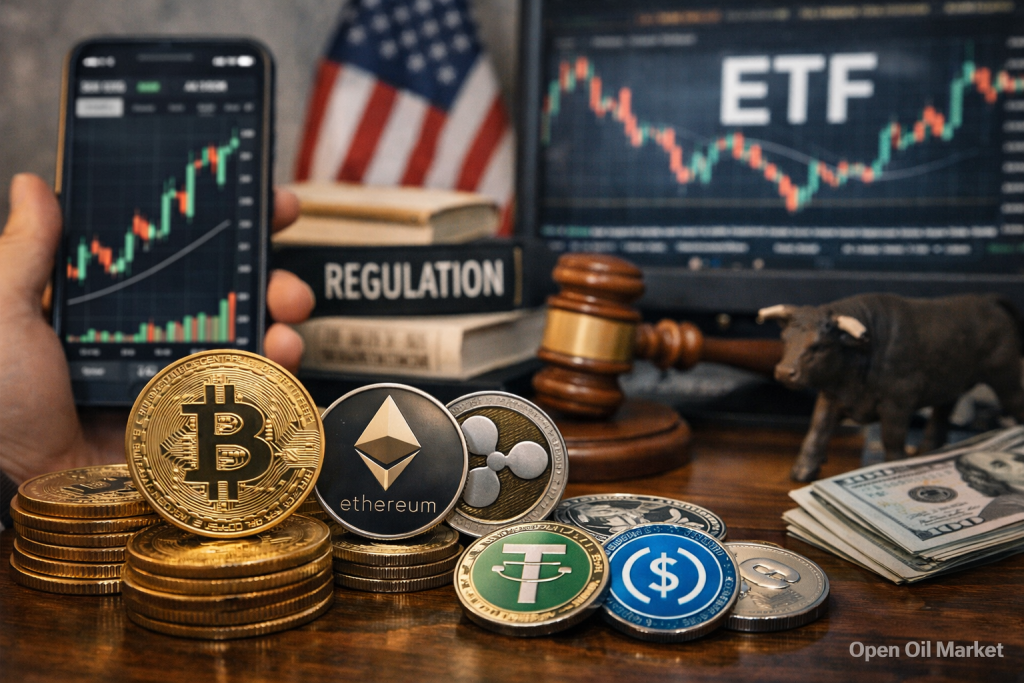
In 2025, the role of institutional investors in the cryptocurrency market has significantly increased. One of the driving factors behind this growth was the emergence of new investment products: for the first time in the U.S., spot exchange-traded funds (ETFs) for Bitcoin and Ethereum were launched, making it easier for large players to access digital assets. Major companies continued to augment their BTC reserves: for example, MicroStrategy, led by Michael Saylor, has consistently increased its Bitcoin holdings, serving as an indicator of corporate sector interest. Pension funds and asset managers have also begun to incorporate cryptocurrencies into their portfolios, viewing them as a promising asset class.
However, the recent correction has led institutions to act more cautiously. In November, record capital outflows were recorded from cryptocurrency-linked investment products. During one week in November, investors withdrew over $1.2 billion from Bitcoin ETFs, booking profits after a swift rise in early autumn. Analysts note that the slow pace of regulatory approvals for new crypto-ETFs and the persistent high volatility are dampening the appetite of some larger players. Nevertheless, the interest in digital assets has not disappeared: new crypto funds and trusts continue to launch globally, major financial companies (banks, brokers) are developing infrastructure to service crypto investments, and the number of regulated instruments (e.g., futures and options contracts on cryptocurrencies) is increasing. Many professional investors are using the current pause to enter the market at lower prices, anticipating a resumption of the upward trend in the medium term.
Cryptocurrency Regulation: New Trends
By the end of 2025, the regulatory landscape for the crypto industry worldwide is undergoing significant changes. Legislators and regulatory bodies in different countries are reassessing their stance on digital assets, establishing clearer "rules of the game". Key trends include:
- U.S.: The Securities and Exchange Commission (SEC) unexpectedly excluded cryptocurrencies as a separate focus in its priorities for 2026, shifting attention to regulating artificial intelligence and fintech. This move signals a potential easing of pressure on the U.S. crypto market: the industry is no longer perceived as "particularly risky" and is gradually integrating into the broader financial landscape. Additionally, the U.S. is approaching decisions on new applications for launching spot crypto ETFs (on a number of altcoins, including Solana and Cardano), and market participants are hoping for their approval in the coming months.
- Europe: The comprehensive MiCA regulation (Markets in Crypto-Assets) comes into effect in the European Union, establishing uniform rules for crypto companies and investor protection across all EU countries. Now, crypto businesses are required to obtain licenses and comply with capital, transparency, and anti-money laundering regulations. The implementation of MiCA is expected to enhance trust in the European crypto industry and attract more institutional investments through clearer rules.
- Asia: Financial centers in the region are showing increasing interest in cryptocurrencies. In 2025, Hong Kong legalized retail trading of major crypto assets through licensed exchanges, aiming to attract crypto business and capital from mainland China. Meanwhile, China continues to maintain stringent bans on crypto operations within the country. In other parts of Asia and the Middle East, authorities are implementing favorable regimes: for example, the UAE and Singapore are offering tax incentives and clear regulations to compete for the status of global crypto hubs.
- Emerging Markets: Several countries are developing national strategies for working with digital assets. For instance, Azerbaijan has prepared a legislative framework for regulating cryptocurrencies by the end of 2025 — from taxation of operations to licensing requirements for local exchanges. Such initiatives reflect a global trend: governments seek to regulate the rapidly growing sector while attempting not to miss out on the economic benefits of its development.
Macroeconomics and Market Influence
External macroeconomic factors continue to impact the sentiment of crypto investors. In recent weeks, the correlation between cryptocurrency prices and the dynamics of traditional risk assets (such as technology stocks) has intensified. Amid persistent high inflation and tightening monetary policies from central banks, investors have become more cautious regarding investments in digital assets. Many anticipated that the U.S. Federal Reserve would begin to lower interest rates by the end of 2025; however, there are currently no signs of impending monetary policy easing. Doubts about a rapid reduction in rates from the Fed and ECB dampen risk appetite for risky assets, including cryptocurrencies.
Market players are closely monitoring economic news, as they immediately reflect on the price of Bitcoin and altcoins. For example, stronger labor market data in the U.S. led to a strengthening dollar and a temporary decline in BTC price, while signs of slowing inflation or decisions around easing monetary policy could potentially boost the cryptocurrency market. News regarding the resolution of the budget crisis in the U.S. in early November (avoiding a government shutdown) was positively perceived — this event briefly heightened investor risk appetite and supported the prices of Bitcoin and Ether. However, uncertainty in the global economy and financial markets generates heightened volatility: traders react to every regulator statement and macroeconomic statistic release. Participants in the crypto market increasingly have to consider traditional factors (interest rates, inflation, geopolitics) when making decisions, indicating a gradual maturing and integration of cryptocurrencies within the global financial system.
Top 10 Most Popular Cryptocurrencies
Below is a list of the ten largest and most popular cryptocurrencies as of the morning of December 8, 2025 (by market capitalization):
- Bitcoin (BTC) – the first and largest cryptocurrency, "digital gold". BTC is now trading around $98,000 per coin after a recent correction (market capitalization ~ $2.0 trillion). Limited supply (maximum of 21 million coins) and growing acceptance by institutional investors support Bitcoin's dominant position (~59% of the market).
- Ethereum (ETH) – the second-largest digital asset by market capitalization and a leading platform for smart contracts. The price of ETH is approximately $3,400. Ethereum serves as the foundation for the DeFi and NFT ecosystems; its market capitalization exceeds $400 billion (approximately 13% of the market). Continuous technical updates (transition to PoS, scalability improvements) and widespread use ensure Ethereum's strong position.
- Tether (USDT) – the largest stablecoin pegged to the U.S. dollar at a 1:1 ratio. USDT is actively used for trading and preserving capital, providing high liquidity in the markets. Tether’s capitalization is about $150–160 billion; the coin consistently holds a price of $1.00, serving as a digital equivalent of cash dollars in the crypto economy.
- Binance Coin (BNB) – the native token of the largest cryptocurrency exchange Binance and the native asset of the BNB Chain. BNB is used for paying fees, participating in token sales, and executing smart contracts within the Binance ecosystem. Currently, BNB is trading around $600–650 (capitalization ~ $100 billion), remaining in the top 5 despite regulatory pressure on Binance: the token's wide range of use and periodic coin-burning programs support its value.
- XRP (Ripple) – the token of the Ripple payment network targeting fast cross-border payments. XRP is around $2.0 per coin (capitalization ~ $110 billion). In 2025, XRP significantly strengthened due to Ripple's legal win against the SEC and the launch of the spot ETF, which returned the token to the ranks of market leaders. XRP is in demand for banking blockchain solutions, remaining one of the most recognizable digital assets.
- Solana (SOL) – a high-performance blockchain platform offering fast and affordable transactions; a competitor to Ethereum. SOL is trading at around $150 (capitalization of approximately $70–80 billion) after significant growth in 2025. The Solana ecosystem attracts investors through the development of DeFi and GameFi projects, alongside expectations of an ETF launch on SOL, helping the coin stay within the top 10.
- Cardano (ADA) – a blockchain platform emphasizing a scientific approach and methodical development. ADA is trading around $0.60 (market value ~ $20 billion) following volatile fluctuations in autumn. Despite a pullback from peaks, Cardano remains in the top 10 due to its active community, continuous network development (updates, scalability improvements), and plans for launching investment products based on ADA.
- Dogecoin (DOGE) – the most famous meme cryptocurrency, initially created as a joke but gaining immense popularity. DOGE trades around $0.15–0.20 (capitalization ~ $20–30 billion) and retains its place among the largest coins due to its strong community and periodic support from prominent figures. The volatility of Dogecoin is traditionally high, but it demonstrates remarkable resilience in investor interest from cycle to cycle.
- TRON (TRX) – a blockchain platform for smart contracts originally focused on entertainment and content. TRX is currently trading at $0.25–0.30 (capitalization ~ $25–30 billion). The TRON network attracts users with low fees and high throughput, making it popular for issuing and transferring stablecoins (a significant share of USDT circulates on TRON). The platform is actively developing and supports decentralized applications (DeFi, games), which helps TRX maintain its position in the top 10.
- USD Coin (USDC) – the second-largest stablecoin issued by Circle and backed by reserves in U.S. dollars. USDC consistently trades at $1.00, with a capitalization of around $50 billion. The coin is widely used by institutional investors and in DeFi for transactions and value preservation due to its high transparency and regular audits of reserves. USDC competes with Tether by offering a more regulated and open approach to stablecoins.
Outlook and Expectations
The key question concerning investors in December 2025: will the recent correction serve as a springboard for a new crypto rally, or will the market continue to be volatile? Historically, the end of the year often brings heightened activity and growth in the cryptocurrency market, although there are no guarantees of this scenario repeating. Optimists note that the main factors behind the recent decline have already been priced in: the weakest players capitulated in November, the market has "cleansed" excess optimism, and positive triggers may be on the horizon (for instance, approval of new ETFs or easing by central banks). Moreover, some analysts from major banks maintain a bullish outlook, projecting that Bitcoin may reach six-figure prices ($150,000–170,000 and above) in the next year, assuming a favorable macroeconomic environment.
On the other hand, the sustained "cost of capital" in the global economy and any new shocks (geopolitics, stricter regulations, potential bankruptcies in the industry) could prolong the period of instability. Many experts agree that for a confident bullish trend to return, several conditions need to be met simultaneously: a reduction in inflation and interest rates, inflow of fresh capital (including institutional), and increased trust in the sector. So far, the market exhibits restrained optimism: major cryptocurrencies maintain key levels, negative news is diminishing, and investors are gradually returning after the shock of November. It is likely that in the coming weeks the cryptocurrency market will continue to balance between hopes for a resumption of growth and fears of potential risks, but most observers are looking at 2026 with cautious optimism, hoping for a new wave of industry development.