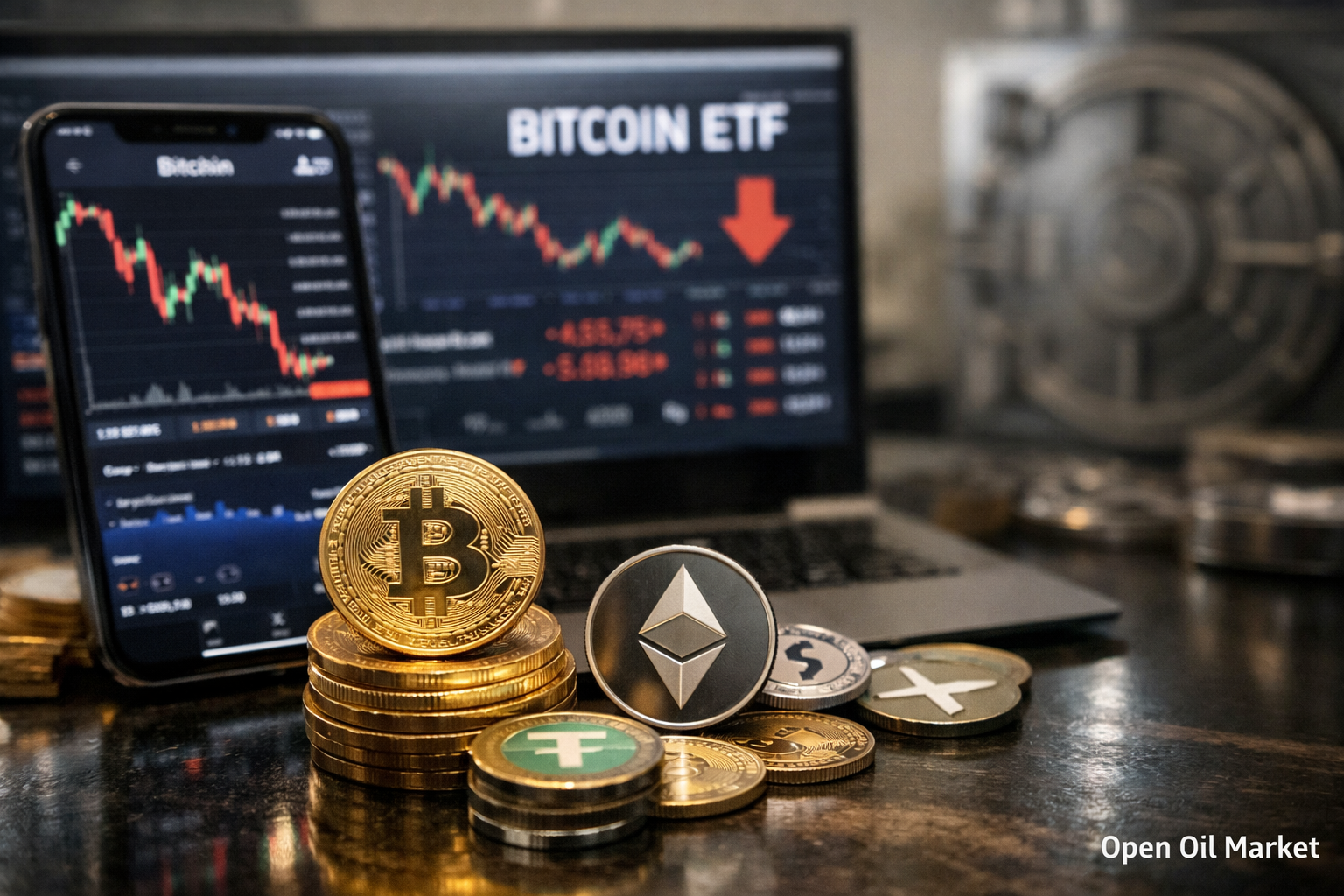
Cryptocurrency News — Sunday, February 22, 2026: Outflows from Bitcoin ETFs and Bitcoin's Struggle to Hold $70,000
Key Market Highlights in Cryptocurrency
The cryptocurrency market concludes the week in a state of "cautious risk": Bitcoin hovers around the $68,000 mark but continues to struggle with a sustained hold above $70,000. Amid mixed macro signals, investors are reallocating risk among major crypto assets, stablecoins, and liquid altcoins, while institutional flows remain uneven.
- Bitcoin (BTC): consolidating around $68,000 after a volatile week.
- Ethereum (ETH): facing pressure due to reassessment of demand expectations and flows in products.
- Crypto ETFs: continue to shape the agenda — outflows signal a decrease in short-term risk appetite.
- Regulation: focus on rules governing stablecoin operations and custodial access models for brokers to crypto infrastructure.
- Cyber Risks: another incident in the bridge segment and key infrastructure serves as a reminder of the costs of operational errors.
Macro Picture: Rates, Inflation Expectations, and "Risk-On / Risk-Off"
For the global investor audience, context is crucial: cryptocurrencies remain sensitive to expectations regarding interest rates and dollar liquidity dynamics. When the market prices in a softer monetary policy trajectory, the demand for risk assets (including crypto assets) rises; in times of increased uncertainty, capital flows into safe-haven instruments and cash equivalents.
- Rates and Yields: higher real yields make it more challenging for the crypto market to expand multiples.
- The Dollar and Liquidity: dollar strength often correlates with a more nervous environment in the cryptocurrency market.
- Geopolitics and Trade Risks: any new barriers to trade and supply chains quickly affect risk appetite.
Bitcoin: Consolidation Around $68,000 and the "Above $70,000" Challenge
Bitcoin remains the central axis of the cryptocurrency market and a primary indicator of sentiment. The scenario in recent days shows resilience around $68,000 with limited momentum: buyers maintain a baseline demand, but new drivers for an upward breakout appear unconvincing for now. For investors, this indicates an increasing importance of risk management and discipline in entries.
- Technical Implications: the $70,000 zone acts as a psychological barrier, and the market requires either new flows or macro support.
- Behavioral Factor: after swift movements, capital often "digests" profits, which strengthens price consolidation.
- Portfolio Practice: during consolidation, the value of incremental purchases and limit orders rises, rather than "chasing" entries.
Ethereum: Liquidity Pressure and Demand Expectations
Ethereum is undergoing a phase of heightened sensitivity to flows and expectations regarding ecosystem demand. Markets are discussing issues of liquidity and the resilience of institutional interest. In this configuration, ETH may exhibit a more "choppy" dynamic relative to BTC, especially when the market lacks a unified positive catalyst.
- Product Demand: redistributing flows influences the short-term trajectory.
- Eco-System: activity in L2, DeFi, and tokenization remains a fundamental factor, but the market often reacts faster than metrics are updated.
- Risk Mode: during "risk-off," ETH historically may drop faster than BTC, an important consideration for portfolio allocations.
Altcoins: Selective Rallies and Growing Differentiation
The altcoin segment is increasingly splitting into a "liquid core" and high-risk narratives. Global market-oriented investors increasingly prefer projects with stable liquidity, broad listings, and clear positioning (infrastructure, payments, scaling, application ecosystems). At the same time, speculative surges continue but become shorter and more demanding of timing.
What is currently performing better:
- Infrastructure Tokens with clear economics and active development.
- Payment/Ecosystem Assets with identifiable roles in transactions and liquidity.
- Liquid Mid-Caps, where institutional interest and derivatives are present.
What increases risk:
- thin liquidity and high concentration among holders;
- aggressive marketing amid weak on-chain metrics;
- opaque bridges and contracts without quality audits.
Institutional Agenda: Crypto ETFs and Balance of Flows
Crypto ETFs remain one of the key "thermometers" for the cryptocurrency market. In recent weeks, a series of net outflows from spot Bitcoin ETFs have been recorded — this signals that some investors opted to reduce exposure and lock in results following previous movements. A vital takeaway for global markets: sustainable price increases require not only retail optimism but also stable institutional flows.
- Why Outflows Matter: this is a direct channel for traditional capital influence on the crypto market.
- How to Interpret: outflows do not equal a "collapse," but they increase the likelihood of sideways movement and sharp downward spikes.
- What to Monitor: weekly flow dynamics, reactions to macro data, and changes in volatility.
Regulation: Focus on Stablecoins and Custodial Infrastructure
The regulatory framework remains a key topic for crypto investors worldwide — from the US and Europe to Asia and the Middle East. The spotlight is on the rules governing stablecoins, reserve requirements, custodial storage models, and access for brokers and infrastructure providers. The market perceives movement towards clarity as a long-term positive, but in the moment, any "grey areas" increase the risk premium.
- Stablecoins: discussions surrounding reserve requirements and storage regimes heighten attention to the quality of the issuer.
- Brokerage and Custody: clarification of digital asset storage rules may expand institutional access.
- Tokenization: cautious opening of "pilot" regimes can accelerate the convergence of TradFi and on-chain infrastructure.
Risks and Security: Key and Bridge Incidents
The market is again discussing a major incident involving the compromise of a private key and vulnerabilities in bridge infrastructure, leading to multi-million losses. For investors, this is not "background news," but a regular reminder: technological risk in cryptocurrencies remains comparable in significance to market risk.
Minimum Security Checklist for Investors:
- use hardware wallets for long-term positions;
- segregate wallets for storage and active trading;
- avoid bridges and contracts without reputation and audits;
- do not hold large sums on exchanges longer than necessary for transactions;
- enable 2FA and monitor "whitelisted" withdrawal addresses.
Top 10 Most Popular Cryptocurrencies (Reference for Global Market)
Below is a practical reference for the global audience: a list of the largest and most discussed cryptocurrencies that most commonly form the "core" of the cryptocurrency market and are present in the portfolios of institutional and private investors.
- Bitcoin (BTC) — the foundational asset of the cryptocurrency market and a primary indicator of risk sentiment.
- Ethereum (ETH) — the essential infrastructure for smart contracts and ecosystem applications.
- Tether (USDT) — the dominant stablecoin for liquidity and transactions.
- XRP (XRP) — a major liquid asset, often reacting to regulatory news and payment infrastructure.
- BNB (BNB) — the ecosystem token of one of the largest infrastructure platforms.
- USD Coin (USDC) — a widely used stablecoin in institutional and on-chain scenarios.
- Solana (SOL) — a high-performance platform, notable in DeFi and consumer applications.
- TRON (TRX) — a network with high transactional activity, significant in stablecoin infrastructure.
- Dogecoin (DOGE) — a liquid "meme" asset, sensitive to market sentiment.
- Cardano (ADA) — a major smart contract platform with cyclical demand dynamics.
For Investors: What to Watch in the Next 24–72 Hours
If you are managing a portfolio with a global focus, the coming days may be viewed as a period for testing resilience: the cryptocurrency market is balancing between expectations of easing financial conditions and signs of caution in institutional flows.
- For BTC: will stability persist around $68,000 and will a new momentum emerge to test $70,000?
- For ETH: will interest recover amidst reassessment of liquidity and ecosystem expectations?
- For the market in general: dynamics of flows in crypto ETFs and reactions to macro developments.
- For risks: news related to cyber incidents and vulnerabilities in infrastructure (bridges, keys, contracts).
In strategic terms, investors should maintain diversification, monitor leverage, and not allow short-term price impulses to replace the analysis of fundamental risks. In the current environment, discipline, liquidity, and risk management pay off.