Current Cryptocurrency News for Thursday, February 5, 2026: Bitcoin Consolidates Around $73K After January Crash; Major Altcoins at Lows; Central Banks and Regulators Impact Market Sentiments; Review of Top 10 Popular Cryptocurrencies and Market Outlook.
Market Overview: Consolidation Before Key Events
As of the morning of February 5, 2026, the global cryptocurrency market shows cautious stabilization following a recent decline. The January sell-off was one of the sharpest in recent times: the sector's total capitalization decreased by approximately a quarter from autumn peaks, and only in early February did a relative calm begin to emerge. Bitcoin (BTC) is holding below ~$80K, recovering from a local bottom around $75K, which served as an important psychological support level. The overall cryptocurrency market capitalization still stands below $3 trillion (down from over $4 trillion at its peak), and investor sentiments remain restrained: the "fear and greed" index is firmly established in the "fear" zone. Market participants are closely monitoring macroeconomic factors and regulatory news (including upcoming decisions from central banks) before resuming active purchases of digital assets.
Bitcoin: Holding the Key Level
The first cryptocurrency is attempting to establish itself after a deep correction. At the beginning of the week, the Bitcoin price fell to ~$72K – a low not seen since spring 2025 – but then the "digital gold" bounced back from this mark. Currently, BTC is consolidating around $73K, approximately 35–40% lower than its historic high (nearly $125K, reached in October 2025). Bitcoin's market dominance has again exceeded 60%, reflecting a capital shift from riskier altcoins to the flagship asset. Experts note that even after significant downturns, Bitcoin remains one of the largest financial assets in the world, and most long-term holders ("whales") are in no rush to part with their coins. On the contrary, a number of large investors view current levels as a strategic opportunity: publicly traded companies, which had previously increased their BTC reserves, signal a willingness to buy on price dips, confident in Bitcoin's long-term value. This behavior of "smart money" maintains trust in BTC's fundamental qualities, despite high short-term volatility.
Ethereum: Price Pressure Amid Strong Fundamentals
The second-largest cryptocurrency, Ethereum (ETH), is also under pressure, following the broader market's trend. Since autumn 2025, ETH's price has declined nearly 50% from its peak value (~$5,000), and this week, it briefly fell below $2,300 during the sell-off. Currently, Ether is trading within the range of ~$2,400–2,500, significantly below its historic high, yet the network's fundamental metrics continue to inspire optimism. In January, Ethereum developers successfully implemented another protocol upgrade aimed at increasing blockchain scalability, and the Layer-2 ecosystem continues to expand, relieving pressure on the main network and lowering fees. A significant portion of ETH coins remains locked in staking or held long-term, limiting market supply. Despite a temporary capital outflow from Ethereum funds during January's downturn, institutional interest in ETH persists: in 2025, the first spot ETFs for Ether were introduced in the U.S., attracting billions of dollars, and many large investors still include Ethereum in their portfolios alongside Bitcoin. Thus, even amid falling prices, Ethereum maintains a key role in the industry (from DeFi and NFTs to decentralized applications) and possesses strong fundamental positions, supporting positive long-term expectations.
Altcoins: Trading at Low Levels Awaiting Momentum
Most leading altcoins in the top 10 continue to trade at reduced levels following January's crash. Many major coins have lost 30–50% of their value from recent highs. The wave of risk aversion has prompted investors to reduce positions in the most volatile tokens, with a significant portion of capital flowing into more stable assets or exiting the cryptocurrency market altogether. This is reflected in the growing share of stablecoins and Bitcoin's increasing dominance: BTC's share of total capitalization has again surpassed 60%, indicating a flow of funds from altcoins to the most reliable digital asset.
Earlier, some individual coins showed outperforming dynamics amid positive news, but the overall downward trend negated these gains. For instance, the XRP token (Ripple) surged to ~$3 following Ripple's major court victory last summer, but by early February had retraced to around $1.5. A similar situation exists with Solana (SOL): in late 2025, SOL's price surged above $200 as the ecosystem recovered, but it has since corrected to just above $100. The Binance Coin (BNB) token reached ~$880 at its peak in 2025, remaining resilient despite regulatory pressures around the Binance exchange, but has decreased to ~$500 following the market's downturn since January. Other notable altcoins – Cardano (ADA), Dogecoin (DOGE), and Tron (TRX) – are also significantly below their historical peaks, yet they maintain their positions in the top ten, thanks to still substantial capitalization and community support. In light of increased uncertainty, many traders prefer to weather the turbulence by holding stablecoins (USDT, USDC, etc.) or Bitcoin. New capital inflow into the altcoin sector remains limited until the overall macroeconomic situation clarifies. Renewed interest in alternative cryptocurrencies is possible following Bitcoin's stabilization and improved investor sentiment, but caution and a preference for the most reliable assets prevail in the near term.
Regulation: Movement Towards Unified Rules
Amid the industry’s rapid growth, governments and regulators worldwide have intensified efforts to create unified regulations for the cryptocurrency market. Key regulatory directions at the beginning of 2026 include:
- United States: In the United States, the issue of digital asset regulation has reached a high level of dialogue between government and industry. The administration is conducting meetings with banks and crypto companies to work towards a compromise and establish a comprehensive regulatory framework (including the under-discussion Digital Asset Market Clarity Act). Stricter requirements for stablecoin issuers (up to 100% backing of their issuance) are also under consideration. Simultaneously, regulators continue targeted measures: at the end of 2025, the SEC and CFTC succeeded in shutting down several fraudulent schemes, and legal precedents (such as Ripple's victory in the XRP case) are gradually clarifying the legal status of key tokens. Individual states are undertaking their own initiatives, including proposals to create regional "Bitcoin reserves" to support innovation.
- Europe: As of January 2026, a European-wide regulation called MiCA has come into effect, establishing uniform, transparent rules for cryptocurrency transactions across all EU countries. Additionally, the introduction of the DAC8 standard is being prepared, which will require crypto platforms to report user transactions to tax authorities (this measure will take effect later in 2026). These steps aim to unify supervision and reduce uncertainty for businesses and investors in the European cryptocurrency market.
- Asia: Asian financial hubs are seeking a balance between regulating the crypto industry and attracting innovation. Japan plans to ease the tax burden on cryptocurrency transactions (a discussion to lower the trading tax rate to around 20% is underway) and is preparing to launch the first crypto ETFs, reinforcing the country’s position as a progressive digital hub. In Hong Kong, Singapore, and the UAE, licensing regimes for crypto exchanges and blockchain projects are being introduced, allowing the attraction of high-tech companies while enhancing investor protections. The global trend is clear: instead of bans and fragmented steps, states are transitioning towards integrating the crypto market into the existing financial system through clear rules and licenses. As these unified regulations emerge, trust among major institutional players in the crypto industry is growing, which positively impacts the market in the long term.
Institutional Investors: A Pause and Strategic Outlook
After a record influx of institutional capital into cryptocurrencies last year, the beginning of 2026 has marked a more cautious position among major players. Sharp price fluctuations in January prompted a temporary capital outflow from some crypto funds and ETFs: many managers took profits and reduced risks while awaiting market stabilization. According to industry analysts, in the last weeks of January, over $1 billion was withdrawn from U.S. spot Bitcoin ETFs, while outflows from Ethereum funds reached hundreds of millions of dollars – indicative of increased caution from "smart money." Nevertheless, long-term interest in digital assets has not disappeared. Major financial firms continue strategic projects in the crypto sphere: they are implementing blockchain solutions, developing custody and servicing infrastructure for digital assets, and investing in related startups. For instance, the Nasdaq exchange operator recently expanded trading opportunities for crypto derivatives, lifting several restrictions and thus aligning trading conditions for crypto ETFs more closely with traditional markets. Public companies holding Bitcoin on their balance sheets are not selling the asset even during market downturns, with some, as noted earlier, ready to increase their positions at attractive prices. It is expected that as macroeconomic uncertainty decreases and regulatory rules clarify, institutional investors may resume their accumulation of cryptocurrency investments at an accelerated pace.
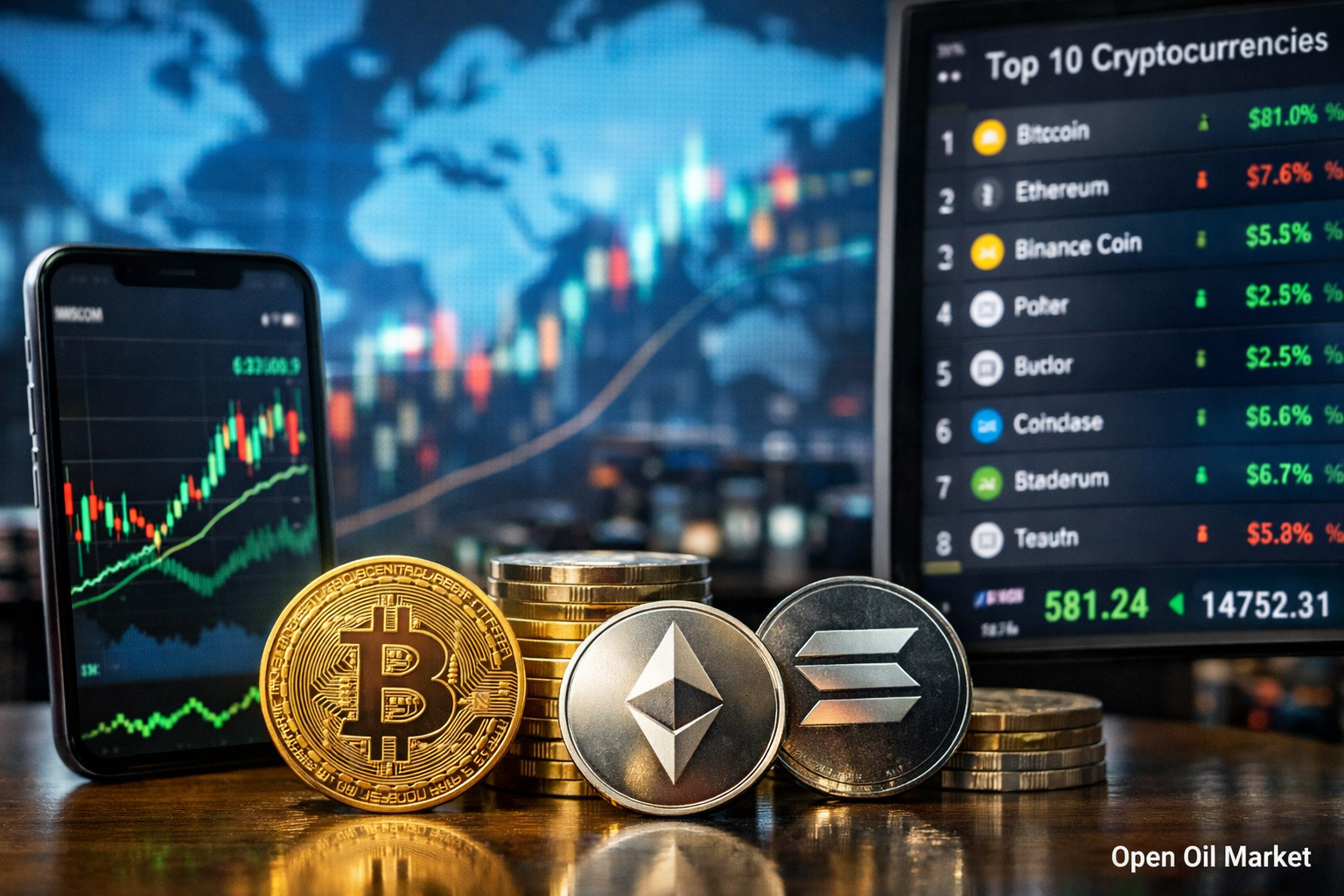
Top 10 Most Popular Cryptocurrencies
As of now, the top ten largest digital currencies by market capitalization include the following assets:
- Bitcoin (BTC) – the first and largest cryptocurrency, currently dominates around 60% of the entire market. BTC is trading below $80,000 after a recent correction, remaining a key "digital gold" and foundational asset for many cryptocurrency portfolios.
- Ethereum (ETH) – the second-largest crypto asset and leading smart contract platform. The current price of ETH is around $2,400; Ether underpins DeFi ecosystems, NFTs, and many decentralized applications, maintaining its crucial importance for the industry.
- Tether (USDT) – the largest stablecoin pegged to the U.S. dollar at a 1:1 ratio. USDT is widely used for trading and transactions, providing liquidity to the market; its market cap (around $80 billion) reflects high demand in the crypto ecosystem.
- Binance Coin (BNB) – the native token of leading cryptocurrency exchange Binance and the BNB Chain blockchain platform. It provides discounts on trading fees and serves as "fuel" for many DeFi applications. After a correction, BNB is priced around $500; despite regulatory pressures surrounding Binance, the coin remains in the top-five due to its wide range of applications.
- XRP (Ripple) – the token of the Ripple payment network for fast international transfers. XRP is trading around $1.5 (approximately half of its multiyear high); due to legal clarity regarding its status in the U.S. and interest from funds, this token retains its position among the largest cryptocurrencies.
- USD Coin (USDC) – the second most popular stablecoin from Circle, fully backed by reserves in dollars. USDC is known for its transparency and regulatory compliance; it is actively used in trading and DeFi (market cap around $30 billion).
- Solana (SOL) – a high-performance blockchain platform known for low fees and fast transaction processing. In 2025, SOL rose above $200, attracting investor attention; however, its price has since corrected to just above $100 after the market downturn, but Solana remains one of the leading protocols for DeFi and Web3.
- Cardano (ADA) – the cryptocurrency of the Cardano platform, which develops based on a scientific approach. ADA remains in the top ten due to its large market capitalization and active community, although its price (~$0.50) is significantly below historical records. The project continues technical updates, laying the groundwork for future growth.
- Dogecoin (DOGE) – the most famous "meme" crypto asset, which started as a joke but has become a mass phenomenon. DOGE hovers around $0.10; the coin is supported by a loyal community and intermittent attention from celebrities. Despite high volatility, Dogecoin continues to feature in the top ten, demonstrating remarkable resilience of investor interest.
- Tron (TRX) – the token of the Tron platform, focused on decentralized applications and digital content. TRX (~$0.25) is in demand for issuing and transferring stablecoins (a significant portion of USDT operates on the Tron blockchain due to low fees), helping it maintain its position among other major coins.
Outlook and Expectations
In the short term, the situation in the cryptocurrency market remains uncertain. Investor sentiment continues to lean towards caution: the "fear and greed" index is in the "fear" zone, reflecting prevailing negative expectations. Analysts warn that if macroeconomic pressures persist, a new wave of price declines could occur. In particular, some experts do not rule out Bitcoin falling to $70,000–75,000 if current support levels fail to hold. Volatility in recent weeks remains high, and ongoing margin liquidation series remind market participants of the importance of strict risk management when working with crypto assets.
Many specialists, however, assess the medium- and long-term perspectives of the industry positively. Historically, each sharp decline has cleaned the market of excess speculation and laid the groundwork for a new phase of growth. Technological development of the ecosystem continues unabated: innovative projects are emerging, infrastructure is improving, and traditional financial institutions are increasingly integrating blockchain into their business. Major global corporations are maintaining interest in cryptocurrencies – on the contrary, they view the current correction as an opportunity to strengthen their positions.
Following the tumultuous rally of 2025, a phase of cooling and consolidation was only natural. It is anticipated that with an improvement in the macroeconomic situation and regulatory clarity, the market will resume its upward trajectory. Fundamental demand factors for digital assets – from mass adoption of distributed ledger technology to the expansion of decentralized finance (DeFi) and the development of the Web3 concept – continue to act. According to several investment firms, under favorable conditions, Bitcoin could not only recover above the psychological mark of $100,000 but also set new records in the coming year or two. Obviously, much depends on the actions of regulators and central banks: if the Federal Reserve eases monetary policy amid slowing inflation, and legislative initiatives eliminate legal gaps, the influx of capital into crypto assets could significantly accelerate.
For now, investors are advised to combine vigilance with a strategic outlook on the market. High volatility is an integral feature of cryptocurrency development, but for long-term investors, the current correction may present new entry points. Digital assets, despite the temporary slump, continue to solidify their position in the global financial system, and their role in the global economy is likely to continue growing in the long term.