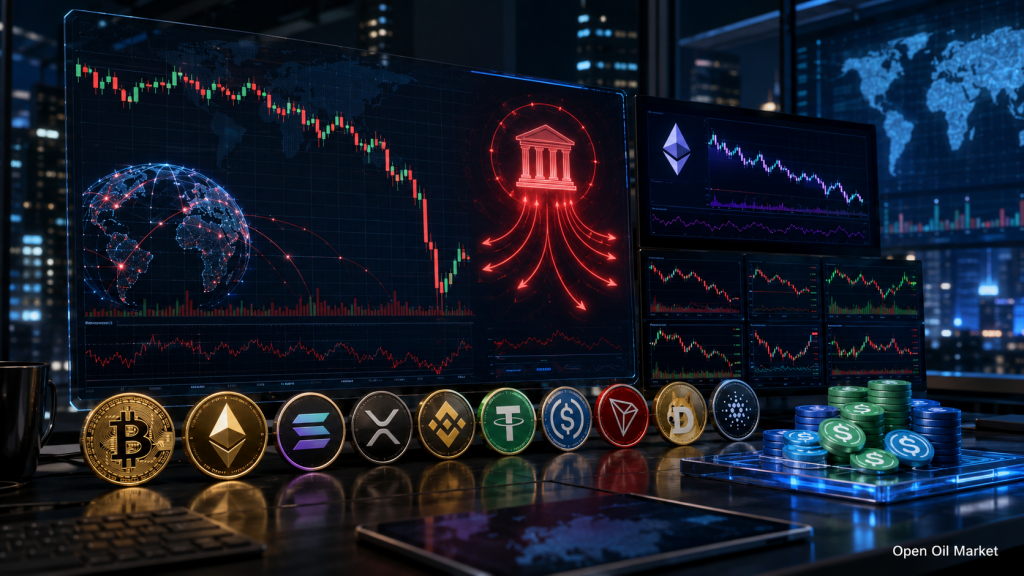
Cryptocurrency Market on 5 June 2026: Investors Assess Bitcoin Correction, ETF Outflows and a New Phase of Digital Asset Regulation
The global cryptocurrency market enters Friday, 5 June 2026, in a state of heightened volatility. After several weeks of pressure, Bitcoin, Ethereum, Solana and other major digital assets remain influenced by three key factors: capital outflows from spot Bitcoin ETFs, weak risk appetite amid competition from the stock market, and expectations of new cryptocurrency regulations in the US and other jurisdictions.
For investors, the current period is becoming a test not only of the Bitcoin price, but also of the resilience of the entire crypto market infrastructure. The focus is on the top 10 cryptocurrencies by market cap, stablecoin dynamics, the behaviour of institutional funds, the prospects for Ethereum and the state of liquidity in altcoins. The global cryptocurrency market is no longer an isolated niche: it is increasingly dependent on macroeconomics, interest rates, stock indices, regulatory decisions and capital flows through exchange-traded products.
Bitcoin remains the main indicator of sentiment in the cryptocurrency market
Bitcoin remains the largest digital asset and the main barometer of the cryptocurrency market. According to current market data as of 4 June 2026, Bitcoin was trading around $63,836 after an intraday range of approximately $61,503 to $65,899. This amplitude shows that the market is in a zone of nervous revaluation, where short-term traders are locking in losses and long-term investors are assessing whether the current correction is an entry point or the beginning of a deeper decline phase.
The main negative factor for Bitcoin is the acceleration of outflows from US spot Bitcoin ETFs. In late May and early June 2026, ETF data indicated a series of large daily net outflows. This is important for global investors because ETFs have become the main channel of institutional access to Bitcoin since the legalisation of exchange-traded products. When money leaves ETFs, pressure on the price increases and the market moves faster from accumulation mode to capital protection mode.
Ethereum loses momentum but retains significance for DeFi and tokenisation
Ethereum also remains under pressure. According to current quotes as of 4 June 2026, ETH was trading around $1,775, reflecting weak demand for the largest smart contract platform. For investors, Ethereum is important not only as the second most significant cryptocurrency, but also as the basic infrastructure for DeFi, NFTs, tokenisation of real assets, stablecoins and corporate blockchain solutions.
The weakness of Ethereum shows that the market is currently assessing not technological prospects, but liquidity and cash flows. When institutional investors reduce risk, pressure spreads not only to Bitcoin, but also to ETH, Solana, XRP and other major assets. At the same time, in the medium term, Ethereum retains its strategic importance: a significant part of the infrastructure for decentralised finance and tokenised securities continues to be formed around it.
Top 10 cryptocurrencies: which assets remain in the focus of investors
As of 5 June 2026, investors need to track not only Bitcoin and Ethereum, but also the entire group of largest digital assets. The top 10 cryptocurrencies by market capitalisation remain the main indicator of demand structure, liquidity distribution and stability of the cryptocurrency market.
Key cryptocurrencies to watch
- Bitcoin (BTC) — the main digital asset and indicator of institutional demand.
- Ethereum (ETH) — the base network for smart contracts, DeFi and tokenisation.
- Tether (USDT) — the largest stablecoin and important settlement tool on crypto exchanges.
- BNB (BNB) — the token of the Binance ecosystem and one of the largest infrastructure assets.
- USDC (USDC) — a regulated dollar stablecoin important for institutional settlements.
- XRP (XRP) — an asset associated with cross-border payments and institutional payment infrastructure.
- Solana (SOL) — a high-performance blockchain network sensitive to demand for DeFi and consumer crypto applications.
- TRON (TRX) — a network actively used for stablecoin transfers and settlement activity.
- Hyperliquid (HYPE) — one of the most notable new assets in the trading infrastructure segment.
- Dogecoin (DOGE) — a memecoin with high recognition but increased speculative risk.
For the portfolio investor, this group shows the stratification of the crypto market. Bitcoin is perceived as a digital reserve asset, Ethereum and Solana as technology platforms, USDT and USDC as settlement infrastructure, XRP and TRON as payment scenario instruments, while DOGE and some new tokens reflect speculative demand.
ETF flows become the main short-term driver of the market
Cryptocurrency ETFs in 2026 have become one of the main entry points for institutional capital. However, the current week shows the flip side of this institutionalisation: when funds record outflows, cryptocurrencies come under pressure almost in the same way as technology stocks during sell-offs in sector ETFs.
For investors, this means that cryptocurrency analysis can no longer be built only on on-chain metrics, Bitcoin halving or miner activity. It is necessary to consider:
- daily flows into Bitcoin ETFs and Ethereum ETFs;
- changes in interest in altcoin ETFs;
- funding costs in derivatives markets;
- liquidity on the largest centralised exchanges;
- correlation of cryptocurrencies with the Nasdaq, S&P 500 and shares of companies related to artificial intelligence.
If ETF outflows continue, Bitcoin may remain under pressure even if long-term interest in digital assets persists. If ETF flows stabilise, the cryptocurrency market may move into a consolidation phase.
Stablecoins strengthen the role of settlement infrastructure
Stablecoins remain one of the most resilient segments of the cryptocurrency market. Tether and USDC are among the largest digital assets, highlighting that investors and traders are increasingly using cryptocurrency infrastructure not only for speculation, but also for settlements, liquidity storage and rapid movement of capital between exchanges, networks and jurisdictions.
In 2026, stablecoins are becoming part of a broader financial architecture. Banks, fintech companies, payment services and crypto exchanges are developing products based on the digital dollar. For the global market, this is an important trend: the regulation of stablecoins could become a bridge between traditional finance and blockchain infrastructure.
Cryptocurrency regulation becomes a factor of global competition
One of the main topics for the crypto market remains the regulation of digital assets. In the US, discussion continues on legislation regarding the structure of the cryptocurrency market, including the division of powers between the SEC and CFTC, rules for digital commodity assets, disclosure requirements, regulation of cryptocurrency exchanges and investor protection.
For the global market, this has direct significance. If the world's largest financial jurisdiction creates clearer rules for cryptocurrencies, this could support institutional demand, the development of ETFs, asset tokenisation and bank participation. If the legislative process drags on, uncertainty will restrain capital inflows and increase volatility.
Europe, Asia, the Middle East and other financial centres are also competing for cryptocurrency companies, exchanges, custodians and payment projects. Therefore, the regulation of digital assets in 2026 is no longer just a matter of risk control, but also an element of global financial competition.
Altcoins remain a zone of increased risk
Altcoins in the current market phase look more vulnerable than Bitcoin and the largest stablecoins. Solana traded at around $69 on 4 June, showing sharper intraday volatility than Bitcoin. This is typical for periods when investors reduce risk: capital first leaves less liquid assets, then medium tokens, and only then pressure intensifies on the largest cryptocurrencies.
For investors, altcoins require stricter risk management. It is important to analyse not only market capitalisation, but also actual network activity, fee volume, number of users, ecosystem stability, tokenomics, ownership concentration and the availability of institutional products. In a correction, weak projects can lose liquidity faster than they manage to publish positive news.
What is important for investors on 5 June 2026
Friday, 5 June 2026, could be an important day for assessing the short-term resilience of the cryptocurrency market. Investors should closely monitor whether Bitcoin can hold near current levels, whether signs of stabilisation in ETF flows appear, and whether demand for the largest stablecoins persists.
Key signals to watch:
- Bitcoin dynamics after a sharp decline and recovery attempts;
- capital flows into spot Bitcoin ETFs and Ethereum ETFs;
- Ethereum behaviour relative to Bitcoin;
- liquidity of Solana, XRP, BNB, TRON and other major altcoins;
- changes in the market capitalisation of USDT and USDC;
- news on cryptocurrency regulation in the US, Europe and Asia;
- correlation of the crypto market with technology stocks and global risk appetite.
Conclusion: cryptocurrencies enter a phase of selecting strong assets
Cryptocurrency news for Friday, 5 June 2026, shows a market that is undergoing an important reassessment. Bitcoin remains the main asset, but can no longer ignore ETF outflows and changing sentiment among institutional investors. Ethereum retains its infrastructural significance but needs a recovery in demand. Stablecoins are strengthening their role as the settlement layer of the digital economy. Altcoins remain promising but require caution and deep analysis.
For global investors, the current moment is not only a period of volatility, but also a stage of selection. Liquidity, regulation, infrastructure quality, project business model sustainability and the ability of a cryptoasset to attract institutional capital come to the fore. In such an environment, the top 10 cryptocurrencies remain the main focus of the market, but even the largest digital assets require discipline, diversification and careful risk control.