Current Cryptocurrency News for Saturday, January 3, 2026: Bitcoin at $90,000, Ethereum and Altcoin Dynamics, Top 10 Cryptocurrencies, Global Trends, and Cryptocurrency Market Analysis for Investors.
Cryptocurrency Market at the Beginning of 2026
The cryptocurrency market welcomes the new year of 2026 with a sense of cautious optimism. After a turbulent rise followed by a correction in the second half of 2025, the total market capitalization of digital assets has stabilized around the $3 trillion mark. Investors are assessing the outcomes of a record-breaking previous year and strategizing for the future, taking into account several key trends.
- Institutional Adoption: Major financial institutions have increased their presence in the cryptocurrency market. Approval of spot ETFs for Bitcoin and Ethereum in the U.S. has attracted billions from institutional investors, enhancing market confidence.
- Expansion of Traditional Support: Banks and payment systems worldwide are implementing cryptocurrency and stablecoin services. Regulators in leading economies (U.S., EU, Asia) have softened their approach and established rules that allow for legal investments in crypto assets.
- Technological Progress: The blockchain sector continues to evolve: new decentralized finance (DeFi) applications, Web3 developments, and NFT projects are emerging. This is stimulating interest in leading platforms, although high volatility remains.
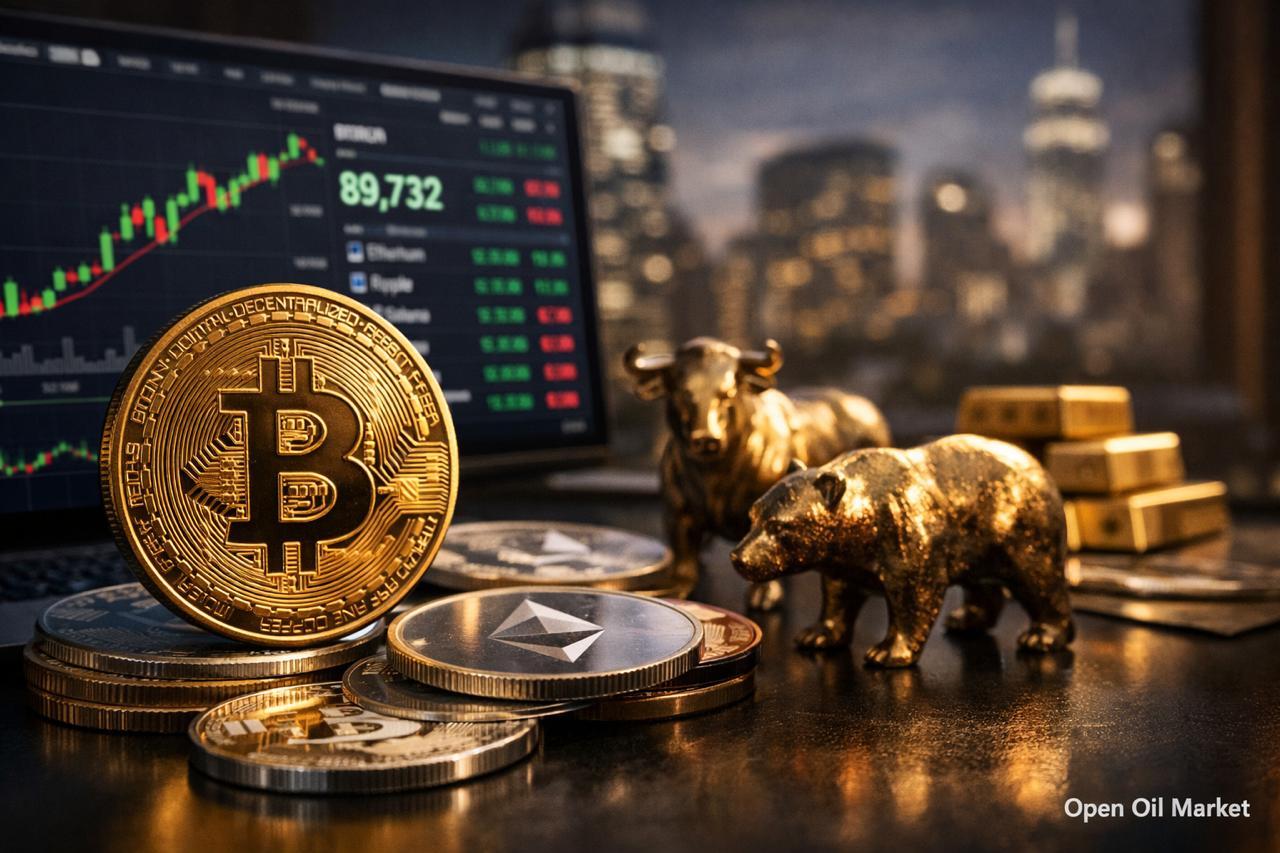
Bitcoin: Consolidation Around $90,000
Bitcoin (BTC), the leading cryptocurrency, is trading close to the psychologically significant level of $90,000 per coin. After hitting an all-time high of nearly $126,000 in early October 2025, Bitcoin has retraced about 30% and ended the year around $88–90,000. Attempts to confidently breach the $90,000 barrier have so far been unsuccessful as sellers activate at these heights to lock in profits. Nonetheless, there is also solid support below $85,000, indicating a balance of power in the market.
Market sentiment surrounding Bitcoin is currently mixed. The “Fear and Greed Index” is in the fear zone (around 25–30 points), indicating investor caution, but there are no signs of panic selling. The past year demonstrated that Bitcoin can lag behind traditional assets amid changing macroeconomic conditions, yet long-term fundamentals remain positive. BTC's share of the total market capitalization holds a high level (~58%), reflecting the inflow of capital into this “digital gold” asset.
- Limited Supply: Of the 21 million BTC, 19.5 million have been issued – the scarcity of coins continues to support price in the long term.
- Institutional Demand: In 2025, publicly traded companies and funds accumulated over 5% of the entire Bitcoin supply. By early 2026, around $110 billion was allocated to spot Bitcoin ETFs. Despite some recent marginal outflows from these funds, their emergence has been a significant growth driver.
- Macro Factors: Expectations of a dovish monetary policy in the U.S. in 2026 (amid potential Fed rate cuts) are fueling interest in risk assets, including BTC. Simultaneously, record-high gold prices (over $4,500 per ounce) demonstrate demand for safe-haven assets, indirectly supporting Bitcoin as a digital equivalent.
- High Volatility: Sharp price fluctuations persist. Analysts do not rule out a correction of Bitcoin to the $70–75,000 range in the event of deteriorating market liquidity. However, a confident breakthrough above $94–95,000 could rekindle bullish momentum and attract a new wave of buying interest.
Ethereum: Demand for the Platform Despite Retracement
Ethereum (ETH), the second-largest cryptocurrency by market capitalization, starts the year around $3,000 per coin. In 2025, Ethereum briefly surpassed its previous all-time high (peaking around $5,000 in August), but by the end of the year, it retraced roughly 40% from those values. Currently, ETH is recovering in tandem with the broader market, although it appears somewhat weaker than Bitcoin, as investors are hesitant to push up ETH prices without clear growth signals.
Despite the relative weakness in quotes, the fundamental positions of Ethereum remain strong. With the network's transition to Proof-of-Stake and ongoing upgrades (scalability, reducing fees), the platform has strengthened its technical advantages. In 2025, the first spot ETFs for Ethereum were launched, and by January 2026, around $18 billion was concentrated in them – a testament to institutional interest. Major financial players, such as BlackRock, have begun experimenting with tokenization of real assets on Ethereum, creating a potential new demand source for ETH as “fuel” for the network.
Experts agree that Ethereum has the potential to return to growth if overall market sentiment improves. Long-term investors see ETH as the backbone for the decentralized finance (DeFi) ecosystem and Web3 applications. However, in the short term, Ethereum may remain in the $2,700–3,300 range, following Bitcoin's dynamics. A breakthrough above the psychological level of $4,000 would signal a potential renewal of highs, while a drop below $2,500 could intensify bearish sentiment towards altcoins.
Altcoins: Mixed Dynamics
The alternative cryptocurrency (altcoin) market is displaying a heterogeneous picture at the beginning of 2026. After price surges in the first half of 2025, many altcoins have retraced from their peaks, and investors are now taking a more selective approach to investments in this segment. Major altcoins from the top 10 by market capitalization retain significant market share, yet not all have reached historical highs in the previous growth cycle.
Ripple (XRP) remains one of the leaders among altcoins due to regulatory successes. The resolution of legal disputes in the U.S. has given a boost to XRP: the token recovered and surpassed $1 in price during 2025, though it is still far from the records of 2018 (~$3). Nevertheless, XRP has firmly secured its position in the top ten largest coins, with its use in cross-border payments gradually expanding.
Solana (SOL) has experienced a resurgence: the high-performance blockchain platform has regained community trust after technical issues in 2022. In 2025, SOL exhibited one of the best performances in the market, with its price skyrocketing (approaching its ATH of ~$260), and institutional investors began including Solana in their portfolios. It is estimated that about 3% of the total SOL volume is currently held by companies and funds. However, Solana also finished the year with a correction, confirming the overall volatility trend among altcoins.
Other major projects are also working to maintain their positions. Cardano (ADA) continues to attract investors with the long-term development of its smart contract ecosystem, although ADA's price growth in 2025 was moderate. The Binance Smart Chain (BNB), via its native token BNB, continues to play a significant role – the exchange's coin remains in the top five, despite regulatory risks faced by some crypto exchanges. Dogecoin (DOGE) and other meme tokens intermittently gain spikes in attention due to social media but overall, in the new market cycle, the focus is shifting towards projects with real utility. As a result, the dynamics among altcoins are currently “mixed”: some coins with strong fundamentals have remained close to their peaks, while speculative assets have experienced a deeper decline.
Top 10 Most Popular Cryptocurrencies: Current Status
Below is the updated list of the ten largest cryptocurrencies by market capitalization at the beginning of 2026, along with a brief overview of their state:
- Bitcoin (BTC): Around $90,000. The flagship of the crypto market is consolidating after the record rally of 2025. BTC remains the primary “digital gold” attracting institutional capital, although its growth has paused recently at this psychological threshold.
- Ethereum (ETH): Around $3,000. The largest altcoin and foundation for smart contracts. Ethereum has retraced from its peak values but continues to be in demand thanks to its key role in DeFi, NFTs, and asset tokenization.
- Tether (USDT): ~$1 (stablecoin). The largest stable token pegged to the dollar. USDT provides liquidity in the cryptocurrency market and remains the primary means of settlement between exchanges. Its market capitalization consistently exceeds $80 billion, reflecting high demand for a digital dollar.
- USD Coin (USDC): ~$1 (stablecoin). The second-most popular dollar stablecoin issued by the Centre consortium (Coinbase and Circle). USDC is strictly regulated and fully backed by reserves, which has strengthened confidence after the passage of the stablecoin law in the U.S. Its market share has slightly decreased in favor of USDT but remains significant for institutional settlements.
- Binance Coin (BNB): ~$400. The token of the largest exchange, Binance, and its blockchain, BSC. BNB remains in the top five, supported by Binance's extensive ecosystem – from trading fees to decentralized applications. The price of BNB fluctuated in 2025, but the overall trend remains upward due to continual usage of the coin within the ecosystem.
- Ripple (XRP): ~$0.80. A cryptocurrency focused on banking payments. XRP has regained investor interest following a legal victory over the SEC and plans from banks to use it for international transfers. Although XRP has not reached historical highs, it showed solid growth in 2025 and solidified its status as one of the most liquid coins.
- Cardano (ADA): ~$0.45. A blockchain platform emphasizing a scientific approach to development. ADA consistently remains in the top ten due to its active community and development of scaling technologies. Over the past year, Cardano released updates that improved network performance, but the price of ADA grew moderately, without any sharp spikes.
- Solana (SOL): ~$180. A high-speed blockchain that has experienced a phase of recovery. SOL has regained positions after the previous decline: the network attracted new DeFi and NFT projects, and its speed and low fees make it attractive. During the market's peak in 2025, Solana approached record levels, and although a correction followed, SOL remains among market favorites.
- Dogecoin (DOGE): ~$0.07. The most famous meme coin, making headlines due to community support and periodic mentions in the media. DOGE maintains significant capitalization and a spot in the top ten, although its price is extremely volatile and largely depends on speculative interest – its fundamental value is limited.
- Tron (TRX): ~$0.10. A blockchain platform popular in the entertainment and decentralized applications sphere. TRX confidently remains among the leaders due to high network activity – especially in Asia – and the use of Tron for issuing stablecoins. The project continues to develop its ecosystem, which supports demand for the coin.
Macroeconomics and Regulation: Market Influence
The global macroeconomic backdrop and regulatory actions remain critical factors for the cryptocurrency market in 2026. In the U.S., a continuation of a friendly policy towards the industry is expected: the presidential administration actively supports the development of digital assets. In 2025, the first comprehensive law regulating the circulation of stablecoins and cryptocurrency exchanges (GENIUS Act) was passed, and regulatory bodies softened their rhetoric. This resulted in major banks on Wall Street launching cryptocurrency custody services, while some central banks (e.g., in the UAE and Singapore) began exploring the inclusion of Bitcoin in their reserve assets.
In Europe, the MiCA rules came into effect, establishing unified requirements for crypto companies across all EU countries. This has made regulation more transparent, attracting new institutional players already in the European market. Progress is also observed in Asia: Hong Kong and Japan are licensing crypto exchanges, and crypto hubs with favorable legislation are being established in Middle Eastern countries. Even in traditionally conservative jurisdictions, changes are happening – for example, the Central Bank of Russia prepared a 'road map' by the end of 2025 for legalizing certain cryptocurrency operations for citizens and businesses.
The economic situation influences risk appetite. By the end of 2025, the U.S. Fed halted the tightening of policy: rates reached a peak, and markets are pricing in a possible reduction in the second half of 2026 if inflation continues to slow. The threat of recession in leading economies prompts investors to be cautious, yet simultaneously supports expectations for stimulus. This dual picture is also reflected in cryptocurrencies: on one hand, an influx of liquidity due to policy easing could raise demand for crypto assets, while on the other, during periods of market turbulence, investors temporarily move into cash and safe-haven instruments.
Overall, as the rules of the game for cryptocurrencies become clearer worldwide, major market participants are feeling more confident. Regulatory clarity and improved macro conditions can lay the foundation for a new phase of cryptocurrency growth in 2026, although sharp rallies may not occur in the coming weeks.
Prospects: Cautious Optimism Among Investors
At the start of 2026, the cryptocurrency market appears more mature and resilient than a year ago. The past year has taught investors caution: many are reassessing strategies, diversifying portfolios, and hedging risks. Nevertheless, long-term enthusiasts remain optimistic. The focus is on the potential resumption of capital inflows into crypto funds after the holiday lull, key economic data (such as labor market reports and central bank decisions), and technological events, such as major network upgrades or the launch of new blockchain products.
Analysts note that for Bitcoin to sustain a bullish trend, it is essential to break and hold above the key level (around $95,000) – this would suggest movements toward new highs. Otherwise, the market may experience sideways trading in the first months of the year. Many altcoins that have undergone corrections are receiving a chance for growth if the flagship shows stability. Increased regulatory support and the influx of “smart money” (from funds and corporations) will be the factors that could transform cautious investor optimism into a full-fledged rally.
In conclusion, the cryptocurrency market enters 2026 with a balance between risks and opportunities. Investors worldwide are closely monitoring the movements of Bitcoin and Ethereum as indicators of the overall trend. If macroeconomic conditions align favorably and the industry continues to gain trust, 2026 could become a period of renewed growth for digital assets. However, volatility remains an inherent part of the cryptocurrency market – therefore, caution and a strategic approach are the main advice as the global investor community embarks on the new year.