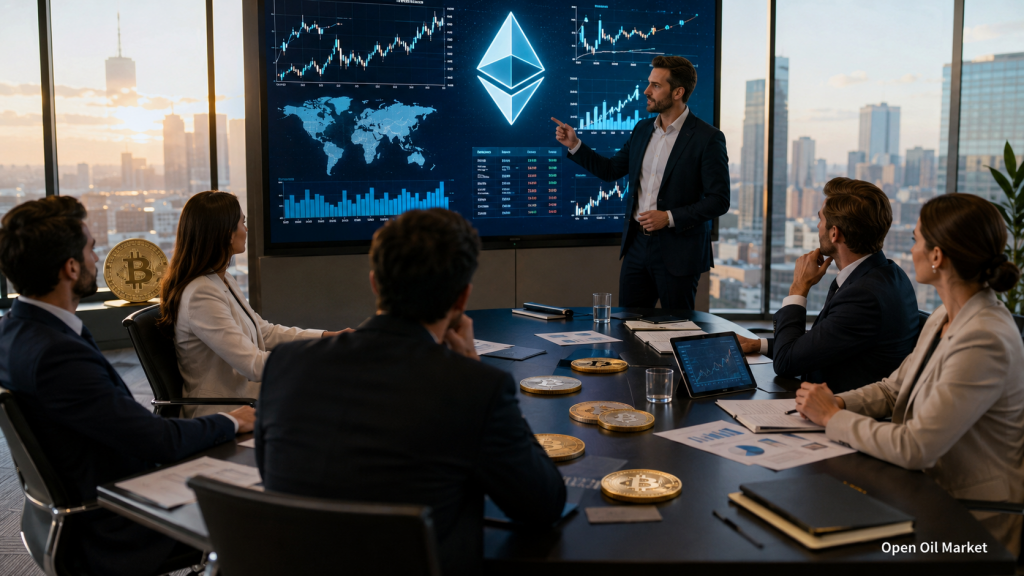
Cryptocurrency News for 22 July 2026: Institutional Investments, Ethereum Development, ETFs, Asset Tokenization, Digital Asset Regulation, Stablecoins, and a Review of the World's Top 10 Cryptocurrencies
One of the key themes in recent weeks remains the return of institutional capital. Major financial firms continue to invest in the digital asset infrastructure, while the interest of traditional market participants gradually shifts from simple cryptocurrency transactions to the development of comprehensive services.
Investors are particularly drawn to:
- the rise of investments in cryptocurrency ETFs;
- the development of custodial services;
- the tokenization of traditional financial assets;
- the expanded use of blockchain infrastructure by major financial organizations.
The market is gradually entering a phase where the main driver is the long-term investment from large companies, rather than just the activity of retail traders.
Ethereum Solidifies Its Position Among Major Digital Assets
Ethereum remains one of the most discussed assets in the cryptocurrency market. The heightened interest from institutional investors is linked to several factors:
- steady capital inflows into spot ETFs;
- increased use of the network in the tokenized assets space;
- development of Layer 2 solutions;
- growth in corporate usage of the Ethereum blockchain.
The Ethereum ecosystem is gradually transforming into a foundation for a multitude of next-generation financial services. This is why many analysts view the network as one of the key infrastructural projects in the global digital economy.
Cryptocurrency Regulation Becomes a Key Factor for Investors
Many countries continue to work on establishing a comprehensive regulatory framework for digital assets. The focus is primarily on regulating cryptocurrency exchanges, stablecoins, digital payment tools, and the activities of institutional participants.
Key regulatory directions include:
- establishing unified rules for the circulation of digital assets;
- monitoring the issuers of stablecoins;
- developing licensing requirements for crypto exchanges;
- enhancing transaction transparency;
- integrating cryptocurrencies into the existing financial system.
For the global market, such initiatives signify a gradual decrease in regulatory uncertainty, which is traditionally viewed positively by long-term investors.
Tokenization of Real Assets Becomes One of the Fastest-Growing Directions
Global banks, investment firms, and technology corporations are actively developing projects for the tokenization of real-world assets (Real World Assets, RWA). There is increasing attention given to the digital representation of bonds, stocks, money market funds, and other financial instruments.
The main advantages of this direction include:
- faster settlements;
- reduced transaction costs;
- 24/7 market availability;
- enhanced operational transparency;
- increased liquidity for certain asset classes.
It is the RWA segment that many analysts tout as one of the main drivers of blockchain industry development in the coming years.
Stablecoins Continue to Strengthen Their Role in the Global Financial System
The use of stablecoins extends far beyond cryptocurrency trading. Banks, payment services, and international companies are increasingly considering digital dollar assets as a tool for cross-border settlements.
The focus is on:
- expanding international payments;
- growing corporate adoption;
- integration with standard banking services;
- developing a regulatory framework;
- enhancing transparency in reserves.
As regulation evolves, stablecoins could become one of the most widely adopted segments of the digital economy.
The Development of Layer 2 Ecosystems Enhances Blockchain Scalability
Layer 2 projects continue to show increasing user activity. Layer 2 solutions significantly lower transaction costs and increase network throughput without compromising the security of the underlying blockchain.
The development of this direction contributes to:
- growth in DeFi;
- widespread use of digital assets;
- the development of gaming projects;
- increasing corporate application of blockchain;
- accelerating the implementation of tokenized services.
Scalability remains one of the key challenges for the entire cryptocurrency industry.
Top 10 Most Popular Cryptocurrencies
As of 22 July 2026, global investors are focused on the following digital assets:
- Bitcoin (BTC)
- Ethereum (ETH)
- Tether (USDT)
- XRP
- BNB
- Solana (SOL)
- USD Coin (USDC)
- Dogecoin (DOGE)
- TRON (TRX)
- Cardano (ADA)
Each of these cryptocurrencies continues to play an important role in the development of the global digital economy, from value storage and international settlements to the functioning of decentralized applications and smart contracts.
What Investors Will Be Monitoring in the Coming Days
By the end of the week, market participants will focus on several key areas:
- new data on capital flows into cryptocurrency ETFs;
- initiatives from major global regulators;
- news on the development of financial asset tokenization;
- corporate investments in blockchain infrastructure;
- the dynamics of Ethereum and other leading networks.
Conclusion of the Day
The cryptocurrency market continues to transition from a phase of high speculation to one of institutional development. Major themes in July include the growing interest from large investors, ETF development, expanded use of Ethereum, active asset tokenization implementation, and the gradual formation of a global regulatory framework.
For long-term investors, these fundamental processes remain the most important indicators for the further development of the digital economy. As participation from the traditional financial sector increases, the cryptocurrency market is becoming increasingly mature, and digital assets continue to solidify their place in the global financial system.