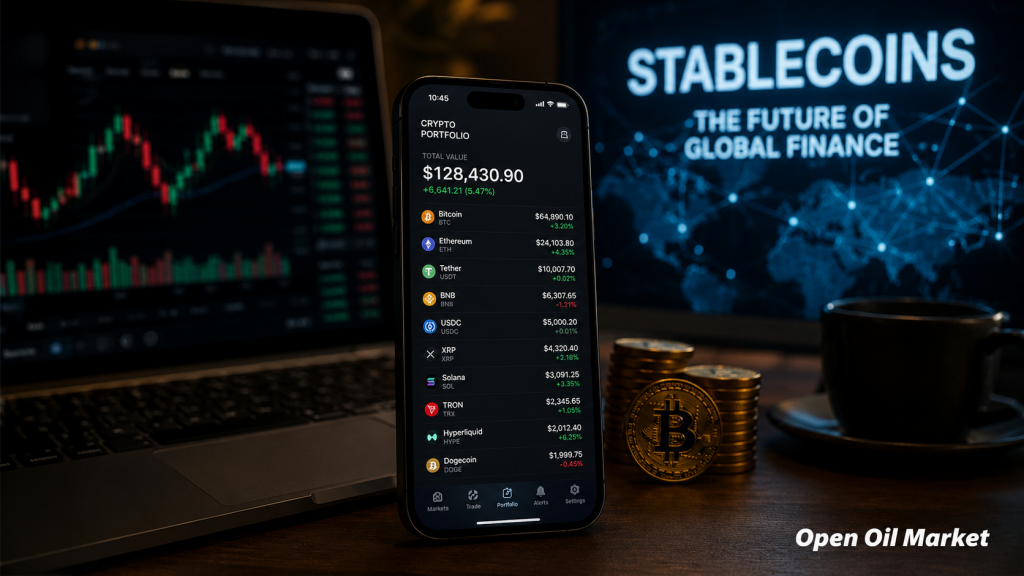
Global Crypto Market Update: June 26, 2026 - Smartphone with Bitcoin, Ethereum, USDT, USDC, Solana, and Other Digital Assets Wallets
The cryptocurrency market enters Friday, June 26, 2026, with heightened caution. For investors worldwide, the central theme revolves not just around the dynamics of Bitcoin and Ethereum, but also the reallocation of capital among cryptocurrencies, ETFs, stablecoins, DeFi projects, and traditional technology assets. Following a period of strong volatility, the digital asset market increasingly resembles a mature financial segment: cryptocurrency news is now assessed through the lenses of liquidity, regulation, ETF flows, and infrastructure resilience.
Today's main backdrop features pressure on Bitcoin, weakness among several altcoins, and the rising importance of stablecoins as a transactional layer of the crypto economy. For investors, this signifies a shift from a speculative "quick growth" mentality to a more institutional approach: not only prices matter, but the quality of blockchain infrastructure, demand resilience, regulatory clarity, and the ability of projects to maintain liquidity in stress scenarios.
Market Overview: Cryptocurrencies Under Risk Pressure
The global cryptocurrency market shows signs of cooling after the strong movements of previous months. Bitcoin remains the key indicator of risk appetite, Ethereum reflects the state of the smart contract sector, while Solana, XRP, BNB, and other major altcoins illustrate how willing investors are to venture beyond the core digital assets.
The market has become increasingly dependent on macroeconomic factors: expectations concerning interest rates, inflation, stock index dynamics, demand for tech stocks, and capital movements in ETFs. For global investors, cryptocurrencies no longer exist independently from traditional financial markets. Bitcoin, Ethereum, and the largest altcoins are increasingly traded as high-risk assets sensitive to liquidity, bond yields, and sentiment on global platforms.
- Bitcoin remains the primary benchmark for the entire crypto market.
- Ethereum continues to rely on activity in DeFi, stablecoins, and asset tokenization.
- Altcoins exhibit heightened volatility amid declining liquidity.
- Stablecoins strengthen their roles in transactions, trading, and cross-border payments.
Bitcoin: The Market Seeks a New Equilibrium Point
Bitcoin remains a central theme for investors. Following a decline from last year's highs, the market is trying to determine where the new zone of sustainable demand lies. The main question for Friday is whether buyers can sustain interest in BTC amidst competition from the stock market, artificial intelligence, major IPOs, and income instruments in the money market.
The weakness of Bitcoin is attributed not to a single factor but to a combination of several reasons. Firstly, some capital is flowing out of cryptocurrencies into tech stocks and artificial intelligence infrastructure. Secondly, Bitcoin ETFs have ceased to be a one-way investment channel and now reflect a more cautious approach from institutional investors. Thirdly, the decline in Bitcoin's dominance indicates that the crypto market has become broader: stablecoins, Ethereum, Solana, BNB, XRP, and new DeFi projects are attracting attention and liquidity away.
For long-term investors, Bitcoin still remains a "core asset" of the cryptocurrency portfolio, but its investment narrative is shifting. It is no longer just a bet on the scarcity of a digital asset but also a test of BTC's ability to compete with other asset classes in a mature market.
Ethereum and Smart Contracts: Price Pressure Versus Fundamental Demand
Ethereum remains the second key cryptocurrency for global investors, but its position is more complex than Bitcoin's. On one hand, Ethereum is the largest platform for smart contracts, DeFi, NFTs, asset tokenization, and stablecoins. On the other hand, the weak performance of ETH shows that the market demands confirmation of real user activity and sustainable demand for blockchain infrastructure.
Investors assess Ethereum through several factors:
- Transaction volumes and fees within the network;
- The role of Ethereum in the issuance and circulation of stablecoins;
- Competition from Solana, TRON, BNB Chain, and other networks;
- Flows into Ethereum ETFs;
- Development of real asset tokenization.
In the short term, Ethereum remains vulnerable to sell-offs in the risk market. In the long run, its investment attractiveness depends on whether the network becomes the primary transactional layer for tokenized finance.
Cryptocurrency ETFs: Institutional Demand Becomes More Selective
Bitcoin and Ethereum ETFs remain crucial channels for institutional capital entering digital assets. However, recent weeks have shown that these funds do not guarantee a continuous influx of capital. Investors utilize ETFs not only for accumulating cryptocurrencies but also for swift portfolio rebalancing.
The ETF situation is significant for assessing the cryptocurrency market for three reasons. Firstly, the funds provide a transparent indicator of demand from professional participants. Secondly, outflows from ETFs intensify pressure on underlying assets. Thirdly, the emergence of new products based on Bitcoin, Ethereum, Solana, XRP, and other coins expands the market while simultaneously increasing competition for capital.
For investors, this means that the simple logic of "ETFs launched = market will grow" no longer holds. Now, net flows, trading volumes, holder structures, and the ability of funds to attract capital during periods of instability are critical.
Stablecoins: The Primary Structural Trend in the Crypto Market
Stablecoins are becoming one of the most important topics in cryptocurrency news. Tether, USDC, and other digital tokens pegged to fiat currencies are increasingly seen not just as trading tools but as infrastructure for payments, international transfers, corporate transactions, and financial flow tokenization.
Regulators in the US, UK, Europe, and Asia are intensifying their focus on stablecoins. This creates a dual effect. On one hand, stringent regulations might limit some issuers. On the other hand, clear regulations enhance the trust of banks, fintech companies, and institutional investors in digital payment instruments.
For the global market, the key question is who will become the main beneficiary of the new infrastructure: crypto exchanges, banks, payment companies, fintech platforms, or major stablecoin issuers. This could form the next significant growth cycle for digital assets.
DeFi and Liquidity Risks: Investors Refocus on Protocol Resilience
The DeFi sector remains an area of heightened opportunities and risks. Recent events surrounding specific crypto-collateralized stablecoins have reminded the market that even collateral-backed models can encounter liquidity issues if demand falls sharply and participants begin to exit positions en masse.
For investors, this is an important signal. In 2026, analysis of DeFi projects must entail not only yields but also collateral quality, liquidity depth, debt structures, oracle resilience, management transparency, and protocol behavior in stress scenarios.
- High yields without liquidity increase the risk of sharp revaluation.
- DeFi stablecoins necessitate assessment of collateral and pegging recovery mechanisms.
- Protocols with transparent reporting gain an advantage over opaque models.
Top 10 Cryptocurrencies to Watch
For investors in the global market, cryptocurrencies with high capitalization, liquidity, infrastructural roles, and sustainable attention from exchanges, funds, and users are of utmost importance. The following digital assets remain in focus:
- Bitcoin (BTC) — the main indicator of the entire crypto market and a core asset for institutional portfolios.
- Ethereum (ETH) — the key platform for smart contracts, DeFi, tokenization, and stablecoins.
- Tether (USDT) — the largest stablecoin and a primary liquidity tool on crypto exchanges.
- BNB (BNB) — the token of the Binance ecosystem and BNB Chain.
- USDC (USDC) — a regulated dollar-pegged stablecoin, crucial for the institutional market.
- XRP (XRP) — an asset linked to cross-border payments and banking infrastructure.
- Solana (SOL) — a high-speed network for DeFi, payments, NFTs, and consumer blockchain applications.
- TRON (TRX) — a network with a strong role in stablecoin transfers and low-cost transactions.
- Hyperliquid (HYPE) — a rapidly growing DeFi asset linked to on-chain derivatives.
- Dogecoin (DOGE) — a highly liquid speculative asset sensitive to retail demand.
What Matters to Investors on June 26, 2026
Friday could be a pivotal day for assessing the short-term direction of the cryptocurrency market. Investors should monitor not just the movements of Bitcoin and Ethereum but also the liquidity behavior in ETFs, the dynamics of stablecoins, the response of the DeFi sector, and macroeconomic signals from the US.
Key indicators for the day include:
- The resilience of Bitcoin following the latest wave of sell-offs;
- Flows into Bitcoin and Ethereum ETFs;
- Demand for stablecoins and trading volumes in USDT and USDC;
- The dynamics of Solana, XRP, BNB, and TRON as indicators of altcoin demand;
- Regulatory news from the US, UK, Europe, and Asia;
- The condition of DeFi protocols and the risks of peg loss for specific stablecoins.
The Crypto Market Transitions from Euphoria to Institutional Selection
Cryptocurrency news for Friday, June 26, 2026, indicates that the digital assets market is entering a more mature phase. Bitcoin remains in the spotlight but is no longer the sole driver. Ethereum is fighting for confirmation of fundamental demand, Solana and other altcoins are competing for users, and stablecoins are becoming key infrastructure within the global crypto market.
For investors, the main takeaway is that cryptocurrencies can no longer be evaluated solely based on price growth expectations. Liquidity, regulation, protocol resilience, issuer quality, institutional flows, and the real utility of blockchain networks are crucial. In such a market, the advantage goes not to the loudest projects but to assets with clear economics, deep liquidity, and a long-term role in the digital financial system.