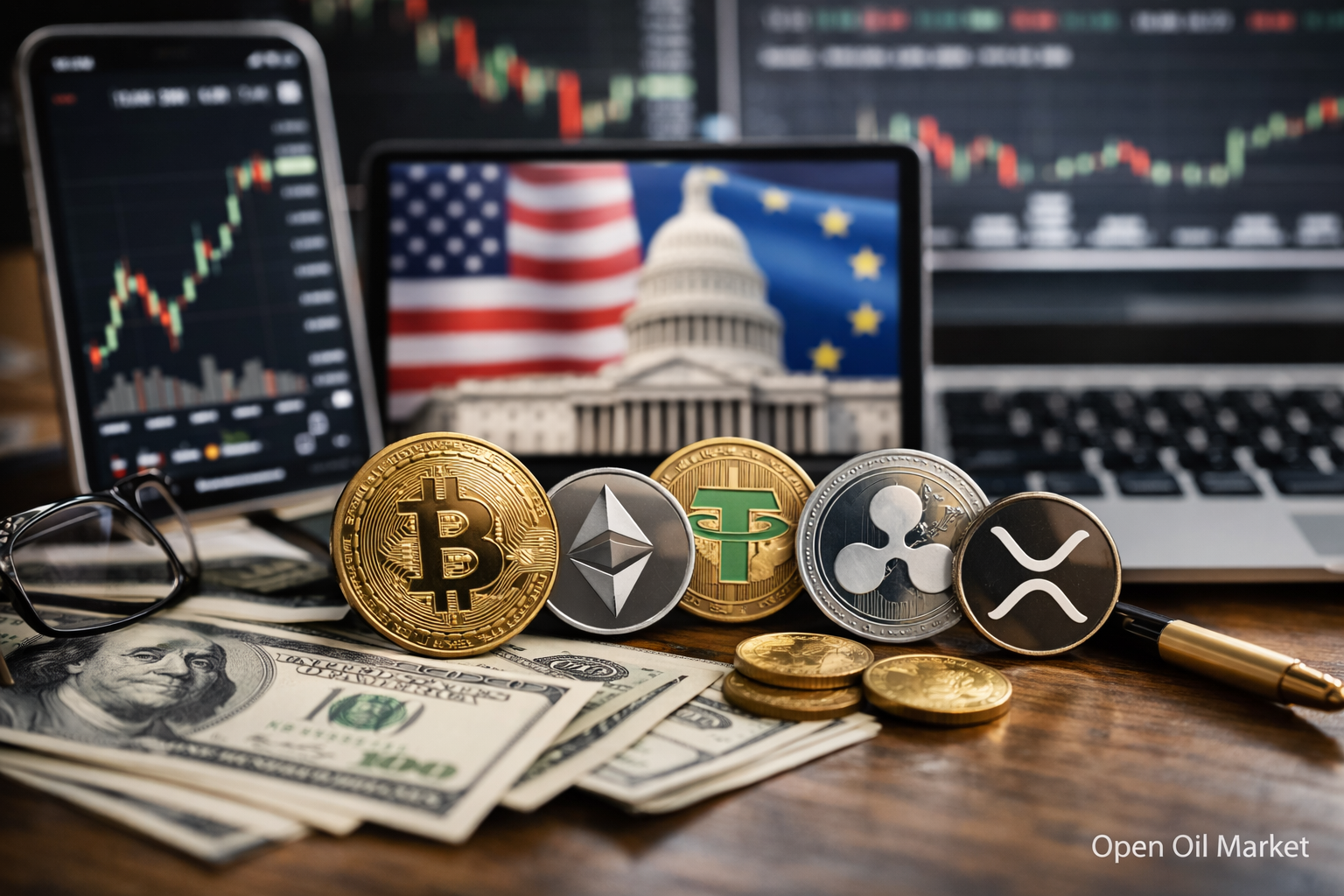
Latest Cryptocurrency News as of March 11, 2026, Including Key Trends in the Crypto Market, Stablecoin Development, Regulatory Overview of Digital Assets, and Analysis of the World's Largest Cryptocurrencies
The primary topic for the global cryptocurrency market remains Bitcoin's position. Even amidst significant macroeconomic uncertainty, BTC continues to set the overall direction for capital flow. Investors are assessing not only price behavior but also more critical indicators: Bitcoin's share of total market capitalization, the nature of institutional demand, and the resilience of demand following the February-March correction.
For the market, this means the following:
- Bitcoin remains the main safe-haven asset within the cryptocurrency segment;
- Major participants still view BTC as a fundamental tool for digital capital allocation;
- Bitcoin's movement directly influences risk appetite in Ethereum, Solana, XRP, and other major assets;
- The sustained high dominance of BTC suggests that a full-fledged alt-season has yet to receive convincing confirmation.
Against this backdrop, the cryptocurrency market appears more mature than in previous cycles: investors are increasingly looking not at short-term impulses but at liquidity structure, quality of capital inflow, and the behavior of leading coins during periods of stress.
Stablecoins Become the Main Driver of the New Phase of the Crypto Economy
While Bitcoin and Ethereum previously received most of the focus, there is now a noticeable shift towards stablecoins. They are becoming the link between the crypto market, payment infrastructure, and the banking system. For investors, this is one of the most significant structural trends of 2026.
The role of stablecoins is increasing in several ways:
- They are being used more actively as a settlement tool in international transfers and corporate payment schemes;
- Regulators are now viewing them not only as crypto assets but also as potential elements of financial infrastructure;
- The banking sector is increasingly viewing stablecoins as competitors for payment flows and customer balances;
- The growth in their capitalization supports liquidity across the entire cryptocurrency market.
Essentially, the stablecoin segment is becoming the zone where the industry’s future is decided: whether the market will be integrated into the global financial system or remain a separate digital ecosystem. For the global audience of investors, this may be as important as Bitcoin's short-term dynamics.
U.S. Regulation Remains a Key Factor for Cryptocurrencies
The American agenda continues to exert a significant influence on the digital asset market. Industry participants are awaiting greater clarity on cryptocurrency rules, delineation of powers between regulators, and the legal status of tokens. However, it is here that the main source of uncertainty remains: political compromises regarding the cryptocurrency market continue to be challenging.
For investors, this creates a dual backdrop:
- On the one hand, the market is counting on the much-anticipated legal clarity;
- On the other hand, the delay in decisions keeps the risk premium high for many digital assets;
- Any signals from Washington instantly impact demand for ETFs, trading activity, and the outlook for altcoins;
- Regulatory news is again becoming a driver just as important as macroeconomic releases.
This is why the cryptocurrency news as of March 11, 2026, cannot be viewed in isolation from the U.S. regulatory agenda: the market is increasingly trading not only on growth expectations but also on regulatory expectations.
Europe Tightens Control While Expanding Market Development Space
The European cryptocurrency market is also becoming increasingly significant. For global players, Europe remains a vital destination due to regulatory unification, substantial institutional demand, and the growing role of licensing. Major crypto companies continue to establish positions within the European jurisdiction, confirming the business’s long-term commitment to regulated growth.
Currently, three European signals are especially important for the market:
- Expansion of the regulatory framework for digital assets;
- Increased attention to the risks of stablecoins for the banking system and monetary policy;
- Willingness of major platforms to adapt to unified rules within the European Union.
For the global cryptocurrency market, this means that Europe is no longer merely a secondary region. It is gradually becoming one of the foundational platforms where the model of interaction between crypto businesses, banks, and regulators will be formed.
The Link Between the Crypto Market and Traditional Finance Grows Closer
One of the key features of the current cycle is the rapid blurring of the lines between traditional finance and digital assets. For investors, this changes the approach to analyzing cryptocurrencies: it is no longer sufficient to monitor blockchain metrics or news from individual projects. It is necessary to take into account cash flows, stock market conditions, risk appetite, ETF dynamics, and geopolitics.
This integration manifests in several forms:
- Crypto companies gain access to the payment infrastructure of the traditional financial system;
- Banks and fintech platforms are increasingly testing products based on stablecoins;
- Institutional investors are viewing cryptocurrencies as part of a broader set of risk assets;
- The crypto market's reaction to global events increasingly resembles the behavior of other financial segments.
In practice, this means that cryptocurrencies can no longer be analyzed as a separate world. For the global investor, digital assets are becoming part of a unified investment field alongside stocks, bonds, commodities, and currencies.
Geopolitics Again Exerts Greater Influence on Cryptocurrencies than Many Expected
The beginning of March has shown that the cryptocurrency market remains sensitive to geopolitical shocks. During times of rising tension, investors quickly reduce risk, which reflects on liquidity and volatility for major coins. At the same time, such periods reaffirm another function of cryptocurrencies: the use of digital assets as a capital transfer tool and alternative access to the financial system.
Against this backdrop, the market receives two conflicting signals:
- In the short-term horizon, geopolitical stress increases volatility and makes participant behavior more cautious;
- In the strategic horizon, such events confirm the practical role of cryptocurrencies in a world with a fragmented financial system.
For investors, this is an important reminder: cryptocurrency news can no longer be separated from international politics, sanctions regimes, cross-border payments, and the overall dynamics of global capital.
Top 10 Most Popular Cryptocurrencies: What the Market is Watching
When it comes to the most popular cryptocurrencies closely monitored by the global market, the largest assets by capitalization and liquidity remain in the spotlight. These form the main part of institutional interest, trading volumes, and media narratives.
- Bitcoin (BTC)
- Ethereum (ETH)
- Tether (USDT)
- BNB (BNB)
- XRP (XRP)
- USD Coin (USDC)
- Solana (SOL)
- TRON (TRX)
- Dogecoin (DOGE)
- Cardano (ADA)
For investors, it is important to understand that this list reflects not only the current popularity of cryptocurrencies but also the market structure:
- BTC and ETH remain foundational assets;
- USDT and USDC confirm the growing role of stablecoins;
- BNB, XRP, SOL, and TRX represent infrastructural and transactional use cases;
- DOGE and ADA maintain high recognizability and a broad audience.
What This Means for Investors as of March 11, 2026
As of March 11, 2026, the cryptocurrency market does not resemble a space of rampant speculative growth, but rather a rapidly maturing financial ecosystem. The narrative centers not only on Bitcoin but also on regulation, stablecoins, payment infrastructure, institutional capital, and the global macro environment.
Investors should pay attention to several key takeaways:
- Bitcoin maintains its role as the primary market strength indicator;
- Stablecoins are becoming a strategic direction for industry development;
- Regulatory decisions in the U.S. and Europe will continue to shape demand structure;
- Major cryptocurrencies remain in the spotlight, while the altcoin market requires a more selective approach;
- Geopolitics and global liquidity continue to directly influence digital assets.
The bottom line for the global cryptocurrency market can be summarized as follows: digital assets retain growth potential, but are increasingly traded as a mature financial asset class where technology, politics, regulation, banking infrastructure, and institutional capital behavior all matter.