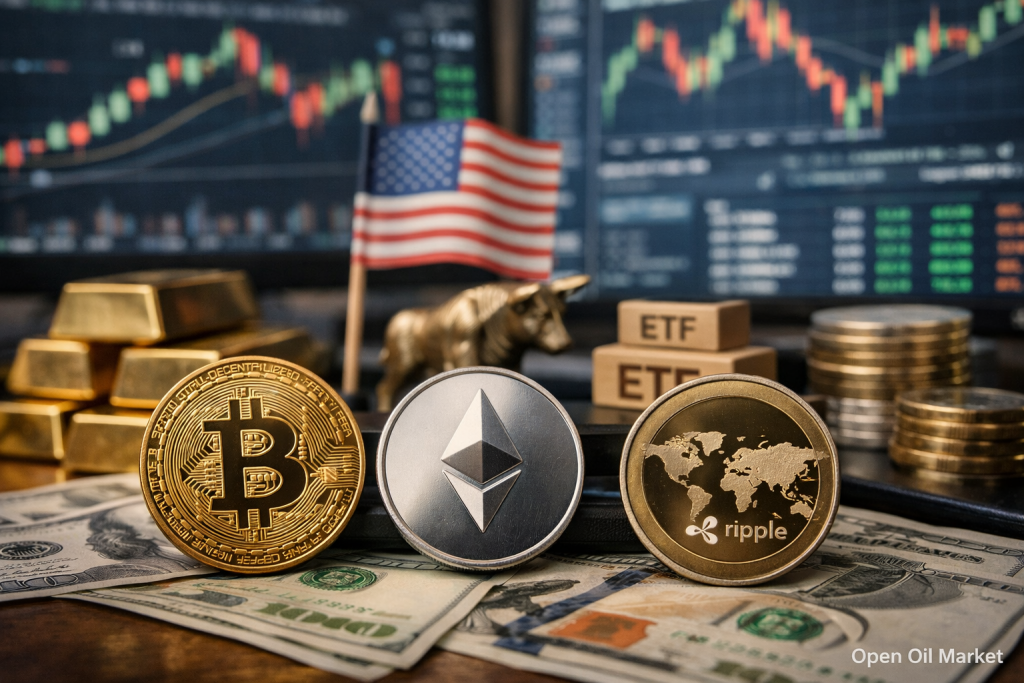
Current Cryptocurrency News as of March 25, 2026, Including Bitcoin ETF Trends and the Top 10 Digital Assets
At this stage, the cryptocurrency market is increasingly responding to institutional infrastructure and regulatory frameworks. This marks a significant shift compared to earlier phases of the cycle when speculative demand and leverage were the main growth drivers. Currently, investors are assessing how quickly digital assets will be integrated into the traditional financial system, which tokens will gain clearer legal status, and which instruments will become more accessible to large funds, banks, and asset management companies.
Consequently, news regarding the approach of American regulators, the expansion of cryptocurrency ETFs, and the reduction of barriers for banking infrastructure have a nearly equivalent impact on the market as the price movements of leading coins. For the global investor audience, this means one thing: the crypto market is becoming less isolated and increasingly part of the global financial system.
Bitcoin Remains the Core of the Crypto Market and the Main Indicator of Institutional Demand
Bitcoin continues to hold a dominant role in the industry. Its value today is defined not only as "digital gold" but also as a fundamental asset for institutional capital allocation. When funds, family offices, and large asset managers return to the sector, the first beneficiaries are those instruments tied to BTC.
For investors, several key takeaways are important:
- Bitcoin remains the primary indicator of overall risk appetite in cryptocurrencies;
- Inflows into ETFs and related products continue to act as a stabilizer for demand;
- The dynamics of BTC continue to dictate the behavior of most liquid altcoins.
Even during periods of local correction, it is Bitcoin that sets the frame for industry assessment: if institutional money returns to BTC, the market receives a signal of sustained long-term interest in cryptocurrencies as an asset class.
Ethereum Maintains Strategic Importance, but the Market Demands New Drivers
Ethereum remains the second key asset in the crypto market, but its investment profile in 2026 appears more complex than Bitcoin's. While BTC is perceived primarily as a macro asset and a store of value in digital form, ETH is evaluated based on network usage, ecosystem activity, stablecoin development, tokenization of real assets, and demand for infrastructure for decentralized applications.
This means that Ethereum today depends less on market narratives and more on the fundamental utilization of its network. Consequently, ETH is more strongly influenced by:
- Activity in the DeFi segment;
- Growth or slowdown in stablecoin turnover;
- Interest in the tokenization of funds, bonds, and other traditional assets;
- Competition from faster and cheaper Layer 1 networks.
Ethereum has not lost its systemic importance, but the market is no longer ready to automatically price in a premium simply for its scale. Sustained revaluation of ETH requires new confirmations of practical demand.
Altcoins Return to Focus, but the Market Has Become More Selective
Unlike previous cycles where altcoin growth was often broad and chaotic, capital distribution is now significantly more selective. Winning projects either have a strong infrastructural function or have developed a clear institutional narrative — for example, expectations around ETFs, expanded use in settlements, ecosystem growth, or enhanced exchange liquidity.
Among major altcoins, market attention is focused on several areas:
- XRP — due to sustained interest in cross-border payments and expectations for the development of exchange products.
- BNB — owing to the resilience of the Binance ecosystem and a strong position within centralized crypto infrastructure.
- Solana — because of high developer activity, network speed, and interest from institutional players.
- TRON — due to its role in stablecoin circulation and stable transactional activity.
- Dogecoin — as an indicator of speculative sentiment and retail interest in the market.
This is a critical moment for investors: the cryptocurrency market in 2026 no longer rewards all risks equally. Premiums are awarded for liquidity, infrastructure, recognition, and sustainable user demand.
Regulatory Environment in the US Improves Sector Perception
One of the most significant developments for the crypto market has been the increased regulatory clarity in the US. This does not imply the complete disappearance of risks, but the tone of discussions is noticeably changing. For global investors, it is particularly important that the American system is gradually moving away from a model of constant pressure on the industry towards a more pragmatic classification of digital assets.
If this course continues, the consequences for the market will be long-lasting:
- It will become easier for large investors to formulate cryptocurrency strategies through regulated instruments;
- Banks and brokers will find it easier to integrate digital assets into their product lines;
- Major coins will gain additional institutional legitimacy;
- Competition among ETFs for various cryptocurrencies will intensify.
For cryptocurrencies, this is strategically more important than short-term price spikes. Regulatory clarity lowers the entry barrier for global capital, which typically shapes the next sustainable growth phase.
Europe, Stablecoins, and Tokenization: The Second Front of the Global Crypto Market
In addition to the US, Europe remains a crucial part of the global agenda. Here, key discussions revolve around stablecoins, their influence on the banking system, and monetary policy. For investors, this is not a peripheral topic but rather one of the most significant indicators of how the future digital financial market will be structured.
Stablecoins have long ceased to be merely a "technical" instrument for trading cryptocurrencies. They are becoming the foundational settlement layer for international transfers, decentralized finance, and tokenized assets. Therefore, any increase in their role automatically elevates the significance of the networks on which they operate and enhances interest in infrastructural blockchains.
Against this backdrop, tokenization does not appear to be a separate trend but rather a bridge between cryptocurrencies and traditional finance. The more banks, asset management companies, and money market funds enter the market, the stronger the demand for quality blockchain infrastructure becomes.
Top 10 Most Popular Cryptocurrencies: Which Assets Are Global Investors Watching
As of March 25, 2026, the most popular and discussed cryptocurrencies among global investors include:
- Bitcoin (BTC)
- Ethereum (ETH)
- Tether (USDT)
- BNB (BNB)
- XRP (XRP)
- USD Coin (USDC)
- Solana (SOL)
- TRON (TRX)
- Dogecoin (DOGE)
- Cardano (ADA)
Each of these assets represents a distinct investment logic. Bitcoin serves as a macro asset and a benchmark for institutional capital. Ethereum functions as an infrastructural platform. USDT and USDC form the basis of liquidity and settlements. BNB, XRP, Solana, and TRON represent infrastructural and ecosystem bets. Dogecoin and Cardano reflect various forms of retail and ideological demand. For the portfolio investor, this means that even within the top 10 cryptocurrencies, the market offers not one but several scenarios for participation in the digital economy.
Key Considerations for Investors as of March 25, 2026
For the upcoming session and short-term horizon, investors should pay attention not only to prices but also to the structure of market movements. The most critical indicators are as follows:
- Will inflows into spot and index cryptocurrency ETFs continue?
- Will Bitcoin maintain its high share of the overall market capitalization?
- Will Ethereum validate demand through network activity?
- Will capital rotation into major liquid altcoins strengthen?
- How will the regulatory agenda around stablecoins and digital assets evolve in the US and Europe?
The cryptocurrency market remains volatile, but it no longer appears to be purely a speculative space. The more regulated products, institutional participants, and infrastructural cases are present, the stronger its connection to the global financial system becomes. This is why the cryptocurrency news as of March 25, 2026, is vital not only for crypto traders but also for a broader range of investors who are monitoring how digital assets transition from the periphery to the core of modern market architecture.