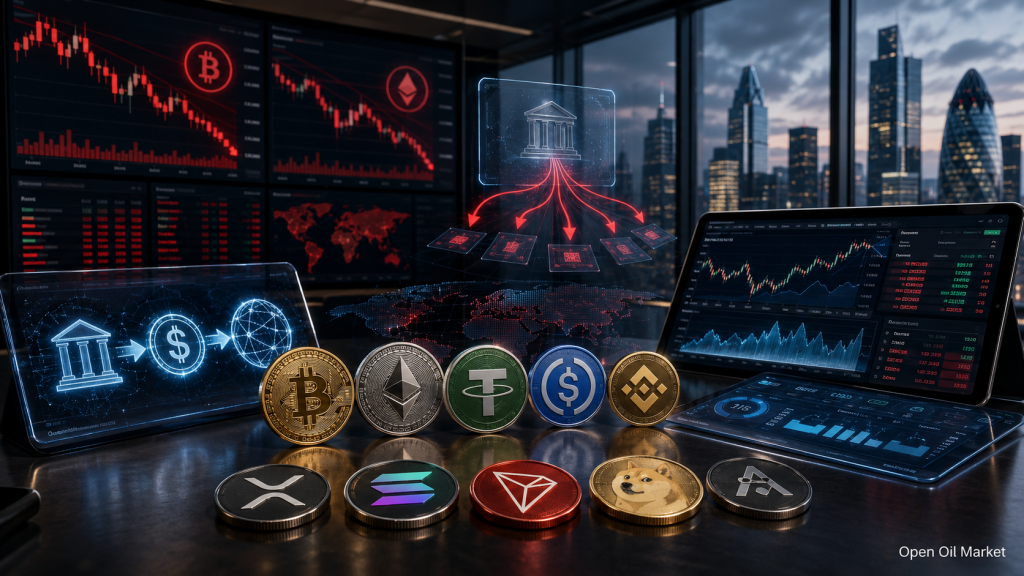
Cryptocurrency Market on 2 June 2026: Bitcoin, Ethereum, ETF Outflows, Stablecoins, Perpetual Futures and Top 10 Cryptocurrencies for Investors
On Tuesday, 2 June 2026, the global cryptocurrency market remains under investor scrutiny due to a combination of several factors: declining risk appetite in Bitcoin and Ethereum, sustained outflows from spot crypto ETFs, the growing role of stablecoins in international settlements, and the expansion of the regulated crypto derivatives market in the United States. For investors, this is not merely another day of volatility, but an important moment for reassessing the entire structure of the digital asset market.
The main theme of the day is the transition of cryptocurrencies from a phase of emotional growth to a more mature institutional model. Bitcoin continues to be the primary sentiment indicator, Ethereum reflects the state of blockchain infrastructure, stablecoins are becoming part of the global payment system, and perpetual futures are gradually moving from the offshore zone into a regulated environment. Against this backdrop, investors need to evaluate not only price dynamics, but also the quality of liquidity, regulatory changes, demand structure, and the resilience of the largest cryptocurrencies.
Bitcoin Remains Under Pressure After a Series of ETF Outflows
Bitcoin begins the new week in a weak technical position. Pressure on the leading cryptocurrency intensified after a prolonged series of outflows from US spot Bitcoin ETFs. For the market, this is an important signal: institutional investors, who previously supported Bitcoin's growth through exchange-traded funds, are now acting more cautiously and partially reducing their exposure.
The key challenge for Bitcoin is that the cryptocurrency has temporarily stopped following the rise of global equity markets confidently. Even with strong performance in the technology sector and interest in artificial intelligence, digital assets show a more subdued reaction. This indicates that the cryptocurrency market at the start of June is being driven by its own internal factors: ETF flows, derivatives, liquidity, and regulatory expectations.
For investors, Bitcoin remains the core asset of the crypto market, but the short-term outlook appears cautious. The main parameters to monitor include:
- the dynamics of net inflows and outflows from spot Bitcoin ETFs;
- trading volumes on spot and derivatives markets;
- the behaviour of long-term holders;
- Bitcoin's reaction to the dollar, bond yields, and global equity indices;
- demand from institutional investors.
Ethereum Holds Its Value as an Infrastructure Asset
Ethereum is also under pressure, but its role differs from that of Bitcoin. While Bitcoin is perceived as a digital reserve asset, Ethereum remains the largest infrastructure platform for smart contracts, DeFi, tokenisation, NFTs, and stablecoins. Therefore, Ethereum's dynamics are important not only for ETH holders, but for the entire blockchain application sector.
At the start of June, investors are assessing whether Ethereum can maintain its leadership amid competition from Solana, BNB Chain, TRON, and new specialised blockchains. Ethereum's strengths include a developed developer ecosystem, high liquidity, institutional recognition, and widespread use in asset tokenisation. Its weaknesses include competition in speed, transaction costs, and user activity in certain segments.
For the Ethereum market, three questions are currently critical: will inflows into Ethereum ETFs return, will DeFi activity persist, and can the network retain its status as the main infrastructure for tokenised financial instruments.
Top 10 Most Popular Cryptocurrencies: The Market Has Become More Complex
The top 10 cryptocurrencies by market capitalisation and liquidity remain the primary reference point for global investors. As of early June 2026, the market focus is on Bitcoin, Ethereum, Tether, BNB, XRP, USDC, Solana, TRON, Hyperliquid, and Dogecoin. This list shows that the cryptocurrency market can no longer be viewed as a single speculative segment; different categories of assets have formed within it.
- Bitcoin — the leading digital asset and indicator of trust in the crypto market.
- Ethereum — infrastructure for smart contracts and tokenised finance.
- Tether — the largest stablecoin and primary settlement unit on crypto exchanges.
- BNB — an ecosystem token linked to exchange and blockchain infrastructure.
- XRP — a cryptocurrency focused on cross-border payments.
- USDC — a regulated dollar stablecoin in demand among institutional participants.
- Solana — a high-performance blockchain for DeFi, consumer applications, and on-chain activity.
- TRON — a network with strong positions in stablecoin transfers.
- Hyperliquid — a representative of the new generation of on-chain derivatives.
- Dogecoin — a memecoin with high recognisability and speculative liquidity.
For investors, it is important to differentiate these assets by function. Bitcoin and Ethereum are core crypto assets; Tether and USDC are liquidity tools; Solana and TRON are infrastructure networks; Hyperliquid is a bet on derivatives development; and Dogecoin is a high-risk speculative asset.
ETF Flows Become the Main Indicator of Institutional Demand
Spot cryptocurrency ETFs remain one of the primary channels for institutional access to digital assets. In 2024–2025, they became an important driver of Bitcoin's growth and increased the legitimacy of cryptocurrencies in the eyes of large investors. However, the current outflows show that institutional capital is not a permanent source of support.
Reducing ETF positions may indicate profit-taking, a decline in risk appetite, or reallocation of capital into other assets. This is particularly important for the cryptocurrency market because ETF flows influence not only the price of Bitcoin, but the entire digital asset sector. When investors reduce positions in Bitcoin ETFs, pressure often spreads to Ethereum, Solana, XRP, BNB, and other major cryptocurrencies.
Stablecoins Become Part of Global Financial Infrastructure
Stablecoins remain one of the most practical areas of the cryptocurrency market. Tether and USDC are used for trading, storing liquidity, settlements, DeFi operations, and international transfers. Their role extends far beyond crypto exchanges: stablecoins are becoming an alternative dollar-based infrastructure for the digital economy.
At the same time, global regulators are increasingly discussing competition between stablecoins, tokenised bank deposits, and central bank digital currencies. For the banking system, this is a sensitive topic: stablecoins can accelerate cross-border settlements, but simultaneously create competition for traditional deposits and payment channels.
The key takeaway for investors is that stablecoins are evolving from merely a supporting tool for crypto trading into an independent element of the global financial system.
Regulated Perpetual Futures Are Changing the Crypto Derivatives Market
One of the most notable events of recent days is the entry of regulated perpetual futures into the US market. Perpetual futures have long been one of the most popular instruments in the global crypto market. They allow trading the price movement of a cryptocurrency without owning the underlying asset and without a contract expiration date.
Previously, a significant portion of this activity took place on offshore platforms. Now the US is gradually moving this segment into a regulated environment. For the market, this could mean increased liquidity, greater transparency, and intensified competition between American and international platforms.
However, investors must also consider the downside: perpetual futures are often associated with high leverage, sharp liquidations, and increased volatility. Therefore, the growth of regulated derivatives makes the crypto market more mature, but does not make it less risky.
Altcoins Are Becoming a More Selective Market
Altcoins at the start of June show mixed dynamics. The market no longer buys all digital assets simultaneously just because Bitcoin is rising. Investors have become more attentive to fundamental factors: user activity, actual fees, liquidity, network resilience, regulatory risks, and competitive advantages.
Solana remains one of Ethereum's key competitors in the fast-blockchain segment. TRON retains strong positions in stablecoin transfers. XRP remains tied to the cross-border payments theme. Hyperliquid attracts attention due to on-chain derivatives. Dogecoin maintains speculative popularity but remains a high-risk asset.
In such an environment, investors should avoid a mechanical approach to altcoins. The main criterion is not only potential growth, but also the presence of sustainable demand for the network or product.
Global Context: The US, Europe and Asia Are Shaping Different Crypto Market Models
The geography of the cryptocurrency market is becoming increasingly important. The US is strengthening the role of regulated ETFs and derivatives, Europe focuses on a controlled regulatory environment, Asia maintains high user activity and exchange liquidity, while emerging markets are increasingly using stablecoins for settlements and protection against currency instability.
The global crypto market is moving toward a model where digital assets become part of a broader financial system. This creates new opportunities for investors, but simultaneously raises the requirements for analysis. It is no longer enough to monitor only the price of Bitcoin; one must consider regulation, ETFs, derivatives, stablecoins, liquidity, and macroeconomics.
What Investors Should Focus on on 2 June 2026
On Tuesday, investors should concentrate on several key indicators. First, monitor flows into Bitcoin ETFs and Ethereum ETFs: they will show whether institutional demand is returning. Second, evaluate the behaviour of the top 10 cryptocurrencies, especially Bitcoin, Ethereum, Solana, XRP, BNB, and Hyperliquid. Third, consider the impact of stablecoins and regulated perpetual futures on market liquidity.
The main investment conclusion: the cryptocurrency market enters June without the previous euphoria, but with more developed infrastructure. This is a market where disciplined analysis of assets, liquidity, regulation, and risks wins over emotional bets on broad growth. For long-term investors, digital assets remain a promising but high-risk class. For short-term participants, key factors will be ETF flows, derivatives activity, and Bitcoin's ability to maintain its role as the anchor asset of the entire crypto market.