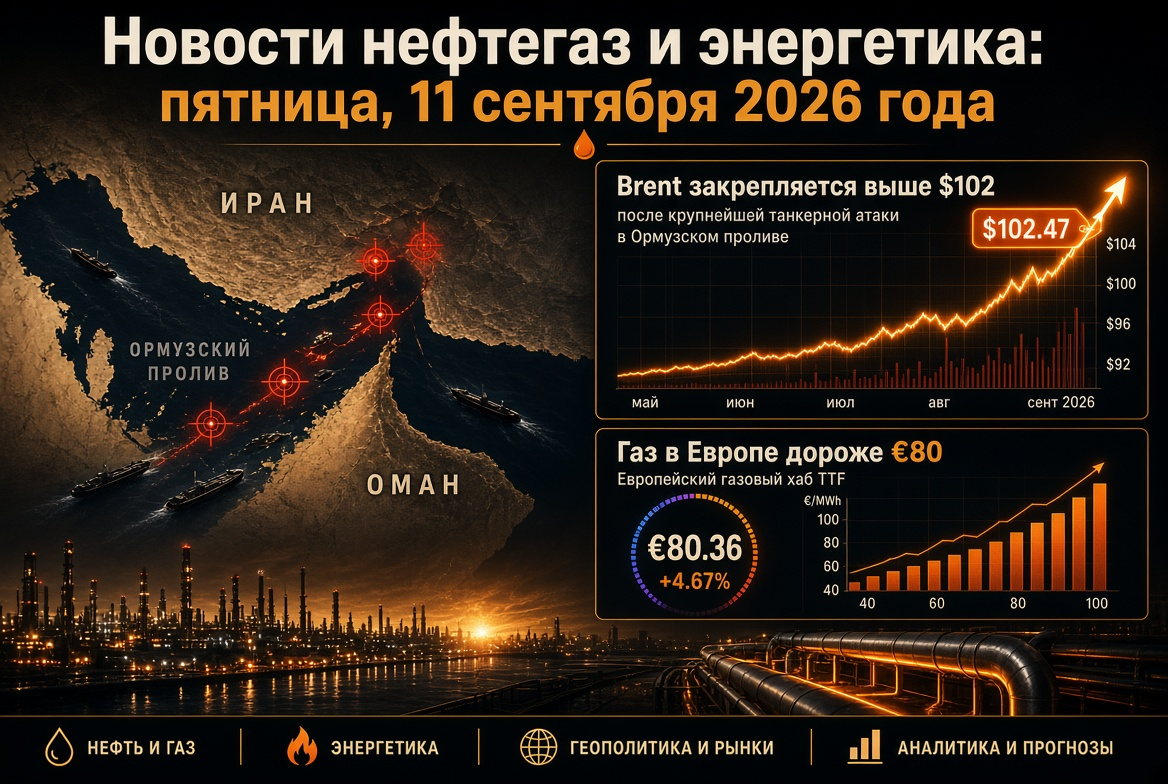
Current News from the Oil, Gas, and Energy Sector for Friday, November 14, 2025. Analysis of the Oil Surplus, Sanctions Against Russia, Risks to European Energy, and New Projects in Nuclear and Renewable Energy.
Global Oil Market: Oversupply Pressures Prices
Global oil prices remain under pressure due to signs of oversupply and weakening demand. Following a sharp decline the day before, prices stabilized on Thursday: Brent is holding around $63 per barrel, while WTI is near $59. Investors are weighing the prospects of overproduction, as OPEC recently revised its forecast, expecting that by 2026, global oil supply will slightly exceed demand. Similarly, the International Energy Agency (IEA) raised its forecast for production growth outside of OPEC+, signaling a possible market surplus next year. Against this backdrop, oil prices have fallen to their lowest levels in recent months.
Statistical data confirms this trend: commercial oil inventories are growing in key regions. In the U.S., crude oil inventories increased by approximately 1.3 million barrels for the week ending November 7, with similar trends observed in Europe and Asia. According to analysts at Vortexa and Kpler, a record volume of oil—around 1 billion barrels—has accumulated in tankers worldwide. A substantial portion of this floating supply consists of hard-to-sell oil from sanctioned countries (Russia, Iran, Venezuela), which ports refuse to accept. Additionally, increased exports from some major producers (e.g., Saudi Arabia) are contributing to a temporary market overload. Nevertheless, experts note a "floor" for prices around $60 per barrel—short-term market support is provided by supply disruption risks, particularly the anticipated tightening of U.S. sanctions against Russian exports.
Russian Oil Under Sanctions: LUKOIL Seeks Exit, Asia Adjusts Imports
New sanctions against the Russian oil and gas sector are forcing companies and buyers to adapt. In October, the U.S. added LUKOIL and Rosneft to the sanctions list, requiring counterparties to complete all transactions with them by November 21. According to sources, LUKOIL has approached the U.S. Treasury seeking an extension, as it needs more time to fulfill existing contracts and sell foreign assets. The company has been urgently trying to divest its international upstream, refining, and trading network—reports indicated a deal with Swiss trader Gunvor, but in early November, the U.S. Treasury expressed objections, and the deal fell through. As a result, LUKOIL's operations abroad are in limbo: the company has already had to declare force majeure on its largest international asset—the West Qurna-2 oil field in Iraq. Now, LUKOIL is hurriedly seeking new buyers for its assets and hopes to secure an extension from U.S. regulators to exit projects smoothly.
Importers of Russian crude in Asia are also restructuring their supply chains. In India, the largest state oil refining corporation, Indian Oil, has announced a tender for crude oil supplies for early 2024, including possible Russian grades ESPO (Eastern Siberia-Pacific Ocean) and Sokol. The tender stipulates that suppliers and loading ports must not be under U.S., EU, or UK sanctions. Consequently, Indian refineries plan to continue purchasing Russian oil through alternative traders, circumventing direct cooperation with Rosneft and LUKOIL. Meanwhile, another Indian refinery, Nayara Energy (partly owned by Rosneft), stated that it will maintain significant levels of imports from Russia despite the pressure from sanctions.
In China, conversely, there is a reduction in Russian oil purchases from major players. Fearing secondary sanctions, several large state-owned refineries (including Sinopec and PetroChina) and independent “teapot” refineries have halved their crude oil imports from Russia. This was prompted by the situation surrounding the private Shandong Yulong refinery, which was sanctioned by the UK and the EU for dealing with Russian crude. According to Rystad Energy estimates, the withdrawal of Chinese companies from Russian oil has impacted about 400,000 barrels per day—up to 45% of former supply volumes to China. This has already reflected on the market: prices for the Far Eastern ESPO grade have dropped to multi-month lows due to reduced Chinese demand. As a result, Russian suppliers are forced to redirect flows to other buyers and engage more complex sales schemes through traders in third countries.
Refining Under Attack: Russian Refineries Withstand Pressure
Alongside sanctions, fuel extraction and refining in Russia face physical threats. In 2025, Ukraine intensified drone attacks on Russia's oil infrastructure deep within its territory. As of this year, at least 17 major refineries, oil depots, and pipelines have been hit, posing an unprecedented challenge for the sector. During the peak of the second wave of strikes (August to October), up to 20% of Russia's total refining capacity was temporarily taken offline (including scheduled repairs). Nevertheless, Russian refiners managed to avert a catastrophic decline: they promptly activated backup capacities at surviving plants and quickly restored damaged facilities. According to industry sources, the total volume of crude processed in Russia from January to October decreased by only ~3% compared to the same period last year (to about 5.2 million barrels per day). The output of petroleum products dropped by only 6%, although due to strikes, the Russian authorities had to temporarily limit gasoline and diesel fuel exports and reinforce air defenses around strategic energy facilities.
Kyiv claims that drone strikes have significantly undermined Russian fuel logistics, reducing internal gasoline supplies by several dozen percent. However, Moscow asserts that the market is stabilizing: the Russian government has implemented manual price controls and normalized supplies, while President Vladimir Putin publicly assured that the country "will not bend under external pressure." Experts note that in the short term, the Russian oil industry has demonstrated resilience to shocks, but further escalation of attacks or tightening of sanctions could create new risks for exports and production.
European Gas and Electricity: Winter Risks Amid Renewable Energy Shortfalls
In Europe, the peak heating season is approaching with less comfortable gas reserves than the previous year. EU gas storage facilities are not fully filled: by early November, the average storage level was about 85% of capacity, whereas typically at this time, they are close to 100%. In Germany—the largest gas consumer in Europe—storage is about 86% full, partly due to the country burning more gas for electricity generation this autumn. A decline in renewable energy output (wind and hydro) forced German energy producers to increase the load of gas and coal-fired power plants. For the first ten months of 2025, gas-fired electricity generation in Germany rose by approximately 15% compared to last year (to 41.6 TWh), while the share of gas in generation climbed to 19%—the highest level in the last decade. Concurrently, total generation from wind and hydropower across the region decreased by about 7% year-on-year, and the shortfall was compensated for by "dirtier" sources: apart from gas, Germany increased coal generation by 4%.
The slowed pace of filling storage implies that Europe is entering winter with a less robust safety "cushion." Experts believe, however, that even in the event of colder weather, the region is unlikely to face acute gas shortages: stocks are close to historical averages, and record LNG imports can replace a significant portion of lost Russian supplies. Nevertheless, the energy market remains fragile. Continued weak winds or disruptions in LNG supplies could lead to price spikes in gas and electricity for consumers. EU authorities assure that the system is ready for winter—recently, the European Commission noted that gas volumes in storage and conservation measures enable Europe to confidently navigate the upcoming heating season without introducing consumption restrictions, though much will depend on weather conditions.
Sanctions and Energy: The U.S. Grants Hungary an Exemption
On the geopolitical front, news has emerged regarding the temporary easing of the sanctions regime. The United States has agreed to exempt its EU ally—Hungary—from certain energy sanctions against Russia. U.S. Secretary of State Marco Rubio announced that for the next 12 months, the restrictions will not apply to the supply of Russian oil and gas to Hungary via pipelines. Effectively, Budapest has received a one-year extension, allowing it to continue importing energy resources from Russia despite the overall Western sanctions regime.
Additionally, the U.S. has indefinitely exempted the expansion project of Hungary's Paks-2 nuclear power plant, which is being implemented with the involvement of Russia's Rosatom, from sanctions. Washington officially explains these steps as an effort to help Hungary ensure energy security and diversification. The decision followed talks between Prime Minister Viktor Orban and U.S. President Donald Trump. Earlier, Orban publicly stated that he had secured a complete exemption from sanctions on Hungary for importing Russian fuel, but it has been clarified that the concession is temporary and pertains only to one year. Hungary's European partners view the U.S. maneuver warily, as Hungary remains the most dependent country on Russian energy within the bloc.
Nuclear Energy: The UK Chooses a Site for Its First SMR
In the United Kingdom, a significant step has been announced in the development of nuclear generation. Prime Minister Keir Starmer confirmed this week that the government has selected a site for the construction of the country's first small modular reactor (SMR). The location will be the Wilfa site on the island of Anglesey in North Wales—formerly the site of a large decommissioned nuclear power plant. The project will employ British Rolls-Royce SMR technology and aims to enhance energy security and achieve climate goals. The compact reactor in Wales is expected to power up to 3 million homes, and its construction will create about 3,000 jobs. The first electricity from the new facility is anticipated to enter the grid in the early 2030s.
However, the UK government's choice has sparked diplomatic tension. The U.S. actively lobbied for an alternative project—a large traditional nuclear power plant from Westinghouse on the same site—and sharply criticized London's decision. The U.S. ambassador described the emphasis on SMR as "disappointing," claiming that small reactors will not provide a rapid reduction in high electricity prices in Britain and will delay the launch of new capacities. The ambassador's statement included unusually strong language directed at an ally. Officials in London countered that the choice of site and construction technology for the nuclear plant remains the sovereign right of the UK. The government emphasized that it is not abandoning its partnership with the U.S. in the nuclear sector—simultaneously, another site is being sought for a potential large nuclear power plant where U.S. developments can be utilized. Experts note that the contradictions surrounding the project in Wales reflect the UK's desire to develop its own innovations in energy while balancing national interests and allied relationships.
New Projects: Gas Field in Suriname Preparing for Development
Another promising source of gas has emerged in the global raw materials market. Suriname’s state company Staatsolie announced the recognition of the commercial viability of a significant gas discovery in offshore Block 52. The Sloanea field was discovered by Malaysian conglomerate Petronas, which operates the block. Petronas holds 80% of the project, with the remaining 20% owned by Staatsolie's subsidiary. The exploration and production contract was signed back in 2013, and three wells have been drilled to date, confirming substantial gas reserves.
The consortium is now transitioning to the development stage. According to Staatsolie's statement, the development concept for Sloanea includes drilling underwater gas wells, establishing underwater infrastructure, and deploying a floating LNG plant (FLNG) directly at the extraction site. It is expected that Petronas will present a detailed development plan for regulatory approval. If all goes well, an investment decision may be made in the second half of 2026, with Suriname expecting to start receiving the first volumes of gas in 2030. The implementation of this project could transform the small country into a new exporter of liquefied gas and attract foreign investment to the regional energy sector.
Renewable Energy: Generation Records and Emission Challenges
The renewable energy sector continues to grow confidently, although climate indicators have yet to improve. According to new data from analytical centers, global electricity generation from solar power plants increased by 31% in the first nine months of 2025 compared to the same period in 2024. Wind energy is also showing significant growth. Consequently, the total introduction of new renewable capacity in 2025 is projected to rise by approximately 10-11%—which means the world will set a record for renewable generation expansion once again. The growth of clean energy is already covering nearly all of the additional electricity demand: according to the International Energy Agency, the increase in wind and solar energy production this year compensates for the lion's share of the growth in global energy consumption.
Nevertheless, a historic peak in greenhouse gas emissions is also being recorded. The international research project Global Carbon Project has published a forecast that in 2025, CO2 emissions from fossil fuel use will increase by another 1.1%, reaching a new record of around 38.1 billion tonnes of CO2. This indicates that even the record pace of renewable energy adoption is still insufficient to reduce the carbon footprint of the global economy. Experts urge countries to double down on efforts to transition to low-carbon technologies. According to IEA analysts, the rapid growth of cheap "green" electricity makes the global energy transition nearly inevitable; however, achieving climate goals by 2030 requires more decisive policy measures and investments.