Global Energy Market Overview: Oil, Gas, Electricity, Coal, and Renewables as of September 10, 2026
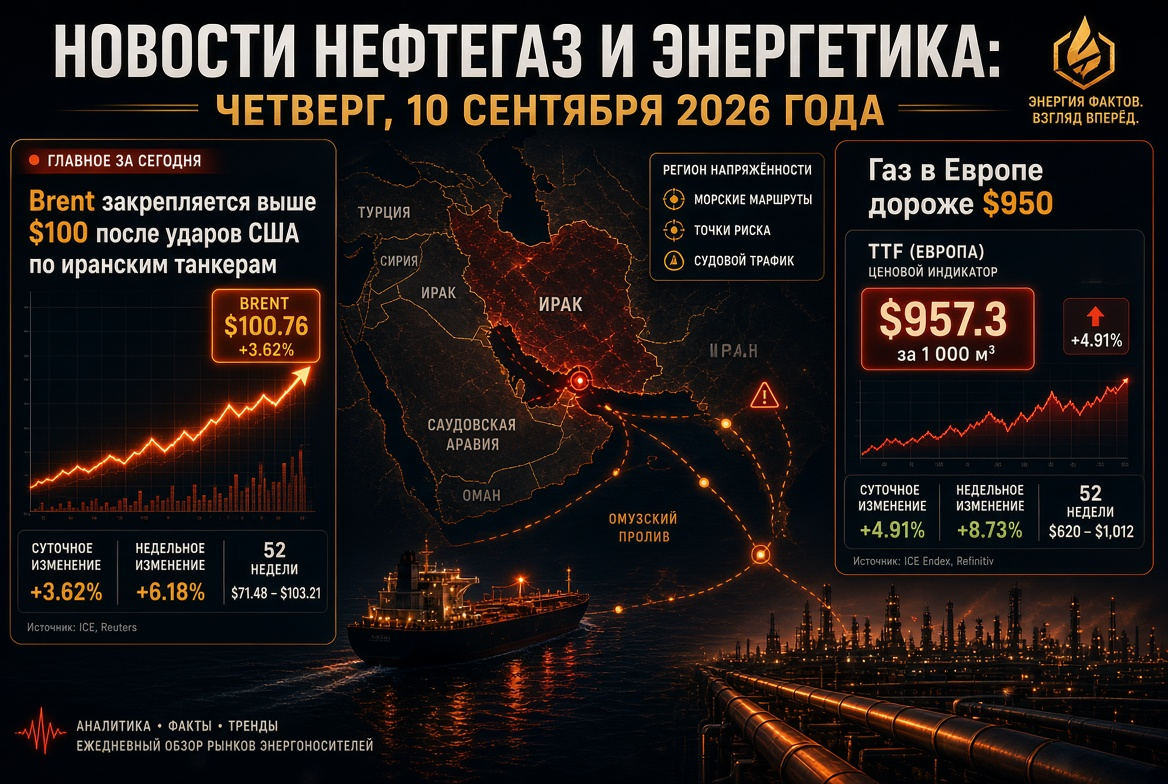
Main Topic of the Day: Brent Above $100 — Hits on Tankers and Tehran's Response
Oil prices are rising for the fourth consecutive session, triggered by direct military escalation in the Persian Gulf. The U.S. Central Command reported the destruction of five Iranian oil tankers in the Gulf of Oman and near Kharg Island in response to attempted attacks on American vessels; according to the Pentagon, a total of ten vessels from the "shadow fleet" have been incapacitated in just one week. Iran reported attacks on the Al-Muwaffaq Salti base in Jordan (18 missiles intercepted), strikes on two U.S. Navy destroyers, and attacks on ten vessels near Hormuz. The UKMTO maritime service recorded an unidentified projectile hitting a tanker near Iraq's Al-Faw and damage to a vessel near Port Rashid in the UAE.
The key threat to shipping is the "forbidden zone" declared by Tehran outside the Strait, where Iranian forces intend to stop vessels without permission. For traders and insurers, this means further increases in war premiums and a reduction in the number of shipowners willing to enter the region. In response, Washington has expanded its sanctions campaign against Iranian aviation, and Seoul is considering participation in ensuring the security of the Strait.
Oil Market: Prices, Dynamics, and Forecasts
The benchmarks for the oil market on Thursday morning are as follows:
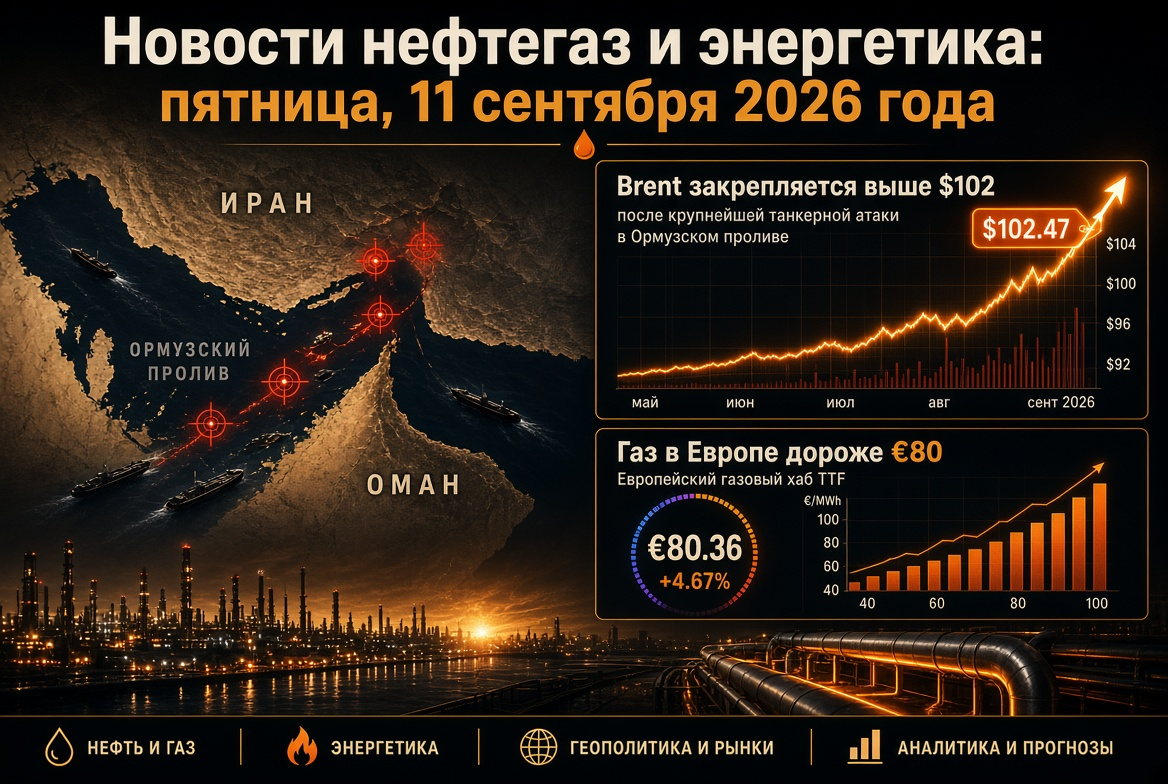
- Brent (November, ICE): peaked at $100.19 per barrel on Wednesday, the first time above $100 since July 24; then consolidated around $99.7–100.5.
- WTI (October, NYMEX): trading around $94.7, approximately a 2% increase for the session.
- Dynamics: since August 31, Brent has added about 13.5%, and nearly 40% since the start of the war with Iran at the end of February; the April peak of the year exceeded $125.
- Forecasts: Goldman Sachs allows for $120 if attacks on vessels in Hormuz and the Red Sea intensify, and a return to $80 with the normalization of exports; ING expects a significant risk premium to remain until negotiations resume.
The fundamental backdrop remains tight. According to EIA estimates, global oil supplies decreased by 4.2 million barrels per day in Q2 and another 3.8 million barrels per day in Q3; transit through Hormuz in Q2 was only 4.9 million barrels per day compared to 21.6 million before the conflict. The August forecast from the agency — $85 per barrel in Q3 and $78 in Q4 — looks outdated against current quotes, and the September release of STEO, published on September 9, will align the market with the reality of "hundreds." The U.S. Strategic Reserve, at around 286.6 million barrels, limits Washington's ability to mitigate price shocks through interventions.
Middle East: Dual Blockade of Saudi Arabia
The second front of risk is the Red Sea. The Houthis struck targets in Abha, Khamis Mushait, Jizan, and Najran on September 8, injuring 73 people; fires broke out at the Aramco refinery in Jizan, which has a capacity of 400,000 barrels per day. At the same time, the movement announced a campaign for control over Bab-el-Mandeb. The issue for oil supplies is that after the closure of Hormuz, the Red Sea has become the main artery for the Kingdom: the East-West pipeline is operating at a record 7 million barrels per day, and the Yanbu terminal accounts for over 90% of Saudi oil's maritime exports. The defense pact between Riyadh, Turkey, and Pakistan has not yet diminished the threat to infrastructure. Any disruption in Yanbu would mean the largest exporter would be off the market for the duration of both straits' closures.
Gas Market: TTF Above $950, Gas Storage at a Minimum Since 2011
The European gas market is moving in contrast to seasonal logic. October TTF futures reached €78.8/MWh (about $970 per thousand cubic meters) on September 9, rising nearly 4% in one day; prices have increased by approximately 120% since the beginning of the year. Key parameters are:
- Filling of EU gas storage facilities - 66.9% as of September 7, around 71.7 billion cubic meters; the lowest level for this date in the entire observation history since 2011 and 13.8 billion cubic meters below last year's level.
- Germany - about 53%, the worst figure among major economies; Italy is the only large market nearing a comfortable 80%+.
- Target norm - 90% in the window from October 1 to December 1 with a tolerance of 10 percentage points; since April, only about 62% of the necessary volumes have been injected.
The European Commission, following the Coordination Gas Group meeting on September 3, stated that there is no immediate threat to supply security and sees no grounds for intervention, citing diversification, regasification capacity, and reduced demand. Meanwhile, LNG production in Qatar remains halted, and Europe has to compete with Asia for tankers at peak prices. For the EU industry, this means entering the heating season with the highest injection costs in four years.
LNG and Coal: Gas Shortage Supports Coal Generation
The deficit of LNG in 2026 is estimated at approximately 35 million tons, forcing import-dependent countries in Northeast Asia to increase coal output: in South Korea, it has risen by nearly 40%, and in Japan by more than 11%. Global coal demand could increase by about 3%, approaching 9.1 billion tons. For coal exporters — Indonesia, Australia, Russia, and South Africa — this is an unplanned window of demand against the long-term trend of decarbonization.
China and Asia: Oil Imports Recover from a Decade Low
Chinese customs statistics for August indicated a second consecutive month of growth: oil imports totaled 37.93 million tons (8.93 million barrels per day), +6.2% compared to July, but still 23.4% lower than last year's level; over eight months, purchases have decreased by 14.6%. Chinese refineries are actively increasing purchases of Russian ESPO bypassing Hormuz and exploring atypical markets, including Argentina. Oil product exports surged by 29% to 6 million tons against the backdrop of global diesel shortages, while domestic demand for gasoline and diesel remains 8–9% lower than last year's levels. The rate of inventory depletion has slowed to 550,000 barrels per day, indicating a gradual return of Beijing to the spot market.
Russia: Urals Discount, Exports, and the Second Wave of Fuel Crisis
The high Brent price partially offsets the expanded discount for Russian companies: after the expiration of the American license for transactions with Russian oil, the Urals discount in summer reached $23–24 per barrel, while the average annual level is estimated at $17–22. The domestic oil products market remains in crisis mode:
- Exchange sales of gasoline from September 1 to 4 increased by 69% compared to August to 72,750 tons, but dropped to 12,240 tons by September 7 due to unscheduled repairs at refineries;
- Unmet solvent demand - 37,700 tons for Ai-92 and 35,300 tons for Ai-95; since May, only about 41% of exchange contracts have been fulfilled;
- Since the beginning of the year, 5.44 million tons of gasoline have been sold on the exchange, which is 23.7% less than the previous year;
- The gasoline export ban has been extended until January 31, 2027, and the Ministry of Energy is discussing restrictions on diesel exports during repair and winter demand periods, while imports from India have begun.
Electricity and Renewables: Structural Trend Does Not Reverse
Amid the commodity shock, the energy transition is accelerating. According to Ember, in 2025, renewable sources will first surpass coal in global generation (33.8% vs. 33.0%), and in May 2026, solar energy will first outpace coal in the U.S. energy balance (12.8% vs. 12.2%). Africa is heading towards a record year with a 45% increase in solar capacity installations. Global electricity demand in 2026 is expected to grow by 3.6% due to electric transport, air conditioning, and data centers for AI. For investors in renewables, storage solutions, and networks, expensive gas is not a brake but an additional argument.
Thursday Calendar: OPEC, EIA, and U.S. Inflation
September 10 is one of the busiest days of the month for participants in the energy market. OPEC publishes its monthly report with updated estimates of demand and production, which will show how much the cartel accounts for the decline in consumption in Asia. Due to the holiday schedule, the EIA will release weekly statistics on oil and petroleum product stocks specifically on Thursday — after a series of reductions in U.S. commercial stocks below a five-year low, these data are critical for WTI. The U.S. PPI index for August will be released, and on Friday, the IEA review and consumer inflation data will determine the rhetoric of the Federal Reserve. The next OPEC+ meeting is scheduled for October 4; October quotas remain unchanged.
Conclusions and Risks for Investors and Energy Companies
- Oil. The consolidation of Brent above $100 depends on whether strikes on tankers escalate into a complete closure of Hormuz and Bab-el-Mandeb; the range of scenarios for the quarter is between $80 and $120.
- Gas. Europe is entering winter with a historic storage deficit; a cold November or a new LNG supply disruption could drive TTF back to four-digit values.
- Coal and Refineries. The gas and diesel shortages support the margins of coal generation and refining, but concentrate profits in regions outside the conflict zone.
- Russia. High oil prices mitigate budget risks; however, the domestic fuel market remains vulnerable until refinery repairs are completed.
- Renewables. Renewable energy remains the only predictable element of the global energy balance and the main benchmark for long-term investments.
The day’s outcome for the global energy sector: the short-term price of oil and gas is determined by military logic in the Persian Gulf and the Red Sea, the medium-term by Europe's and Asia's ability to weather winter with partially empty storages, and the long-term by the pace of the energy transition. Under these conditions, scenario planning, logistics diversification, and hedging discipline are becoming a condition for the survival of market participants in the energy sector, rather than an option.