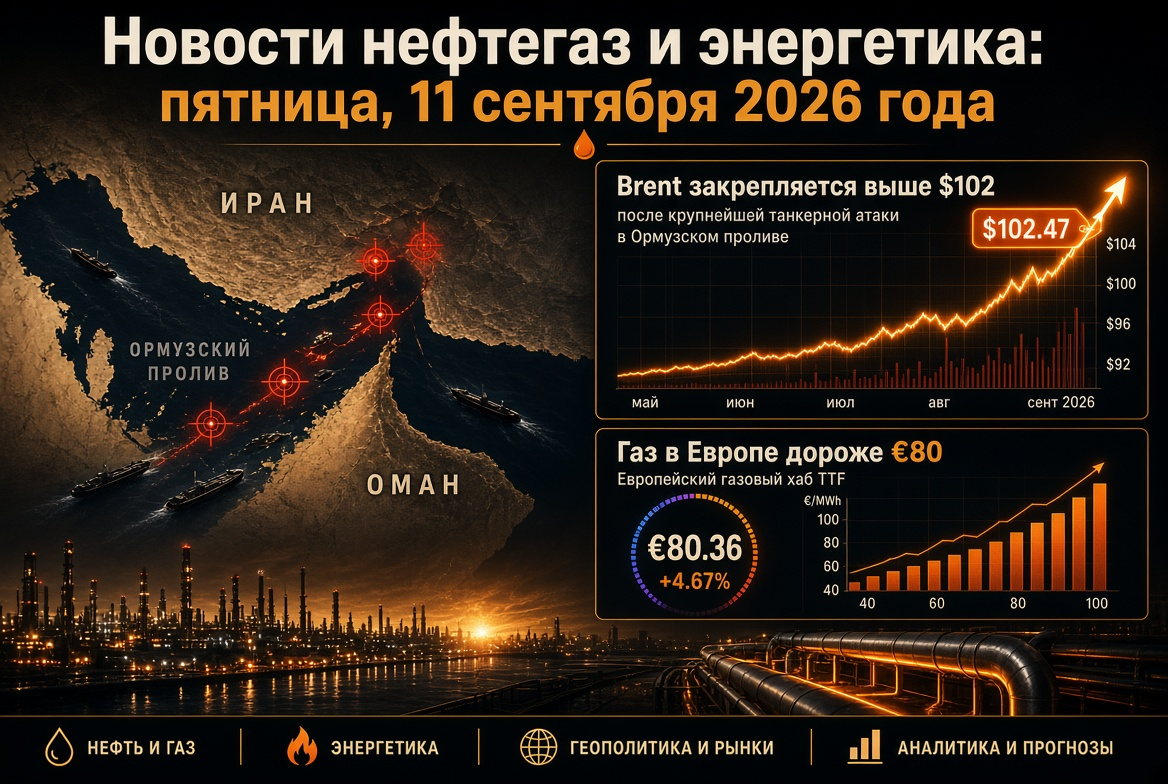
Oil and Gas News and Energy: Friday, September 11, 2026 – Brent Remains Above $102 Following Largest Tanker Attack in Strait of Hormuz, Gas in Europe Exceeds €80
The global fuel and energy sector heads into Friday, September 11, 2026, under the pressure of a full-fledged price shock. For the first time since late May, Brent oil is trading above $102 per barrel, the European gas benchmark TTF has surpassed €80 per MWh for the first time since January 2023, and underground gas storage in the EU is only two-thirds full, despite a seasonal norm of over 80%. The trigger has been the most extensive wave of attacks on shipping in the Strait of Hormuz since the start of the war, compounded by a second front in the Red Sea. For investors, oil and fuel companies, refinery operators, and participants in the gas, coal, electricity, and renewable energy markets, the key question of the day is: how much more geopolitical premium can the global economy absorb before demand for energy resources begins to crumble.
Key Theme of the Day: Tanker War in the Strait of Hormuz Escalates
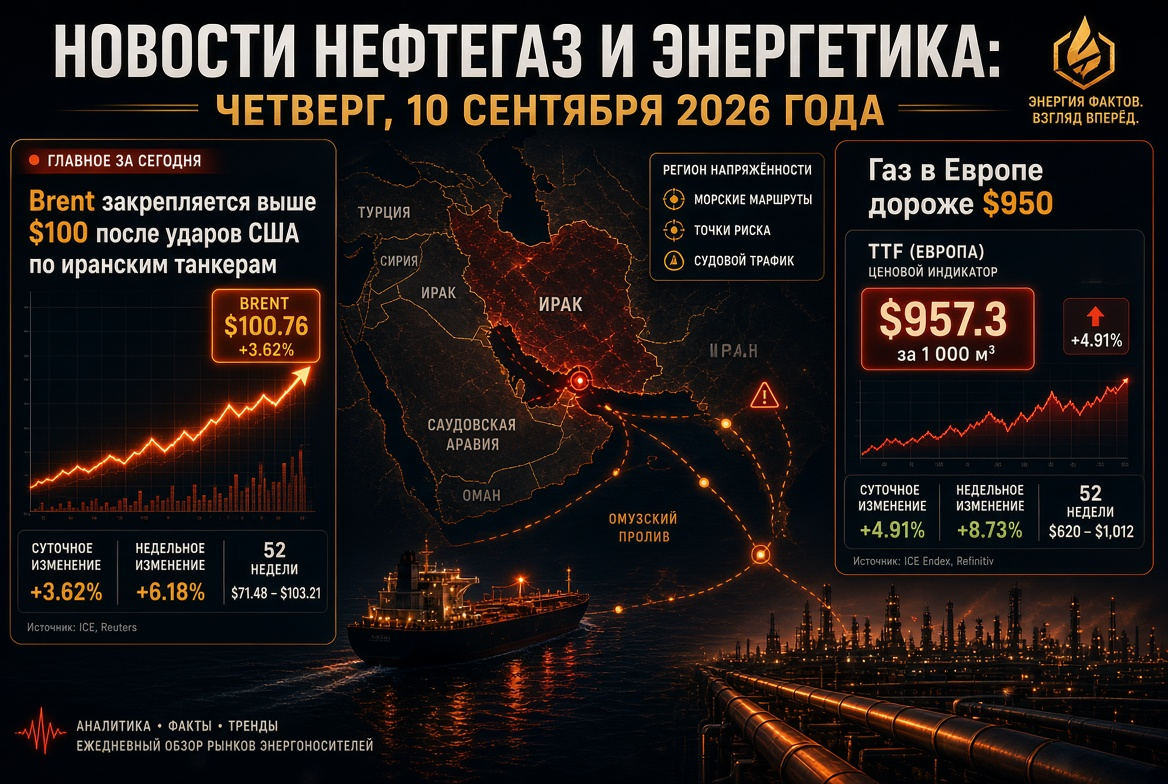
On Wednesday night, the USA sank five Iranian oil tankers in the Gulf of Oman and near Kharg Island as part of the "tanker-for-tanker" policy announced by Washington at the beginning of September. Tehran responded with attacks on ten vessels near the Strait of Hormuz and a missile strike on the U.S. base Al-Azraq in Jordan. According to maritime monitors, at least one crew member has been killed, and another is reported missing. This is the largest series of strikes on commercial shipping since February 28, when the war began.
The physical landscape for the oil and gas markets is deteriorating in three key areas:
- Expansion of the Exclusion Zone. The IRGC has declared a maritime restricted zone extending from Chabahar across the Gulf of Oman to the Arabian Sea and has urged tanker crews off the coasts of Bahrain and Kuwait to leave their vessels immediately.
- Insurance and Freight. New incidents have effectively nullified the availability of military risk coverage for vessels taking "unauthorized" routes, locking transit through the strait at minimal levels.
- Environmental Risk. Damaged and partially submerged tankers in the Persian Gulf pose a threat to desalination facilities and coastal infrastructure in Gulf states.
Oil: Brent Above $102, WTI at $96 – Market Rewrites Price Expectations
Key benchmarks for the oil market as of Friday morning:
- Brent (November contract, ICE): rose 3.4% to $101.21 on Wednesday, and on Thursday briefly reached $102.4–102.9 – a maximum since May 22. The yearly peak of $126.41 (April 30) remains a target for the "bearish" scenario over Hormuz.
- WTI (October contract, NYMEX): stabilized in the $96–97 per barrel range.
- Forecasts: The September review by the U.S. Department of Energy projected an average price for Brent around $90 for the second half of 2026, dropping to $74 in 2027 – figures that seem outdated just two days after publication at current quotes. Long-term models from several Asian banks indicate prices of $113–114 in 12 months.
Stocks and Physical Balance
Global oil stocks, according to estimates from the U.S. regulator, have decreased by about 400 million barrels since the beginning of the year, and recovery of production in the Middle East to pre-war levels has been pushed back to the second quarter of 2027. The strategic reserve in the U.S. stands at about 286.6 million barrels, the lowest level since the early 1980s. Commercial oil stocks in the U.S. before the delayed weekly report originally scheduled for Thursday were at 424.5 million barrels with refineries operating at 98% capacity; distillate stocks are 14% below the five-year average, and are expected to drop below 100 million barrels by September.
OPEC+ and Monthly Reports
Seven OPEC+ countries decided at the meeting on September 6 to keep October quotas unchanged after six consecutive months of production increases; the next meeting is scheduled for October 4. The monthly OPEC report set to be released on Thursday will frame demand after the August downgrade in the forecast for consumption growth in 2026 to 0.58 million barrels per day. The International Energy Agency anticipates a decline in global demand of 1.6 million barrels per day amid a shortfall of 1.8 million barrels per day in the third quarter, while production in the Gulf remains halted at 8.3 million barrels per day.
Red Sea: Houthi Strikes on Jazan Refinery Open a Second Front for Oil Exports
While the market focused on Hormuz, Yemeni Houthis carried out a series of drone and missile strikes on the Saudi Aramco oil refinery complex in Jazan, with a capacity of 400,000 barrels per day, and on tank farms in Jazan and Abha on September 7–8. The plant has been shut down, and the coalition led by Riyadh has promised to "respond to the sources of threat". Simultaneously, the Houthis are fighting near the port of Mocha, advancing towards the Bab-el-Mandeb coastline.
The significance of this front for global energy cannot be overstated: following the closure of Hormuz, Saudi Arabia redirected exports through the East-West pipeline to the Yanbu terminal, which accounted for over 90% of the kingdom's maritime supplies in June. The embargo declared by the Houthis has led to a redirection of Asian shipments via Suez, extending the voyage by approximately 30 days and increasing freight costs. The threat to Yanbu represents a risk to the last major bypass for Middle Eastern oil.
European Gas Market: TTF Exceeds €80, Storage at 67% – Worst Winter Start in 15 Years
The front-month TTF futures traded at €80.3–80.8 per MWh (around $985 per thousand cubic meters) on Thursday, surpassing €80 for the first time since winter 2023. Since the onset of the conflict, prices have risen by about 150%, and more than 120% since the start of the year. The British NBP approached 200 pence per therm. Key growth drivers include:
- attacks on tankers in the Persian Gulf and ongoing stoppage of LNG exports from Qatar;
- expansion of the JKM–TTF spread, pulling spot shipments to Asia;
- record-low inventories: as of September 9, EU gas storage facilities were filled to 67.33% (71.87 billion cubic meters) compared to a five-year average of around 84%.
Country-specific variations remain critical: Germany – approximately 53%, Austria – 67%, France – 71%, Italy – 83%. European operators are injecting gas at record rates, but at the highest prices seen in four years. In contrast, on the American market, Henry Hub has dipped below $2.8 per million BTU – transatlantic arbitrage opportunities for U.S. LNG exporters have reached historic levels.
LNG and Coal: Atlantic and Coal Generation Close Qatar’s Gap
Damage to the Ras Laffan complex has sidelined about 17% of Qatar's export capacity; full recovery is estimated to take up to five years with a loss of around $20 billion in annual revenue. Approximately 15 loaded LNG tankers remain idled outside Hormuz, with two more loading at port – the market perceives the return of empty vessels home as a potential preparation for resuming shipments, but without transit through the strait, this remains a signal, not a delivery.
For the coal sector, the LNG crisis signifies an unanticipated window of demand. The switch from gas to coal in Europe and Asia is estimated to be between 40–60 million tons; coal power generation in South Korea has increased by nearly 40%, while in Japan it has risen by more than 11%. Newcastle prices are holding around $130 per ton, supported by disruptions in Indonesian supplies, and global demand for coal in 2026 may rise by about 3% – up to 9.1 billion tons.
Oil Products and Refineries: Refining Margins Increase, Russia Manually Controls Domestic Market
The global market for middle distillates remains the tightest segment: shortages of diesel and jet fuel in Asia and Europe are keeping crack spreads at multi-year highs, while autumn scheduled maintenance at U.S. refineries is temporarily reducing supply. The shutdown of Jazan removes over 200,000 barrels per day of export volumes of diesel and naphtha from the market.
In Russia, the domestic market for oil products is operating in manual mode:
- The full ban on gasoline exports has been extended until January 31, 2027, with the exchange sale norm reduced to 10% (of which 8% are targeted sales), effectively leaving about 2% of production to the free market;
- Exchange indices are paradoxically declining despite shortages: the average price for Ai-92 on the St. Petersburg International Mercantile Exchange on September 8 was 69,200 rubles/ton, and Ai-95 was 71,800 rubles/ton with a trading volume of 11,600 tons per session – three times below normal;
- The reason is delays in shipment under exchange contracts for months due to refinery outages following drone attacks; the price gap between bases reaches 25,000 rubles/ton;
- The deficit is being offset by sea imports of gasoline from India of up to 400,000 tons per month.
Power and Renewables: Energy Transition as the Only Predictable Trend
Amid raw material chaos, a structural shift in the electricity sector is accelerating. Global electricity demand is expected to rise by 3.6% in 2026, driven by data centers, electric transportation, and air conditioning, while renewables are set to surpass coal in global production for the first time. Solar generation is set to add around 600 TWh, claiming the second spot after hydropower. However, short-term vulnerabilities remain: in Europe, the share of wind power fell below 15% of demand at the beginning of the week, which was directly transmitted into rising gas and electricity prices. Each euro increase in TTF enhances the economics for storage, network investments, and long-term contracts for green electricity.
Calendar: What to Watch for Energy Market Participants on Friday
- The market's reaction to OPEC's monthly report and the delayed weekly statistics from the U.S. Department of Energy regarding oil, gasoline, and distillate stocks.
- U.S. inflation data for August: commodity shocks raise the likelihood of tightening rhetoric from the Fed, which restrains speculative demand for oil.
- Statements from the coalition regarding Yemen and any signals regarding the state of the Yanbu terminal.
- Injection dynamics into European gas storage and the JKM–TTF spread as an indicator of competition for spot LNG.
- Weekly results on the St. Petersburg International Mercantile Exchange and decisions by Russian regulators concerning exchange regulations and fuel imports.
Conclusions and Risks for Investors and Energy Sector Companies
- Oil. The $100 level has flipped from resistance to support; the range of scenarios for the quarter varies from $85 in case of de-escalation to $120 in the event of renewed attacks on vessels and infrastructure in the Red Sea.
- Gas. Europe enters the heating season with historically low stock levels; in the event of a cold winter, TTF prices above €90–100 per MWh become a base scenario instead of a stress scenario.
- Coal. Northeast Asia and part of Europe will maintain elevated coal consumption until Qatar's LNG is restored – at least until spring 2027.
- Oil Products and Refineries. Crack spreads support refiners in non-conflict zones; in Russia, profits are being redistributed from independent gas stations to vertically integrated companies.
- Renewables and Electricity. The long-term flow of capital into solar and wind generation, storage, and networks remains the only resilient investment idea amid geopolitical volatility.
The day's outcome for the global oil, gas, and energy sectors: Both maritime chokepoints – Hormuz and Bab-el-Mandeb – are currently under fire, and their state, rather than OPEC+ quotas or macro statistics, will determine prices for oil, gas, and electricity in the coming weeks. For energy market participants, scenario planning, logistics supply diversification, and hedging discipline are critically important.