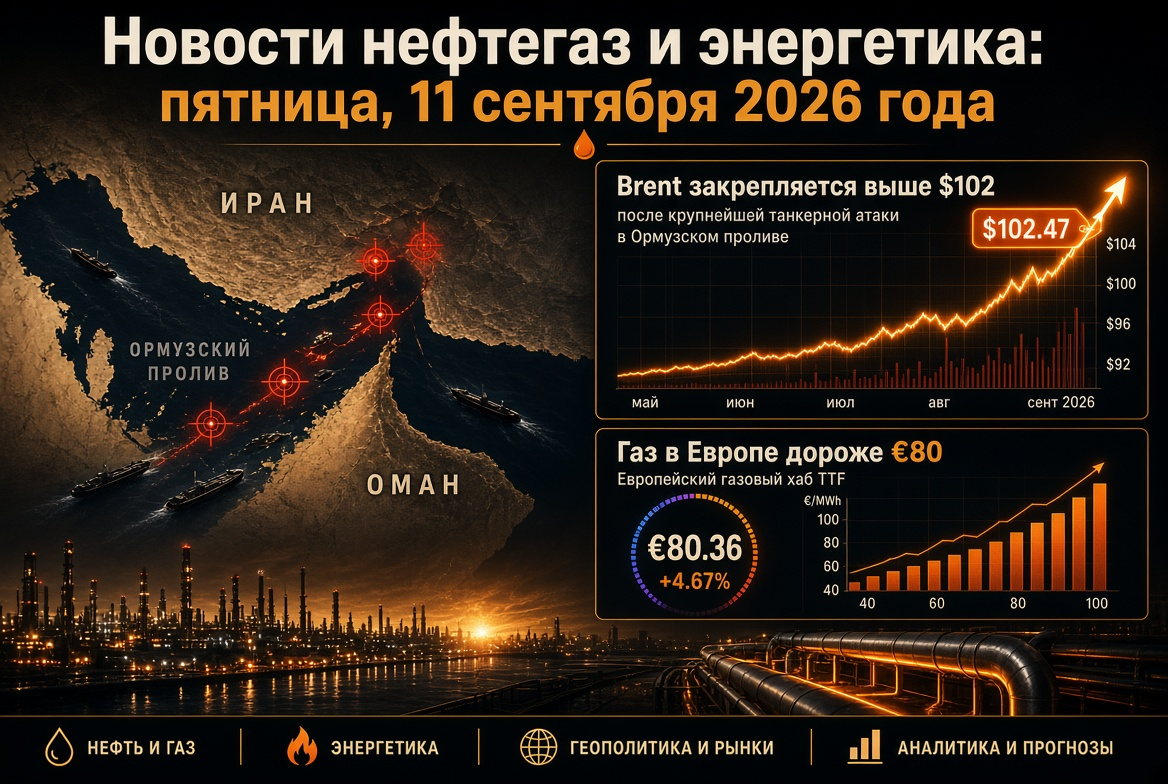
Overview of the Oil, Gas, and Energy Market as of Saturday, November 15, 2025: Stable Oil Prices, Sanction Pressure on the Russian Fuel and Energy Sector, Europe's Confidence in Gas Reserves, and Preparations for COP30.
Key Highlights
- Oil: Global oil prices have stabilized following a recent decline and end the week at local minima amid signs of overproduction and expectations regarding OPEC+ decisions.
- Gas and Winter: Europe enters winter with high gas storage levels (~85%) and expresses readiness to endure the heating season without shortages, although the energy market remains dependent on weather and LNG imports.
- Sanctions: Intensified sanction pressure on the Russian oil and gas sector (including sanctions against "Lukoil" and "Rosneft") forces market participants to restructure supply chains; Russian companies offer discounts and utilize shadow tanker fleets to maintain exports.
- USA and Canada: North American oil production remains at record levels (~13 million barrels per day in the USA), oil and LNG exports are rising, and major infrastructure projects (pipelines, terminals) are resuming with government support.
- Asia: China experiences a slowdown in energy demand growth and planned maintenance of major refineries, while India continues to ramp up imports of cheap oil, remaining one of the drivers of global demand.
- New Projects: New promising projects are emerging on raw material markets – from oil and gas field developments in South America to nuclear power plant construction plans – indicating ongoing investments in energy even amid climate agendas.
Oil Market: Price Stability Amid Expectations and Surplus
Prices. After a noticeable decline earlier in the week, global oil prices show relative stability at the end of the trading week. Benchmark Brent holds around $62–63 per barrel, while American WTI is near $59. These levels are close to the lowest in recent months and reflect the ongoing excessive supply in the market. Investors are assessing the risks of overproduction: according to updated forecasts from OPEC, global supply may exceed demand as early as 2026, with the International Energy Agency also indicating a leading growth in production outside OPEC+. Consequently, Brent and WTI quotes are under pressure, showing slight declines over the week.
Supply and Demand Factors. The price dynamics are influenced by several factors:
- High Supply: Oil production remains historically high. OPEC+ countries have gradually increased exports after easing restrictions – in early November, the alliance permitted a symbolic increase in quotas (~+0.14 million barrels/day from December), postponing more significant steps until 2026. Simultaneously, US oil production reached record volumes (around 13 million barrels/day) thanks to the shale boom and deregulation. Additionally, some previously restricted barrels have returned to the market – for instance, exports have resumed from the Kurdistan oil region in Iraq. Collectively, this supports a surplus of oil in the market.
- Slowing Demand: Global demand for oil is growing much more slowly than in previous years. Slowing economic growth in China, high prices in recent years, and advancements in energy efficiency are curbing consumption. According to estimates from the IEA, global demand growth in 2025 is expected to be less than 1 million barrels/day (compared to over 2 million in 2023). The rapid spread of electric transport is also beginning to affect long-term gasoline demand outlooks.
- Stocks and Floating Reserves: Commercial stocks of oil and petroleum products in key regions continue to rise. In the US, crude oil stocks increased by ~1.3 million barrels last week, with similar trends observed in Europe and Asia. Additionally, significant volumes of oil are accumulating in floating storage – traders estimate that around 1 billion barrels of oil are currently on tankers, some of which are transporting hard-to-sell sanctioned oil. The accumulation of such reserves adds pressure to prices.
Market Expectations. Despite clear signs of oversupply, the price decline is being held back by several factors. Geopolitical risks and supply disruption concerns create a price floor around $60 per barrel – market participants remember the possibility of sudden events (escalation of conflicts, force majeure) that could curtail supply. Furthermore, a scheduled OPEC+ ministers' meeting is approaching, and markets are pricing in expectations that leading exporters will prevent prices from crashing below critical levels. Saudi Arabia and its partners have signaled their readiness to revise production and extend voluntary restrictions if the price decline intensifies. Thus, the consensus forecast for the coming weeks is for continued moderately low prices without sharp fluctuations unless unforeseen events occur. Under these conditions, oil companies are focused on cost reduction and hedging, planning their budgets for 2026 based on cautious price expectations.
Sanction Pressure: Restructuring Russia's Export Flows
New Western sanctions targeting the Russian fuel and energy sector are entering a critical phase. In October, the US included major Russian oil companies "Lukoil" and "Rosneft" in its sanctions lists, requiring counterparties to terminate all operations with them by November 21. This deadline is approaching, and Russian market participants are frantically adapting to the new conditions. According to sources, "Lukoil" has appealed to the US Treasury for an extension, justifying the need for more time to close contracts and sell overseas assets. Until a decision is announced, the company's transactions abroad remain in limbo – including operational activities at refineries and trading subsidiaries overseas. For instance, "Lukoil" previously attempted to sell several international assets to trader Gunvor, but in November, US authorities blocked that deal.
Adapting Exports. The Russian oil and gas sector is seeking alternative ways to market its crude under sanction pressure. Traditional buyers are restructuring supply chains: the largest Indian state company, Indian Oil, stipulated in a new tender for oil that suppliers and shipping ports must not be sanctioned by the US, EU, or UK. This means that Indian refineries are willing to continue purchasing Russian oil, but through intermediaries from third countries, avoiding direct dealings with sanctioned structures. Another Indian company, Nayara Energy (partly owned by "Rosneft"), stated that it would maintain significant import volumes from Russia despite external pressure. Simultaneously, direct purchases of Russian oil by leading players in China have noticeably decreased: fearing secondary sanctions, several state and independent refiners in China have curtailed imports from the RF. Reports indicate that Russian oil deliveries to China have fallen to half of previous volumes – particularly after one of the Chinese refineries was sanctioned by the EU and UK for cooperating with the RF. This led to price reductions for East Siberian grades (ESPO, "Sokol"), and Russian exporters had to redirect these volumes to other countries at larger discounts.
Alternative Logistics. To maintain exports, Moscow is increasingly employing shadow mechanisms. Oil sales are conducted through lesser-known traders registered in friendly jurisdictions, with shipments carried out by an "invisible fleet" of old tankers that have officially changed ownership. These vessels turn off transponders and transfer oil at sea, concealing its origin. While this scheme carries higher costs and risks (both environmental and insurance), it allows Russian oil to find its way into Asian and African markets outside official channels. Analysts note that the share of Russian exports vulnerable to "gray" schemes rose to record levels in 2025. Concurrently, Russia continues to develop trade in national currencies and barter deals with several countries to circumvent financial restrictions.
Domestic Market. The strict measures by the Russian government to stabilize the domestic fuel market, adopted earlier in the fall, continue to be in effect. Export restrictions on gasoline and diesel imposed in September have been extended until the end of the year, which, combined with dampening payments to refineries, has allowed for saturated domestic markets with petroleum products.Wholesale fuel prices in Russia have retreated from peak levels in August, while retail prices have ceased to rise. Thus, despite external pressure, the Russian oil industry is currently managing to avoid sharp disruptions: the domestic market is protected by manual regulation, and export flows have been redirected as part of the "Eastern turn." However, experts warn that further tightening of sanctions or new physical threats (such as drone attacks on infrastructure) could deliver a more significant blow to export revenues and production in the future.
USA and Canada: Record Production and Infrastructure Renaissance
The North American energy sector at the end of 2025 is showing sustainable growth, setting the tone for the global market. In the United States, oil production remains at record levels – around 13 million barrels per day, just like in the best pre-crisis periods. American producers, seizing favorable prices from the previous year, have increased drilling activity, especially in Texas and New Mexico's shale fields. Although growth rates slowed in 2025, the US firmly retains its status as the largest oil producer.
Export Growth. Thanks to high production levels, the US has also increased its oil and gas exports. American oil shipments abroad consistently exceed 4 million barrels per day, heading to Europe, Asia, and Latin America. The US has effectively become one of the key global exporters, providing allies with resources amid sanctions against other producers. At the same time, liquefied natural gas (LNG) exports from the US are breaking records: in 2025, several new LNG terminals on the Gulf Coast are expected to come online, boosting total capacity to ~150 billion m3 per year. This strengthens the US position as a leading supplier of natural gas in the global market – American LNG has helped Europe compensate for the loss of Russian pipeline gas and is competing for market shares in Asia.
Infrastructure and Policy. The US administration is stimulating the energy sector by easing regulatory barriers. In 2025, certain oil and gas provinces previously closed due to environmental restrictions are being allowed again for development. Moreover, a large-scale infrastructure project has resumed: the Keystone XL pipeline (linking Canadian tar sands with US refining) has received a green light and has resumed construction halted back in 2021. This decision, backed by the administration, aims to increase the reliability of heavy oil supply from Canada and create jobs. Concurrently, both Canada and the US are investing in the expansion of pipelines and export terminals on the Pacific coast to expedite the delivery of energy resources to Asian markets. Canadian producers, taking advantage of demand, have ramped up production in Alberta and are planning new LNG projects on the west coast.
Balance of Interests. Despite support for traditional fuels, the energy transition continues in North America. Major oil and gas corporations are investing in carbon capture, blue hydrogen, and renewable energy projects while attempting to diversify their business models. The governments of the US and Canada declare their commitment to climate goals while emphasizing the need to strengthen energy security through domestic production. This dual approach – increasing oil and gas production now while concurrently developing clean technologies – reflects an effort to find a balance between economic requirements and climate commitments.
Asia: Demand Under Control, China Treads Carefully, India Grows
The Asian region remains a key consumer of energy resources; however, demand dynamics in the largest Asian economies are shifting somewhat. China, once a driving force behind global oil and gas consumption growth, is demonstrating a more moderate appetite for commodities in 2025. China’s economic growth has slowed, affecting oil demand – crude oil imports have stabilized at around 11 million barrels per day and are no longer breaking records as before. Additionally, active electrification of transport and energy-efficient technology development are reducing the pace of gasoline and diesel consumption growth. An indirect sign of market balance is PetroChina's decision to temporarily halt one of the largest refineries in Yunnan, which has a capacity of 13 million tonnes per year, for repairs. From November 15 to January 15, this facility will undergo scheduled upgrades, and fuel supplies to south-western China will be redirected from alternative sources. The two-month shutdown of such a large enterprise indicates sufficient reserves and backup capacities in the system to carry out upgrades without the risk of gasoline or diesel shortages in the region.
India. In contrast to China, India is maintaining a high rate of energy consumption growth in 2025. The world’s second-most populous country is increasing its oil imports, benefiting from the availability of cheaper barrels from Russia and the Middle East. According to traders, Indian oil imports hit an all-time high of over 5 million barrels per day in the fall, satisfying the rising demand for fuel in the economy. Indian refineries are actively processing a diverse array of crude types, aiming to secure discounts and benefits from changing global flows. The Indian government is simultaneously accelerating its domestic production and infrastructure development: LNG terminals are being expanded, and new pipelines are being constructed for natural gas distribution across the country. Increasing gas-based generation and renewable energy sources is also a priority for New Delhi – the country is investing in solar and wind power plants, aiming to significantly reduce dependency on coal by 2030. However, coal remains a primary fuel for India for now: in 2025, new modern coal blocks are being commissioned to meet rising electricity demand.
Other Asian Economies. In Southeast Asian countries, a similar picture emerges: energy consumption is growing with industrial development, but governments are attempting to reduce import dependencies. In Indonesia and Vietnam, programs are being implemented to develop domestic oil and gas production, and LNG terminals are being built to diversify gas supply sources. China, aside from curbing demand, is investing in strategic oil reserves and speeding up its transition to renewable sources – the share of renewable energy in China's energy system has surpassed 30%. However, coal still plays a significant role in China: following last year’s power disruptions, authorities increased domestic coal production to a record 4.6 billion tonnes per year to avoid shortages. Overall, Asia is balancing between traditional and new energy sources: on one hand, the region remains the main driver of oil and gas demand; on the other hand, it records the highest growth rates in green energy.
Europe: Confidence in Reserves but Market Dependent on Weather
The European energy market enters winter relatively prepared, although not without vulnerabilities. **Gas Sector:** Underground gas storage facilities in the EU are filled to about 85% of capacity by mid-November – this is lower than nearly 100% a year ago, but still provides a solid buffer in case of a cold winter. A mild autumn allowed EU countries to conserve fuel: gas demand in October and early November was below average levels, helping to maintain reserves. Additionally, supply diversification continues: Europe is being stably supplied with record volumes of LNG from the USA, Qatar, and Africa, nearly fully compensating for the cessation of pipeline gas imports from Russia. Wholesale gas prices in the EU remain at a moderate level of around $400-500 per thousand cubic meters, far from the peak crisis levels of 2022. The European Commission reported this week that their calculations indicate that even in a colder winter, Europe's reserves and current supplies should be sufficient to avoid acute shortages without implementing emergency conservation measures.
Electricity and Renewables. In the electricity sector, Europe is also demonstrating resilience but remains dependent on natural factors. Wind and hydropower generation faced setbacks in 2025: prolonged calm weather and summer droughts led to a ~5-7% drop in renewable energy generation in several EU countries compared to last year. This forced operators to increase the load on traditional power sources. For example, Germany offset a decline in wind generation by increasing output from gas and even coal-fired power plants (electricity generation from gas in Germany rose by ~15% year-on-year over ten months, while from coal it rose by 4%). With adequate reserve capacity and sufficient fuel supply, serious electricity supply issues have not arisen. However, the situation remains fragile: continued calm weather or gas supply disruptions could cause price spikes. European regulators are prepared with stabilizing tools – from joint gas purchasing mechanisms to a temporary price cap on the gas exchange implemented last year.
Policy and Plans. Recognizing the vulnerabilities of their energy systems, authorities in EU countries have intensified efforts to accelerate the energy transition. Investments in energy storage, cross-border electricity networks, and expanding renewable generation are being encouraged throughout. The EU recently extended its target programs to reduce gas consumption by 15% through 2026 and allocated additional funds for installing heat pumps and improving the energy efficiency of buildings. Moreover, electrification of vehicles is being prioritized, a clear move towards reducing energy dependency. Discussions are also underway to reform the electricity market to better integrate renewables and protect consumers from price volatility. In the short term, Europe hopes to navigate this winter without shocks – much will depend on weather conditions. However, in the strategic long term, Europeans are drawing lessons from the gas crisis and accelerating the shift away from dependencies: by 2030, the EU plans to build dozens of gigawatts of new renewable energy capacities, enhance LNG infrastructure, and, despite controversies, maintain some nuclear generation to ensure the stability of the energy system.
New Players: Guyana at a Crossroads and Other Projects
New production growth hotspots continue to emerge on the global oil map – particularly in developing countries. One of the most prominent examples is Guyana in South America, where some of the world's richest oil fields have been discovered in recent years. By 2025, production in Guyana exceeds 0.6 million barrels per day, and the country has become an important oil exporter in the Western Hemisphere. Projects led by an international consortium (ExxonMobil, Hess, and CNOOC) sequentially commission floating production platforms in the giant offshore Stabroek block. However, the Guyanese oil boom is now facing a political factor: general elections are expected in December, and the outcome may impact the terms under which investors operate.
Political Risks. Opposition forces in Guyana are declaring intentions to revise agreements with oil companies, arguing that the government's share in profits is inadequate. Calls to increase the tax burden on the oil sector and secure a more significant benefit for the country from oil exports are being heard. These statements raise concerns among investors: while current contracts are protected, uncertainty may affect the timing of new investment decisions. Analysts note that the influx of oil revenues has substantially accelerated Guyana's economic growth (GDP has increased by several tens of percent), but it has also highlighted issues of inequality and revenue management. The current and future governments face the challenge of ensuring transparent distribution of oil revenues and balancing the interests of investors and the population.
Other Projects. Aside from Guyana, other significant projects are developing on the global energy horizon. In neighboring Suriname, a consortium led by Petronas is preparing to develop the recently discovered offshore gas field Sloanea – a floating LNG plant is planned to be installed, with gas exports expected to start by the early 2030s. In Namibia, promising oil deposits have been found off the coast, and major companies are assessing the region's commercial potential, which could become Africa's "new Guyana." The Middle East is also not lagging: Saudi Arabia is actively advancing a megaproject for gas field development at Jafurah with the goal of becoming a leader in blue hydrogen and ammonia exports by the end of the decade. These initiatives demonstrate that despite the global shift towards reducing hydrocarbons, investments in oil and gas extraction continue – they are merely shifting to new regions while accompanied by demands for cleaner and more efficient technologies.
Climate Agenda: Expectations Ahead of COP30
In late November, global attention will turn to COP30 – the annual United Nations Climate Conference, which will take place in Belém, Brazil this year. Hundreds of countries will once again discuss ways to limit global warming, and the energy sector will be at the center of discussions. The main question is how to balance energy security with the need to reduce emissions. Developed countries and international organizations are urging speedier movement away from coal and a gradual reduction in oil and gas consumption over the coming decades. More than 100 countries have already signed declarations for a gradual phase-out of coal generation by the 2040s. The European Union is contemplating benchmarks for gradually reducing oil use. However, major hydrocarbon producers are approaching such initiatives cautiously. OPEC insists that oil and gas will remain an important part of the energy balance for many years to come and that investments in extraction must continue, or the world faces another price shock by the end of the decade.
A Rift of Positions. Intense debates are expected at COP30 between the block of countries calling for more decisive decarbonization actions and those dependent on oil, gas, and coal exports. The former group includes many island states, European governments, and the scientific community – they point to the increasing climate disasters and the urgent need to reduce CO2 emissions. The latter group, alongside OPEC member states, includes some developing nations arguing that they need time and funding to transition to clean energy. It is already clear that reaching a complete consensus will be challenging. However, several initiatives are likely to gain traction: including the establishment of mechanisms for global carbon quota trading and the increase of funding for green energy in poorer countries.
Impact on Business. For investors and energy companies, the climate agenda signifies the reinforcement of long-term trends. G7 countries and the EU plan to impose stricter standards for carbon footprints of products – for example, emissions accounting during the extraction and transportation of oil may soon affect market access. Banks and funds are gradually reducing financing for new coal projects and becoming more cautious in evaluating oil and gas assets with long payback periods. At the same time, the impending demand for metals and technologies for renewable energy and energy storage presents new investment opportunities. Statements about additional contributions to the development of hydrogen infrastructure, nuclear energy (as a non-carbon-based generation foundation), and large-scale CO2 storage are expected at COP30. Thus, the global energy sector stands on the brink of major changes: while oil, gas, and coal remain the foundation of the world energy system for now, the political course is increasingly shifting towards sustainable development. The outcomes of the climate summit in Brazil will provide guidance on how quickly governments intend to move towards reducing fossil fuel usage over the next decade.