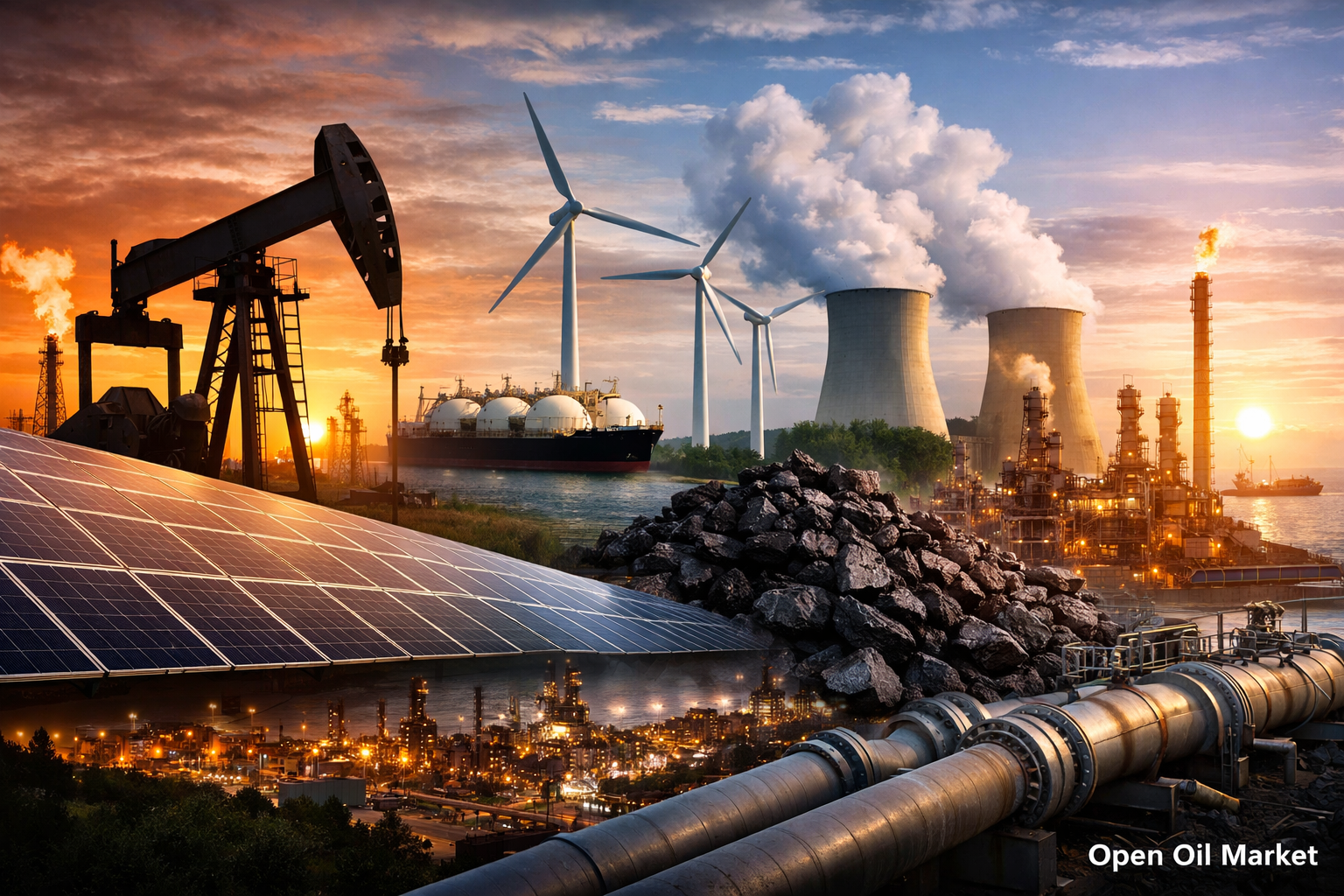
Current News in Oil, Gas, and Energy for Friday, December 26, 2025: Global Oil and Gas Markets, OPEC+ Decisions, Renewables, Coal, Refineries, Electricity, and Key Trends in the Energy Sector for Investors and Market Participants.
Current events in the global fuel and energy complex (TЕC) as of December 26, 2025, are attracting the attention of investors and market participants with conflicting signals. On the diplomatic front, intensive negotiations continue to resolve the protracted conflict in Eastern Europe, but specific results are still lacking. The USA and European partners have offered Kyiv unprecedented security guarantees in exchange for a ceasefire, instilling cautious optimism about the possibility of a peaceful agreement. However, no formal agreements have been reached, and the strict sanctions regime against the Russian energy sector remains fully in place.
The global oil market remains under pressure from oversupply and weakened demand. Benchmark Brent prices hover around $62 per barrel—close to the lowest level since 2021—indicating a burgeoning surplus of crude. The European gas market demonstrates resilience: even at the peak of winter consumption, underground gas storage in the EU is approximately two-thirds full, effectively eliminating the risk of shortages. Steady deliveries of liquefied natural gas (LNG) and alternative pipeline supplies keep wholesale prices at a moderate level, significantly below the peaks of 2022, easing the burden for consumers.
Meanwhile, the global energy transition is gaining momentum. Many countries are setting new records in electricity generation from renewable sources, though traditional coal and gas plants continue to play a vital role for grid reliability. Simultaneously, interest in nuclear energy is reviving in several regions as a stable low-carbon source. Global coal consumption is estimated to have peaked in 2025 and is on the brink of decline. Below is a detailed overview of key news and trends across the oil, gas, electricity, and commodities sectors as of this date.
OPEC+ Maintains Production to Stabilize the Market
- At its December meeting, alliance members decided to keep current oil output quotas for the first quarter of 2026 to prevent possible oversupply in the market.
- OPEC+ countries have already brought back around 2.9 million barrels per day to the market from previously reduced volumes; however, an overall cut of about 3.2 million bpd remains in effect and has been extended until the end of 2026.
- The meeting took place amid new efforts by the USA to reach a peace agreement between Russia and Ukraine. OPEC+ is mindful that the success of negotiations and potential easing of sanctions could release additional volumes of oil to the market, while failure would heighten sanction pressure and restrict exports from Russia.
Oil Prices Remain Stable
Global oil prices are approaching the end of the year without sharp fluctuations, settling in an average range. Brent is holding around $62–63 per barrel, while WTI is around $58–59, reflecting a balance between sustained demand and adequate supply in the oil market.
- At the beginning of the week, oil prices rose by approximately 2% on the back of strong macroeconomic data from the USA: GDP growth in Q3 exceeded forecasts, strengthening expectations for sustained demand for energy resources.
- As the holiday season approached, trading activity on exchanges decreased, further limiting volatility and contributing to relative price stability by year-end.
Natural Gas: Comfortable Reserves and Moderate Prices
The natural gas market is entering winter relatively quietly. Even the cold weather in December did not trigger panic in Europe: EU gas storage remains filled to over 65% of total capacity, substantially higher than historical averages for the end of the year. This level of reserves virtually guarantees the absence of gas shortages this winter.
- Wholesale gas prices are being kept at moderate levels. Futures at the TTF hub are trading around €27 per MWh (approximately $320 per thousand cubic meters)—the lowest in nearly 18 months, which is significantly below the price peaks of 2022.
- Active LNG imports continue to fill European storage; total LNG imports into Europe by the end of 2025 are expected to approach record levels. High volumes of supply are curbing price rises even amid increased demand during the cold period.
- Looking ahead, potential price risks could stem from competition for LNG from Asia if economic growth in Asia-Pacific countries accelerates, resulting in rising Asian demand. However, for the moment, the balance in the gas market remains favorable for consumers.
Geopolitics and Sanctions: Impact on Fuel Supplies
Political conflicts and sanctions continue to significantly impact global energy markets, creating both threats of disruptions and hopes for improvement. In recent weeks, market attention has been focused on diplomatic efforts to resolve the crisis: negotiations involving the USA, EU, Ukraine, and Russia (including meetings in Berlin and Anchorage) have shown a willingness to find a compromise.
So far, no breakthrough has occurred, meaning that strict sanctions against Russian oil and gas exports remain in place. Moreover, Washington has previously signaled its readiness to tighten measures in the absence of progress: discussions included potential 100% tariffs on all Chinese exports to the USA if Beijing does not reduce purchases of Russian oil. However, continued dialogue has allowed the most stringent actions to be postponed, and markets are hopeful for positive shifts in the coming weeks. Any rapprochement could improve investor sentiment and soften sanction rhetoric, while a failure in negotiations threatens a new escalation of trade restrictions. Thus, the political factor remains a key uncertain driver for oil and gas supplies in 2026.
Renewable Energy: Wind Records and Investment
The renewable energy sector continues to grow rapidly worldwide, setting new capacity records and attracting large investments—even amidst ongoing geopolitical instability. The year 2025 has been pivotal for "green" energy, demonstrating its resilience and appeal for investments.
- The UK achieved a historical peak power generation from wind on December 5, reaching 23,825 MW, accounting for more than half of the country's power consumption at that moment. This record was made possible by strong winter winds and the expansion of offshore wind farms.
- According to BloombergNEF, global investments in new renewable energy projects in the first half of 2025 reached a record $386 billion, with the bulk directed toward the development of solar and wind generation, as well as energy storage systems necessary for integrating renewables into the energy grid.
- In the USA, a federal court overturned a ban on the construction of new wind power projects on federal lands and offshore, which was imposed earlier this year. This ruling paves the way for the realization of large offshore wind farms and supports states' plans to increase the share of clean energy.
- China maintains its global leadership in renewables: the total installed capacity of renewable sources in the country has surpassed 1.88 TW (approximately 56% of the total power capacity). Extensive deployment of solar and wind installations, along with storage systems, has enabled China to maintain stable CO2 emissions despite economic growth.
Nuclear Energy: The Return of Major Capacity
After a long decline in the global nuclear industry, a revival is underway. Various countries are re-evaluating the role of nuclear generation as a stable low-carbon energy source, aiming to reduce dependency on fossil fuels and ensure the reliability of energy systems.
- Japan is preparing for the partial restart of the largest nuclear power plant, Kashiwazaki-Kariwa. The energy company TEPCO has received approvals from the Niigata prefectural authorities and plans to launch reactor No. 6, with a capacity of 1,360 MW, on January 20, 2026—this will be the first reactor brought online by the company since the 2011 disaster. Full restoration of the 8.2-gigawatt plant is planned to occur in phases over the coming years.
- The Japanese government has announced measures to support the nuclear industry to at least double the share of nuclear generation in the country's energy balance by 2030. A system of state loans and guarantees for the modernization of reactors is being introduced; currently, 14 of the 33 reactors that remained post-Fukushima have resumed operation.
- A return to nuclear energy is also being observed in other regions. In Europe, the Finnish reactor Olkiluoto-3 became fully operational in 2025, while France and the UK are investing in new nuclear plant construction. In the USA, extending the life of existing units and financing small modular reactor projects is under consideration.
Coal Sector: Peak Consumption and Gradual Decline
The global coal market reached a historical peak in 2025, after which a trend reversal is expected. According to the International Energy Agency, world coal consumption grew by about 0.5%, reaching approximately 8.85 billion tons this year. However, no significant further growth is anticipated: instead, a gradual decline in coal demand is forecasted by the end of the decade as renewables, nuclear, and natural gas increasingly displace coal in electricity generation.
- In the USA, coal burning for electricity generation increased in 2025. This was facilitated by last year's spike in gas prices and a temporary directive from the administration to extend the operation of several coal-fired power plants that were previously slated for closure.
- China remains the largest consumer of coal, accounting for approximately 60% of the country's electricity generation. In 2025, coal demand in China stabilized and is expected to gradually decline by 2030, thanks to the large-scale introduction of renewable capacities. Beijing's policy aims to achieve peak emissions by 2030, suggesting a reduced role for coal in the coming years.
Oil Products and Refining: High Margins at Year-End
By the end of 2025, the global market for oil products is demonstrating high profitability for refineries. The decline in oil prices, combined with stable demand for gasoline, diesel, and jet fuel, has led to increased refining margins in many regions. Refiners benefit from the relative cheapness of crude while still maintaining healthy levels of oil product consumption.
- Global indicative refining margins have risen to their highest levels in recent years. Notable growth in profitability is observed in the diesel segment, where demand remains strong in transport and industry.
- The construction of new refineries in Asia and the Middle East (for instance, significant complexes in China and Gulf countries) is increasing global refining capacity. However, the simultaneous closure of outdated plants in Europe and North America maintains a relative balance in the oil products market, preventing oversupply and sustaining margins.
- In Russia, authorities extended the ban on gasoline and diesel fuel exports after the summer crisis to saturate the domestic market and lower prices. These measures stabilized the situation within Russia while simultaneously reducing the supply of diesel fuel to the global market, which also contributed to maintaining high margins in Europe and Asia.
Corporate News: Deals and Strategies of Energy Companies
The end of the year is marked by significant corporate moves in the TЕC sector, reflecting companies' aspirations to optimise their asset portfolios and adapt to new market conditions. Oil and energy corporations are revising strategies, focusing on enhancing the efficiency of traditional businesses while investing in the transition to clean energy.
- BP announced the sale of 65% of its subsidiary Castrol (a lubricant manufacturer) to the American investment fund Stonepeak for $6 billion. The deal values the entire Castrol business at $10.1 billion; BP will retain 35% of the shares in the new joint venture. The funds raised will be directed towards reducing debt and distributing dividends, aligning with the strategy of improving returns in the traditional oil segment.
- Despite sanctions, foreign partners continue to show interest in Russian oil and gas projects. For example, Indian ONGC and Japanese SODECO retained their stakes in the Sakhalin-1 project, while a preliminary agreement between ExxonMobil and Rosneft regarding compensation for losses from previous years signals a readiness among major players to resume cooperation once the political situation improves.
- The integration of technology and energy continues: American tech giant Alphabet (parent company of Google) announced in December the acquisition of Intersect Power for $4.7 billion, a company engaged in renewable energy projects and power grid infrastructure (including supplying power to data centers). This move will accelerate Alphabet's development of its renewable generation capacity and reduce its data centers' reliance on overloaded electrical grids.