Startup and Venture Capital News for Monday, June 22, 2026: Mega-Rounds in AI, Growth of Sovereign AI, Cybersecurity, Robotics, and Energy Infrastructure for Data Centers
The global startup and venture capital market enters the final week of June marked by a pronounced shift towards artificial intelligence, computational infrastructure, cybersecurity, robotics, and energy solutions for data centers. For venture investors and funds, this is now not just another technological cycle, but a new structure for capital distribution: money is consolidating around companies that have the capacity to control computation, data, models, security, and the industrial application of AI.
For Monday, June 22, 2026, the main theme for the market is the acceleration of mega-rounds in AI startups while simultaneously witnessing an increase in the quality demands regarding revenue, strategic partnerships, and access to infrastructure. Investors are increasingly evaluating not only the growth rates but also the capability of the startup to protect margins, reduce inference costs, secure corporate clients, and enter global markets.
AI Remains the Primary Magnet for Venture Capital
A key trend this week is that venture capital continues to flow into AI startups, but the structure of deals is becoming more mature. While in 2023–2024 the market often financed generative models and consumer applications, by 2026, funds are increasingly focusing on infrastructure, sovereign AI, specialized models, AI agents, robotics, and cybersecurity.
For venture funds, this signals a change in investment logic. Startups that possess one or more of the following advantages are moving to the forefront:
- Access to computational power and specialized chips;
- Proprietary models or unique data;
- Contracts with corporate clients, governments, or industrial groups;
- Clear economics of deploying AI in real business processes;
- Protection against competition from major tech platforms.
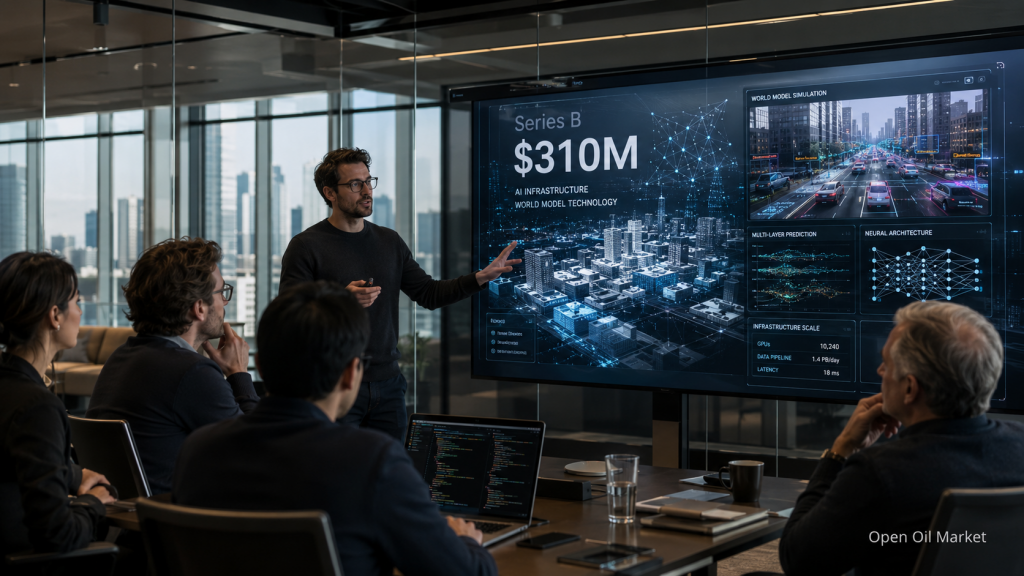
Odyssey Raises $310 Million: A Bet on World Models and Real-World Simulation
One of the most notable events was the deal for AI laboratory Odyssey, which raised $310 million in a Series B round at a valuation of $1.45 billion. The round was led by Natural Capital, with participants including Amazon, AMD Ventures, Google Ventures, EQT, and In-Q-Tel. This signals an important message for the venture investment market: investors are increasingly funding not only language models but also world models—systems that can simulate the physical world, object interactions, and complex scenarios.
The deal is of interest to funds for three reasons. First, it demonstrates demand for AI beyond classic chatbots. Second, the involvement of strategic investors confirms that major tech companies wish to control future simulation infrastructure. Third, Odyssey's partnership with AWS underscores the importance of access to cloud capabilities and specialized chips.
Potential markets for such startups include autonomous transportation, robotics, industrial design, defense scenarios, training AI agents, and virtual environments for testing complex systems.
Dream Secures $260 Million: Cybersecurity Becomes a Sovereign AI Direction
Israeli AI startup Dream raised $260 million at a valuation of around $3 billion. The company operates in the cybersecurity segment for governments and critical infrastructure, including energy, water supply, and other strategic assets. For venture investors, this confirms the growth of a distinct direction—sovereign AI, where clients do not merely want to use AI services, but also control data, infrastructure, and security.
Cybersecurity in 2026 is no longer a supplementary category, but one of the central focuses for venture capital. The rationale is simple: the faster companies and governments implement AI, the higher the risk of AI attacks, automated phishing, infrastructure attacks, and data manipulation.
For funds, the cyber AI sector remains attractive because it combines several investment advantages: high average deal size, long contracts, state demand, a global market, and protection against cyclical declines in consumer spending.
DeepSeek and China: A Major Signal in the Fight for Technological Sovereignty
Chinese AI startup DeepSeek reportedly closed its first large external funding round of more than $7 billion at a valuation exceeding $50 billion. The deal stands out not only due to its size but also its structure: investors gain limited influence while control remains with the founder. For the global startup market, this represents an important geopolitical indicator.
DeepSeek demonstrates that AI is becoming not only a commercial but also a strategic industry. China, the US, India, Europe, and Middle Eastern countries are increasingly forming their technological ecosystems. For venture funds, this creates both opportunities and risks:
- Rising demand for local models and national AI platforms;
- Increased role of the state as an investor and customer;
- Strengthening restrictions on chip and data exports;
- Valuations for market leaders may rise faster than traditional financial metrics;
- Liquidity for such assets increasingly depends on the regulatory environment.
Sarvam AI Becomes an Indian AI Unicorn
Indian startup Sarvam AI has raised $234 million in the first closing of its Series B round at a valuation of $1.5 billion. This round became one of the key events for the Asian venture market because Sarvam is building a full-stack sovereign AI: from training and inference infrastructure to models, corporate solutions, and government scenarios.
For investors, India remains one of the most promising regions in the global venture economy. The country combines a large domestic market, a strong engineering base, and high demand from banking, insurance, gov tech, and the defense sector. While Indian startups were previously often associated with fintech, e-commerce, and SaaS, the country is now vying for a place in the global AI infrastructure.
Particularly significant is the involvement of strategic investor HCLTech. This underscores a new trend: large IT companies no longer wish to simply purchase AI tools, but want to participate in the equity of startups that may become the underlying infrastructure for corporate digital transformation.
Baseten and Inference Infrastructure: The Market Seeks AI Economics Post-Model Training
The market is actively discussing a potential new round for Baseten—a company focused on AI infrastructure—which may reportedly raise about $1.5 billion with a valuation of up to $13 billion. Even considering that the deal still requires careful interpretation, investor interest in inference infrastructure reflects a significant shift in the venture agenda.
The next big challenge for the AI market is not only training models, but also the cost of their daily usage. Corporate clients want AI services that operate quickly, reliably, and cost-effectively. Consequently, startups that optimize inference, query routing, the use of open-source models, and GPU expenses are becoming critically important parts of the technology stack.
For venture funds, this area appears attractive because it is linked to actual AI consumption. The more companies implement AI agents, support automation, coding, analytics, and content generation, the higher the demand for infrastructure that reduces the cost of each request.
Europe Bets on Robotics: The Example of THEKER
The European startup market is also showing signs of revitalization in deep tech. Barcelona-based THEKER raised $85 million in a Series A for the development of AI-native robotics. This round is noteworthy not only for its size but also for the participation of strategic investors, including Samsung and entities related to the luxury sector.
Robotics is becoming an important focus for venture investments as it connects AI with the physical economy. Unlike purely software products, such startups are harder to scale, but upon success, they can access enormous markets: manufacturing, logistics, warehousing, retail, industrial automation, and service robotics.
For funds, Europe in 2026 is attractive as a region with fewer mega AI rounds than the US, but with strong engineering schools, industrial clients, and the opportunity to build companies at the intersection of hardware, software, and AI.
Helion and Energy for AI: Venture Capital Focuses on Data Center Power Supply
A separate venture market direction is energy startups associated with the growing electricity consumption of data centers. Helion raised $465 million at a valuation of $15.5 billion, enhancing investor interest in nuclear energy and new sources of clean electricity.
For venture funds, this represents an essential macro trend. The AI economy requires not only models and chips but also colossal amounts of energy. Thus, data center infrastructure, new generation sources, energy storage, cooling, load management, and grid tech become a part of the same investment narrative as AI startups.
Funds should consider that the more capital flows into AI, the higher the strategic value of companies addressing issues concerning electricity, heat, energy system resilience, and computation costs.
What This Means for Venture Investors and Funds
The news on startups and venture capital for June 22, 2026, indicates that the market has not returned to the broad euphoria of 2021, but certain segments are already showing signs of a new overheating phase. This is particularly evident in AI infrastructure, large models, cybersecurity, sovereign AI, and energy tech.
For venture investors, the key takeaways are as follows:
- AI remains the primary focus, but not all AI startups benefit; those with infrastructure advantages win out.
- Sovereign AI is emerging as a distinct investment theme in India, China, Israel, Europe, and the Middle East.
- Cybersecurity receives an additional boost from the rise of AI threats and geopolitical tensions.
- Robotics and industrial AI are stepping out of niche status and becoming the target of significant Series A rounds.
- Energy infrastructure is becoming part of the investment thesis surrounding artificial intelligence.
- Market leaders' valuations are rising rapidly, so funds need to assess not only the technology but also revenue quality, unit economics, and round terms.
The main investment conclusion for the global audience is that the venture market is once again active, but capital has become more selective. Funds are willing to pay a premium for startups that control the critical infrastructure of the future AI economy. However, for late-stage funding, the risks of inflated valuations, complex deal structures, and dependence on strategic partners are increasing. Therefore, in the coming months, a key question for investors will not just be who secured the largest round, but who can convert technological advantages into sustainable revenue, margins, and liquidity.