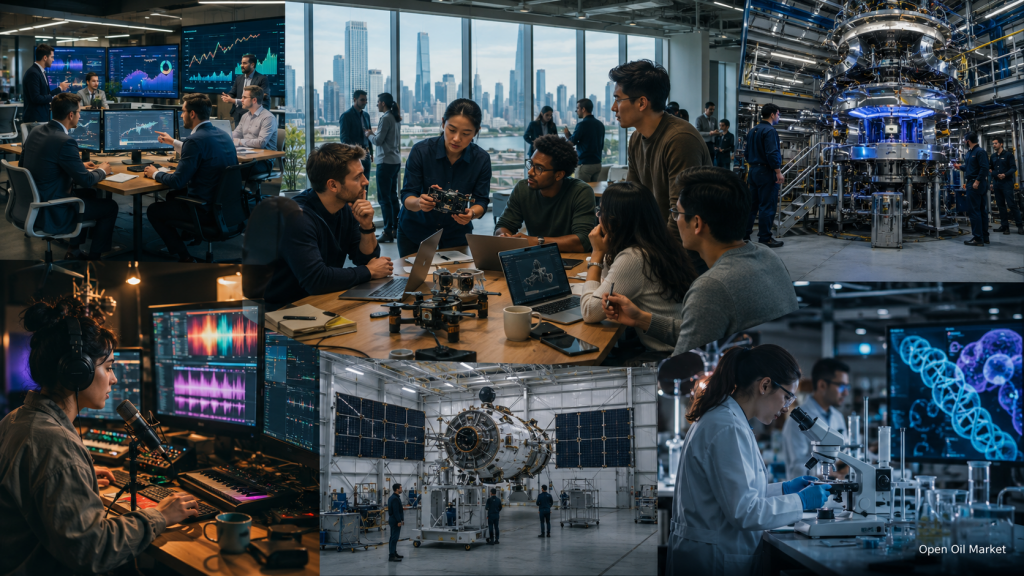
Latest Startup and Venture Capital News for 5 June 2026: Fintech, Artificial Intelligence, Fusion Energy, Space, Biotech and the New Concentration of Capital
The global venture capital market enters June 2026 in a state of high capital concentration. Money is once again flowing actively into technology startups, but it is being deployed with increasing selectivity. The main focus of venture capital funds is on AI startups, fintech platforms, deep tech, space technology, biotech, energy projects and artificial intelligence infrastructure.
For venture investors and funds, the key signal of the week lies not just in the size of new funding rounds, but in the quality of the companies receiving financing. Capital is shifting towards businesses with strong revenue, clear unit economics, scalable technology and the potential for a public market listing. Startup and venture capital news for Friday, 5 June 2026 shows that the market is willing to pay high valuations, but only for category leaders.
Global Venture Capital Market: Capital Exists, But It Has Become More Demanding
After a record first quarter of 2026, venture capital investment remains at elevated levels. According to industry surveys, global startup financing in the first quarter reached roughly USD 300 billion, with the majority of capital going into artificial intelligence, computing infrastructure and large late-stage deals.
For the market, this signals a shift from recovery to a new phase of competition. Venture capital funds are no longer funding growth at any cost. Priority is given to startups that can demonstrate:
- rapid revenue growth and customer retention;
- genuine market demand, not just technological novelty;
- sustainable unit economics;
- the ability to scale internationally;
- the prospect of an IPO, strategic sale or a large secondary round.
Against this backdrop, startup news increasingly resembles not an early venture cycle, but a race for the infrastructure assets of the future economy.
Ramp Raises USD 750 Million: Fintech Back in the Spotlight
One of the largest events of the week was a new round by Ramp. The fintech company raised USD 750 million at a valuation of around USD 44 billion. For the market, this is an important signal: investors are once again willing to commit large sums to fintech startups if they have a substantial client base, high automation and embedded AI tools.
Ramp is developing in the segment of corporate expense management, payments, financial operations and accounting automation. The interest from funds is explained by the fact that the new generation of fintech is becoming not just a service for cards and payments, but an operating system for corporate finance.
For the venture market, the Ramp deal is important for three reasons:
- it confirms demand for mature private tech companies;
- it shows that AI functionality is becoming part of fintech infrastructure;
- it sets a benchmark for valuations of other B2B SaaS and fintech platforms.
Funds will be closely watching whether Ramp can sustain its growth rate and prepare for a future IPO without a sharp decline in multiples.
Helion and Energy Deep Tech: Fusion Startup Valued at USD 15.5 Billion
Another major event is Helion’s round. The fusion energy startup raised USD 465 million in a Series G round, with its valuation rising to approximately USD 15.5 billion. This underscores the strengthening interest of investors in energy deep tech, where payback horizons are longer but the potential market is enormous.
Helion is working on commercialising fusion energy. For venture funds, such deals are particularly telling: capital is beginning to flow more actively not only into software, but also into physical infrastructure – energy, manufacturing, materials, space and industrial automation.
This trend is important for global investors because the AI economy requires ever more electricity. The growth of data centres, computing clusters and generative models is intensifying demand for new energy sources. Hence, energy startups are becoming a part of the venture agenda alongside AI companies.
Suno and AI Content: The Generative Economy Expands Beyond Text
AI startup Suno, which operates in the music generation space, raised more than USD 400 million at a valuation of around USD 5.4 billion. The deal shows that venture capital continues to search for new categories within generative artificial intelligence.
If the first wave of AI investment was concentrated around text models, corporate assistants and developer tools, investors are now more actively looking at creative verticals: music, video, design, advertising, gaming and user-generated content.
For funds, this presents both significant potential and elevated risk. On one hand, AI content could radically reduce the cost of media production. On the other hand, the market faces questions of copyright, data licensing, regulation and the sustainability of business models. As a result, valuations of such startups will increasingly depend on the legal cleanliness of the technology and the ability to monetise the audience.
Space Technology: Impulse Space Raises USD 500 Million
The space sector also remains in the focus of venture investors. Impulse Space raised USD 500 million at a valuation of around USD 4.26 billion. The company is involved in transporting satellites and payloads between orbits – in other words, it operates in the space logistics segment.
Interest in this direction is linked to the growth of satellite constellations, military and commercial space projects, and the development of communication, observation and navigation infrastructure. After the reduction in launch costs, the next bottleneck is managing objects once they are in orbit.
For venture funds, space is gradually transforming from a niche topic into a full-fledged infrastructure market. Startups that solve applied problems – orbital delivery, satellite servicing, space communications, data analytics and components for defence systems – appear most promising.
Biotech and Longevity: NewLimit Strengthens Interest in Longevity Medicine
Biotech startup NewLimit, which works in the field of longevity medicine and cellular reprogramming, raised USD 435 million. The company’s valuation rose to approximately USD 3.1 billion. For the market, this is another example of how capital is returning to complex scientific areas after a period of caution.
Biotech differs from classic SaaS in its longer investment cycle, high regulatory burden and significant research costs. However, the potential profitability of successful companies remains extremely high. Projects at the intersection of biology, artificial intelligence, computational chemistry and personalised medicine are especially attractive.
For investors, an important criterion is not only the scientific hypothesis, but also the path to clinical trials, partnerships with pharmaceutical companies and future commercialisation.
Europe and India: Regional Markets Become More Prominent
Besides the US, activity is noticeable in Europe and India. In London, Airspeed raised EUR 17.2 million in a Series A round to develop an AI platform for sales teams. In India, quick-commerce startup FirstClub raised USD 55 million at a valuation of around USD 255 million, while TrueFan AI received USD 10 million to develop AI video.
These deals show that venture capital investment is distributed globally, although the US still maintains leadership in capital volume. Europe is betting on enterprise AI, climate technology, deep tech and industrial software. India is strengthening its positions in consumer services, fintech, AI video, voice AI and quick commerce.
For funds, this creates an opportunity for regional diversification. In developed markets, valuations are higher but liquidity is greater. In emerging markets, entry multiples are lower but operational and regulatory risks are higher.
New Funds and Strategy Shifts: Venture Investors Move into Growth-Stage
A separate trend of the week is the change in strategy of venture funds themselves. Large managers are increasingly creating funds for more mature companies. This is because startups stay private longer, require more capital and often postpone IPOs until they achieve significant scale.
For the venture ecosystem, this means intensified competition between traditional VCs, private equity, sovereign wealth funds, pension funds and strategic investors. The growth stage is becoming the arena where it is decided who will gain access to future public technology leaders before they list on the stock exchange.
Meanwhile, the early stage is not disappearing, but its logic is changing. Seed and Series A investors increasingly require from founders not only a strong idea, but also initial signs of commercial validation: paying customers, a clear sales channel and proven market need.
What Venture Investors and Funds Should Watch For
Startup and venture capital news for Friday, 5 June 2026 shows that the market is open again for large deals, but has become significantly more professional. Investors are willing to finance growth if it is backed by a technological advantage, revenue, a strong team and a clear exit strategy.
In the coming weeks, venture funds should pay attention to several factors:
- the dynamics of AI startup valuations and the risk of overheating in certain segments;
- deals in fintech, where AI is becoming part of operational infrastructure;
- the growing interest in energy deep tech driven by data centre electricity demand;
- activity in space technology and defence infrastructure;
- the IPO pipeline of large private technology companies;
- regional opportunities in Europe, India and emerging markets.
The main takeaway for investors: the venture market of 2026 remains a market of opportunities, but no longer one of mass optimism. It is a market of concentration, discipline and selection. The best startups are receiving record rounds, while weak projects face a capital deficit. That is precisely why the quality of due diligence, assessment of unit economics and understanding of global technology trends are becoming key tools for the venture investor.