Startup and venture capital news, Wednesday, 3 June 2026: AI infrastructure, defence technology, and the bet on the physical economy
Capital and AI leaders: the new price tag at the top of the market
Venture capital market overview as at 3 June 2026
The global startup and venture capital market meets mid-2026 in a state that is increasingly difficult to describe as a 'boom'. More accurately, it is a structural restructuring: capital has become more accessible, but simultaneously far more selective, concentrated, and tied to real barriers to entry. Money continues to flow into artificial intelligence, but increasingly not into yet another application, but into its foundation — computing, networks, memory, energy, data centres — and into the physical and regulated economy: defence technology, space, biotech, and industrial infrastructure.
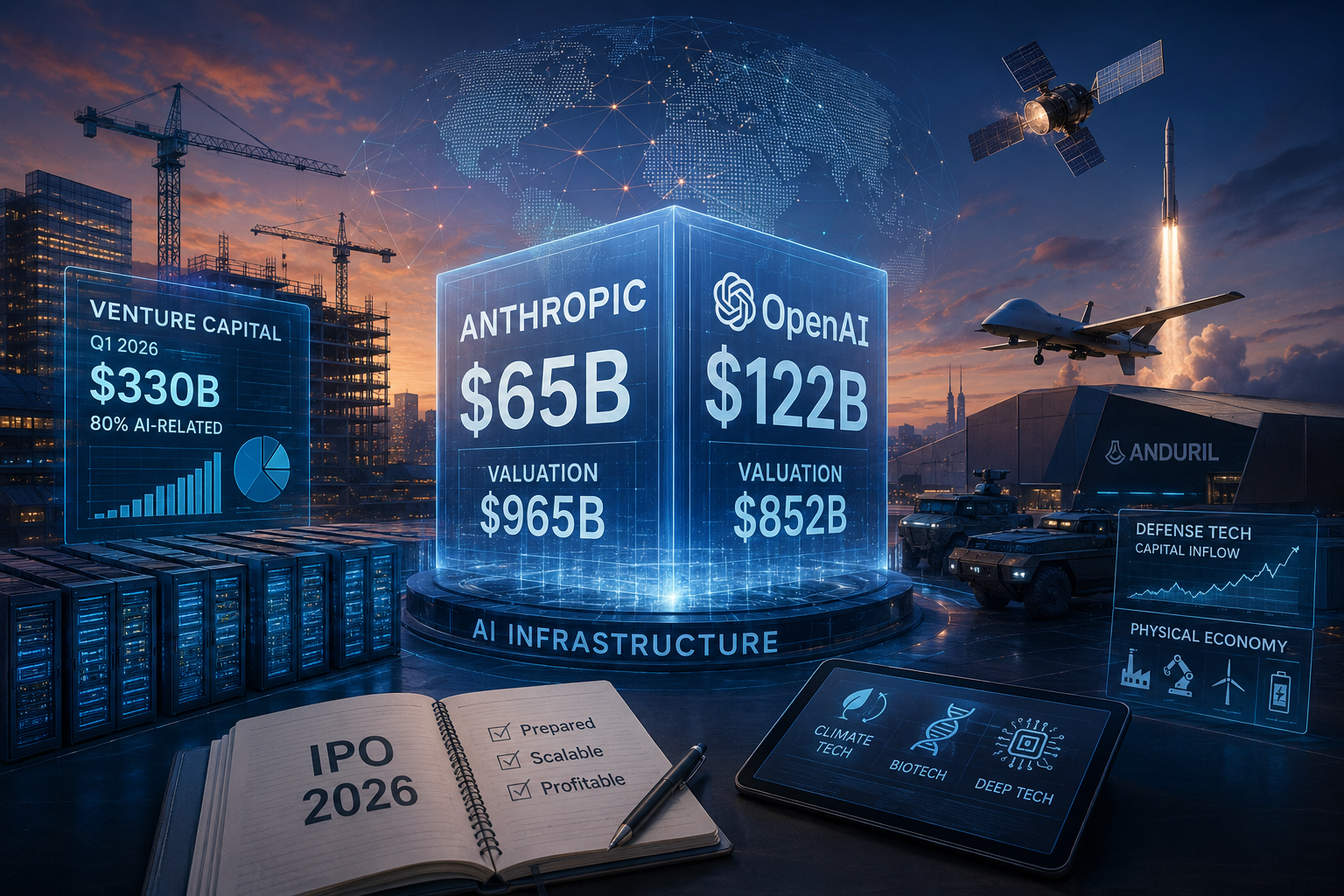
Context is set by the first quarter. According to analyst estimates, global venture funding in Q1 2026 broke records and reached approximately $330 billion, with about 80% of that sum somehow linked to artificial intelligence. Four of the five largest rounds in venture capital history occurred in that single quarter, and roughly 65% of global venture investments were concentrated in just a few companies — OpenAI, Anthropic, xAI and Waymo. In one pair of numbers, a record-generous market coexists with notably cooled activity: the total amount is growing, but the number of active investors and deals is shrinking. For founders outside the AI narrative, this changes the rules of the game; for funds, it forces a rethink of capital allocation strategies.
AI mega-rounds and the new price tag of leaders
Mega-rounds as infrastructure deals
The main storyline of recent weeks is the new scale of financing for the largest AI companies. At the end of May, Anthropic closed a Series H round of $65 billion at a post-money valuation of around $965 billion, becoming, by market estimates, the most valuable private AI company in the world and surpassing OpenAI in market capitalisation. OpenAI itself remains a benchmark in absolute figures: its largest ever private round is estimated at $122 billion at a valuation of about $852 billion, with Amazon cemented as its exclusive third-party cloud partner. These deals set a new standard for late-stage rounds: investors are no longer funding a software product, but an entire value chain — models, computing power, corporate clients, cloud partnerships, and a future public market listing.
In practical terms, a class of private companies is forming in the AI sector that rivals the scale of the largest public technology platforms. Anthropic's capitalisation already exceeds the market valuations of many companies in the upper part of the S&P 500, and its reported annualised revenue has surpassed $47 billion. This changes the logic for corporate clients and government regulators: they are forced to perceive frontier model creators not as startups, but as strategic infrastructure nodes comparable to major cloud providers and telecommunications operators. For the same reasons, mega-rounds cease to be a 'pure venture' story — in syndicates, classic VCs, sovereign wealth funds, corporate investors, and strategic clients increasingly sit side by side, for whom the deal is simultaneously a commercial contract.
Applied and agentic AI: demand for operational reality
Demand for applied and 'agentic' AI is confirmed by deals at the next level down. Anysphere, developer of the Cursor code editor, raised around $2.3 billion in Series D, nearly tripling its valuation to roughly $29 billion in just five months — against the backdrop of revenue exceeding a billion dollars on an annualised basis. Cognition, creator of the autonomous software engineer Devin, closed around a billion dollars at a valuation of about $26 billion and emphasises that Devin already writes up to 89% of the company's own production code. Essentially, the market is paying not for the promise of autonomous development, but for its operational reality, and the same shift will repeat in adjacent segments — from autonomous lawyer to autonomous design engineer.
Implication for venture capital funds
For venture funds, the implication is twofold. On one hand, valuations of leaders are growing faster than the market, opening a window for late-stage investors and potential exits via IPOs and large secondaries. On the other hand, the pace of revaluation is beginning to outpace revenue growth and test the patience of even the most disciplined LPs. One of the main questions for the second half of the year: can the multiples of frontier AI companies hold if the macroeconomic or regulatory environment turns against them for even one quarter?
Infrastructure shift and the physical economy
AI infrastructure as a new premium category
The most enduring trend of 2026 is the shift of capital 'down the stack', from consumer and even enterprise applications to the infrastructure layer. Investor logic is changing before our eyes: the market is ceasing to evaluate an 'AI startup' as an independent category and is starting to pay for specific forms of control over scarce resources. Those who reduce GPU idle time and losses, who supply training data that cannot simply be scraped from the open internet, who can finance electricity in conditions of overloaded grids — those receive the premium.
Networks, data and world models
Deals in recent days are indicative. Network startup DriveNets raised about $410 million in Series D to develop AI network infrastructure — the 'factory' of connections without which it is impossible to scale the training and inference of large models. Mecka AI closed around $60 million for collecting and preparing data for robotics training: the shortage of labelled, physically relevant datasets has long become an independent bottleneck and simultaneously a protective moat. Tripo AI disclosed funding of nearly $200 million for research in 3D and so-called 'world models' — a continuation of the trend in which the next wave of models aims not to work with text, but to simulate physical reality.
Energy and climate tech as part of the compute story
A separate and rapidly growing layer is energy as an extension of the AI boom. Maxwell Power (formerly HDM Renewable Finance) from San Diego received a $750 million investment commitment from Fairtide Partners to finance energy storage and solar generation projects, bringing the fund's total commitments to over a billion dollars. The deal is notable not for its size, but for its logic: in 2026, 'software' no longer allows investors to ignore electricity, grids, sensors and physics. The growing demand from data centres for capacity turns energy, storage, and critical minerals into part of the 'computing story', rather than a separate ESG category.
This same shift redefines climate tech. If previously climate technologies were often evaluated through the lens of sustainable development, funds now talk about modernising the physical economy — energy grids, storage, supply chains, rare earth materials, and industrial infrastructure. The launch of new thematic funds like Gigascale Capital, with a volume of around $250 million, confirms: for a climate startup, environmental impact is no longer sufficient; it must prove economic superiority. Projects that lower the cost of energy, increase supply reliability, and help corporations adapt to rising demand from AI infrastructure are winning.
Defence technology: a record year and the shift from prototypes to production
If the infrastructure trend has a 'hot' physical projection, it is defence tech. The sector is experiencing a record year: while in 2025 defence startups raised about $9.6 billion (a record at the time), in just five months of 2026 that annual record has already been surpassed, and the number of rounds has exceeded one hundred. Capital is flowing into AI systems for military purposes, autonomous aerial and maritime vehicles, command software platforms, and dual-use space infrastructure. After two decades during which a significant portion of venture capital conspicuously avoided the defence theme, in 2026 it has turned out to be one of the fastest-growing segments of global venture capital.
Anduril as the symbol of the year
The main symbol of the year is Anduril Industries. The company closed a Series H of $5 billion led by Thrive Capital and Andreessen Horowitz, doubling its valuation from $30.5 billion to $61 billion in less than a year; total funding reached $11.4 billion. Anduril reported revenue of about $2.2 billion for 2025 (growth of over 100% year-on-year) and forecasts $4.3 billion for 2026 as production ramps up at its Arsenal-1 plant in Ohio. In spring 2026, the company received a ten-year contract from the US Army worth up to $20 billion. According to management, capital will go into production capacity, R&D, and the Lattice command platform — a critical detail, because it is precisely the integration of software and hardware solutions that separates modern defence tech from classic defence contractors.
Mach Industries and the shift to production urgency
In the same trend, a fresh round for Mach Industries of $300 million in Series C at a valuation of about $1.8 billion. The manufacturer of autonomous drones explicitly names execution, not 'valuation optics', as the priority: government contracts, hiring, development, and expansion of its own Forge production network. The deep signal is simple: investors in defence tech are moving from an infatuation with prototypes to production urgency. It is no longer about demo reels and test contracts, but about series production to timelines set by real geopolitics. A similar logic is seen in the financing of companies like True Anomaly, Sierra Space, and Vast, which combine military and commercial applications in a single technology base.
First signs of liquidity
It is also important that the sector is seeing liquidity for the first time in a long while. One small defence startup, AI drone developer Swarmer, went public, and its shares rose more than 500% on the first day of trading, holding near the top of the range in early June. For venture funds, this is the first tangible hint that an exit window is starting to open in defence, meaning investors are ready to lock in profits and reinvest in the next generation of defence startups.
Space: from rockets to orbital logistics
Space technology is returning to the venture agenda, but no longer as a speculative bet; rather, as industrial and defence infrastructure. Impulse Space raised about $500 million in Series D, bringing total funding to over a billion dollars. The company is betting on 'mobility after launch' — orbital logistics, or what investors increasingly call 'space freight': three completed missions, the operational Mira vehicle, the Helios planned for 2027, and hundreds of millions of dollars in contracts support the thesis that the transport and servicing of cargo in orbit is becoming basic infrastructure for commercial, civil and defence demand.
Space companies with defence applications have generally been among the notable recipients of capital: True Anomaly, Sierra Space and Vast are among the largest recipients of defence funding this year. At the same time, the space market itself is ceasing to be exclusively a US-China story. Startups from South Korea, Japan, India and Australia are increasingly vying for places in the new chain of launches, satellite communications and orbital infrastructure — and therefore in international fund portfolios. Regional governments are supporting this trend through direct contracts, tax incentives and state launch programmes, turning sovereign space into part of industrial policy.
For venture funds, this means an important shift in deal geography. Global funds are increasingly creating joint structures with local players, especially in Seoul, Tokyo, Bengaluru and Sydney, to gain early access to companies that are highly likely to enter international markets. The same pattern is visible in semiconductors and hardware: Asia is no longer seen as a local pool of domestic demand; it is perceived as part of the global value chain, and without a presence in the region, it becomes difficult for a large fund to explain its 'global leadership' thesis to LPs.
Deep tech, biotech and embedded AI
Behind infrastructure and defence lies a broader turn — from classic SaaS to the physical and regulated economy. There are two reasons. First, artificial intelligence is devaluing many traditional software products: basic functions are increasingly quickly copied and automated, and an 'AI wrapper' alone ceases to attract serious capital. Second, physical infrastructure, regulated markets and a long engineering cycle create a high barrier that competitors must 'pass', and the owner of the bottleneck gains leverage.
This is clearly visible in healthcare and biotech. Waypoint Bio raised about $20 million in Series A for developing CAR-T cell therapy using spatial biology and computer vision. Adaptive Innovations closed a round of $50 million, restructuring home healthcare operations around AI. In parallel, in narrower niches, deals such as a $92.5 million Series B for Contraline (development of male hormonal contraception NES/T Gel) and a $42 million Series A for Layup Parts (composite materials and supply chains) have closed. Such companies demonstrate a new pattern: AI is not a product in itself, but an embedded layer tied to control of work processes, insurance reimbursements, or measurable operational outcomes. Universal AI is no longer sufficient to attract serious capital: it must be embedded in a scarce work process or in a regulated distribution infrastructure.
The funds themselves confirm the turn. Venture firm Eclipse, an early investor in chip maker Cerebras, disclosed the raising of about $1.3 billion across two vehicles (approximately $720 million for early stages and $591 million for late stages), directly targeting 'physical' industries — AI infrastructure, manufacturing and defence. Together with Kleiner Perkins' March AI fund of $3.5 billion, this confirms: institutional capital for AI-adjacent physical sectors continues to scale even where the sizes of individual rounds are normalising after the peaks of early this year. The emergence of specialised funds for the physical economy has become another signal to the market: the bet on deep tech has ceased to be thematic and has turned into a strategic portfolio allocation.
Structural dynamics of capital and the liquidity horizon
Capital concentration and the Series B gap
Behind the record figures lies a picture that is alarming for most founders. Despite the growth in total volume, the number of active global investors in Q1 2026 decreased by about 10% quarter-on-quarter — to roughly 10,000, a multi-year low. The number of deals fell by approximately 15% quarter-on-quarter, to about 7,000, the lowest quarterly result since the end of 2016. Late stages collected about $246 billion in 584 deals, while seed rounds accounted for only about $12 billion, distributed among nearly 3,800 teams. In one pair of statistics, a record-generous late-stage market simultaneously coexists with a notably cooled early-stage market — and this is not a temporary anomaly, but a structural divergence that has been determining fund behaviour for a year.
Capital concentration is also evident at the fund level. According to analyst estimates, about 73% of institutional investor (LP) capital in Q1 2026 went to just five venture firms. Andreessen Horowitz's single $15 billion fund in January exceeded 18% of all commitments to the US venture industry in 2025. For emerging managers (funds of up to $250 million), this means effectively frozen LP fundraising channels, which is why the greatest consolidation and fund closures are expected in this segment over the next 12–18 months. A so-called 'Series B gap' is forming in the market: companies that have grown beyond seed but are not inscribed in the AI narrative find themselves in a zone where money is structurally lacking — and are often forced to turn to corporate venture arms, government guarantees, venture debt instruments, and revenue-based financing.
Geography, however, is expanding. North America remains dominant — AI segments attracted about $221 billion there in the quarter. Europe showed about $17.6 billion (growth of almost 30% year-on-year, with AI taking more than half of funding for the first time). Latin America raised about a billion dollars in the quarter, while Asia is strengthening its position in semiconductors, space and hardware. For global funds, this means that the best deals are increasingly being born outside the familiar Silicon Valley geography — and those who build a network of local partners gain asymmetric access to early opportunities.
IPO window and the liquidity horizon
A separate storyline to watch in the coming weeks is the market's preparation for major listings. Investors are awaiting roadshows for IPOs related to SpaceX and xAI, and are also eyeing a potential OpenAI exit closer to the end of 2026 at a valuation approaching a trillion dollars. These listings, along with the already completed debut of Swarmer, could determine the public market's appetite for AI for the next couple of years and open the long-awaited liquidity window for late-stage investors.
The opening of the IPO window is not only an opportunity to lock in profits. For the entire ecosystem, it is a signal without which LPs are no longer willing to agree to further commitments. Since 2022, the late-stage market has lived in a mode of deferred liquidity: valuations rose, secondaries became increasingly common, but 'real' exits remained rare. If the flagship listings of 2026 succeed, funds will be able to return capital to LPs and reopen the cycle — which, in turn, will also unlock Series B. If key IPOs fail or are delayed, the market risks another cooling, this time even in AI, and pressure on the valuations of leaders will become inevitable.
What matters for venture investors and funds
As at 3 June 2026, the startup and venture capital market offers funds, LPs and strategic investors several converging conclusions. AI remains the main magnet for capital, but competition has already shifted from applications towards infrastructure — data, memory, chips, networks, energy and computing power. Deep tech and defence technology are returning to the forefront precisely because physical assets, engineering barriers and regulated markets are again perceived as protection against copying and a source of long-term advantage. Valuations of leaders are growing faster than the market, and this simultaneously creates an exit window and increases the risk of overheating, requiring stricter scrutiny of revenue, margins and customer quality.
At the same time, capital concentration has turned into a systemic risk: the market for mega-funds and mega-rounds coexists with a shortage of money at Series B and frozen channels for emerging managers. For founders, this means the path from seed to sustainable growth has become longer and requires a more carefully thought-out 'fundraising stack' — a combination of corporate venture, government guarantees, grants and venture debt, rather than just a series of rounds from the same type of investor. For funds, the main conclusion is different: the best choice today lies not in trying to compete with five mega-funds for leadership in the most high-profile deals, but in specialisation — in specific verticals, geographies or stages where insight and network relationships translate into a real advantage.
The main practical conclusion remains the same, but in 2026 it sounds harsher: the market is once again ready to fund growth, but only where there is a technological barrier, global demand and a clear role in the new infrastructure of the economy. It is not startups with a fashionable AI wrapper that win, but companies that become a critical element of productivity, computing, energy, logistics, security and automation. This is why the startup and venture capital news for Wednesday, 3 June 2026, can be described as a transition from a speculative AI boom to an infrastructure race for scarce resources. Money continues to flow into artificial intelligence — but increasingly into its 'foundation': chips, memory, energy, data centres, defence platforms, space technology and the physical economy. This creates new opportunities for those willing to work with a long cycle and engineering risk, and simultaneously demands from investors stricter selection discipline and valuation control.