Venture Market News, June 1, 2026: AI Infrastructure, Mega-Rounds, Robotics, Fintech, AI Chips, and Anticipations of New Tech IPOs
The global startup and venture investment market enters June 2026 with a high concentration of capital focusing on artificial intelligence, computing infrastructure, robotics, fintech, and imminent tech IPOs. For venture investors and funds, the key question is no longer whether the market has returned to growth, but rather how sustainable this new cycle will be and where the line lies between fundamental demand and overheated valuations.
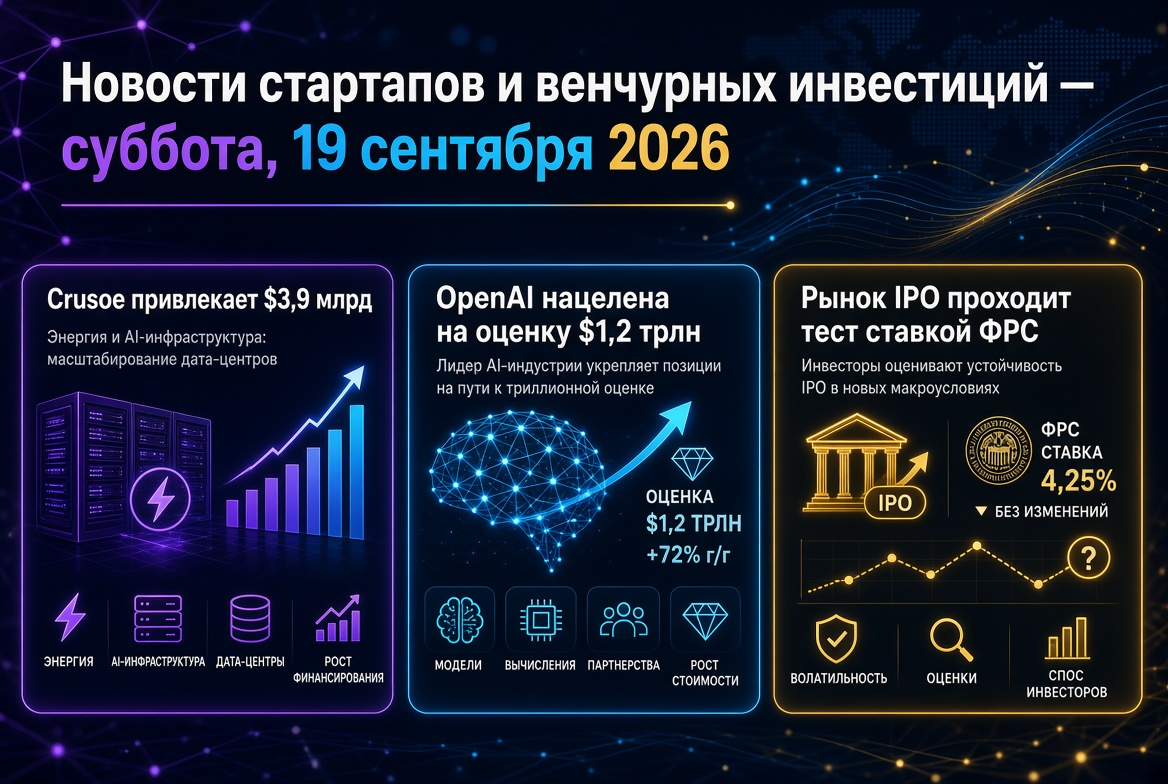
The key theme for Monday, June 1, 2026, is the increasing significance of AI infrastructure. Capital is increasingly directed not only towards model developers and AI applications but also towards companies that provide computing power, memory, data centers, energy foundations, tools for developers, and corporate AI implementation.
AI Mega-Rounds Set the Tone for the Venture Market
The most notable signal for the venture market remains the ongoing race for AI leaders. Large AI companies are attaining valuations comparable to the largest publicly traded tech corporations, while private capital is increasingly competing with the public market for access to the fastest-growing assets.
This shifts the mechanics of venture investments for funds. Previously, the key focus was on finding early-stage companies with potential for exponential growth. Now, a significant portion of capital is concentrated in late-stage investments, where investors are buying access to the infrastructure of the future digital economy.
- The most sought-after startups are in the generative AI, AI agents, and corporate automation sectors.
- The demand for companies associated with AI infrastructure and computing remains strong.
- Valuations of market leaders are growing faster than those of most SaaS and fintech companies.
- Investors are increasingly assessing not just revenue but also access to computing power, data, and corporate clients.
AI Infrastructure Becomes a Distinct Investment Class
By early June 2026, venture investments are increasingly shifting towards the infrastructure layer of artificial intelligence. Ambitious plans for building data centers, energy capacities, and specialized computing clusters indicate that the market is now viewing AI not as a separate sector but as a foundational platform for the next technological cycle.
For venture funds, this means a new set of investment criteria is emerging. Not only product, team, and growth rates are important, but also capital intensity, access to electricity, partnerships with cloud providers, inference costs, and the ability to reduce clients' operational expenses.
Startups that help companies save on computing, optimize memory, speed up query processing, and manage AI models are particularly attractive to investors. Against this backdrop, interest in chips, memory, inference platforms, and middleware solutions is growing.
AI Chip and Memory Startups Move to the Forefront
One of the important topics for the week is AI chips and memory technologies. Investors are increasingly stating that the main limitation for scaling AI is not just the shortage of GPUs but also the cost of memory, bandwidth, and data processing efficiency.
This is why startups that offer alternative architectures for inference, new approaches to memory, and solutions to reduce dependence on dominant hardware suppliers are receiving funding. For venture capital, this is a strategic segment: a successful player in this niche can become not just a technology provider but a critical element of the entire AI chain.
- Inference chips are becoming a distinct investment theme.
- Demand for energy-efficient solutions for data centers is on the rise.
- Companies that reduce AI query costs receive premium valuations.
- Funds are becoming more interested in deep tech, where the payback horizons were previously deemed too long.
AI Developers and Coding Platforms Maintain Market Premium
Another significant trend is the rapid growth of startups that automate programming. AI coding platforms are becoming not just tools for developers but potentially a substitute for parts of the traditional software engineering workflow. For funds, this is one of the most appealing segments, as it combines a large market, measurable impact for corporate clients, and a high speed of implementation.
Startups that create autonomous AI engineers, development assistants, and code generation platforms are attracting substantial rounds and valuations that reflect expectations of a radical shift in the labor market in IT. Investors are paying closer attention to user retention, the cost of computing, and actual performance, rather than just technological novelty.
Fintech Adapts to the New Wave of AI Companies
Fintech also remains in the spotlight of venture investments, but its structure is changing. Companies catering to startups, AI teams, developers, and the rapidly growing tech business are taking center stage. Banking platforms, corporate cards, treasury services, and liquidity management tools are once again becoming in demand when integrated into the ecosystem of new tech companies.
For venture funds, this is an important signal: fintech has not disappeared from the investment agenda, but classic consumer models are yielding ground to B2B services with clearer monetization. Companies that work with corporate clients, maintain a strong deposit base, develop AI tools for financial analysis, and can scale without a sharp increase in credit risk are particularly interesting.
Robotics and Autonomous Systems Gain New Momentum
Robotics is gradually re-entering the center of the venture agenda. Investors are increasingly viewing this sector as a continuation of the AI boom: if models have already learned to work with text, code, and images, the next step is to transfer artificial intelligence into the physical world.
The most promising startups appear to be those working at the intersection of industrial automation, warehousing logistics, autonomous transport, defense technologies, and robotic construction. For funds, this is a more complex segment than classic software, but potentially more secure due to technological barriers, patents, production competencies, and long-term contracts.
- Industrial robotics is becoming part of the re-industrialization strategy.
- Autonomous systems are seeing demand from logistics, defense, and construction.
- AI models for physical objects are forming a new layer of deep-tech startups.
IPO Window Becomes the Key Factor for Late Stages
The preparation of major tech companies for the public market heightens expectations among venture investors. If new IPOs are successful, this could unlock liquidity for funds that have been waiting for several years to realize returns on late-stage investments.
This is particularly important for the startup market. The venture ecosystem depends on exits: without IPOs and M&A, funds find it harder to return capital to LP investors, which makes them more cautious about new investments. Potential listings from major AI and space companies could indicate how ready the public market is to accept high valuations in the private tech sector.
However, investors will look not only at brand scale but also at the quality of the financial model: revenue, profitability, debt load, capital expenditure needs, and transparency in corporate governance.
Europe, India and Global Funds Intensify Capital Competition
The venture market is becoming increasingly global. Europe is strengthening its positions in artificial intelligence, data infrastructure, and deep tech. India is developing its own funds for AI and tech companies. Particular attention is being drawn to initiatives to expand European capital for startups, including potential UK participation in pan-European investment mechanisms.
For investors, this signifies an expansion of deal geography. Competition for strong companies is no longer limited to Silicon Valley. Paris, London, Stockholm, Berlin, Bangalore, Singapore, and Dubai are becoming full-fledged magnets for venture capital.
What Matters for Venture Investors and Funds
As of June 1, 2026, the venture market appears strong but uneven. Capital is available, but it is distributed very selectively. The best AI startups, infrastructure companies, chipmakers, robotics, and fintech platforms receive premium valuations, while weak SaaS models and companies without a clear economic model continue to come under pressure.
Funds should focus on several key factors:
- quality of revenue and share of recurring payments;
- customer acquisition cost and sales payback velocity;
- startup dependence on external computing power;
- gross margin sustainability under increased loads;
- presence of strategic buyers or IPO prospects;
- capital concentration in a single sector and risk of overvaluation of AI companies.
The main takeaway for venture investors is that the startup and venture investment market is entering a phase where it's not just companies with a fashionable AI narrative that win, but projects capable of becoming the infrastructure of a new technological economy. On Monday, June 1, 2026, the focus shifts to asset quality, capital intensity, liquidity, and startups' ability to turn technological breakthroughs into sustainable business models.