Current Startup and Venture Capital News as of April 2, 2026, Including Growth in AI Defence Tech, Fintech, and Global Market Trends
As of early April 2026, the global startup and venture capital markets have entered a phase of rapid acceleration. The primary driver is artificial intelligence, but unlike previous cycles, capital increasingly flows not only into applied AI products but also into infrastructure, chips, autonomous systems, defence technologies, and next-generation financial platforms. For venture investors and funds, this signifies a shift in priorities: it is not just "AI startups" that are winning, but companies building the foundation of a new technological economy.
At the same time, the market is becoming more complex. On one hand, the largest rounds in the history of venture capital are occurring, company valuations are rising, new unicorns are emerging, and interest in IPOs is returning. On the other, capital is concentrating in a limited number of segments, and competition for quality assets is significantly intensifying. Therefore, the agenda on April 2 is no longer simply about market growth but a transition to a new cycle of selection: capital is available, but it is becoming increasingly selective.
Global Venture Market: Capital is Scaling Again
The key characteristic of the current phase is scale. The venture market in 2026 is not growing uniformly but rather in jumps. The largest deals create an overall sense of a new boom, even though strong polarization persists within the market between leaders and all others. For funds, this means a return to competition for large deals and a new increase in the cost of entry into the most promising assets.
- The largest flow of capital is directed towards AI and related infrastructure.
- Late-stage investments once again dominate a significant share of the total.
- Seed and early-stage investments are also active, but investors are being tougher on team quality, technical barriers, and commercialization pathways.
For global investors, this represents an important shift: the venture market is once again capable of creating very large rounds, but the capital distribution model is fundamentally different from that of 2021. Money is concentrating around technological depth, strategic significance, and infrastructural rarity.
AI Remains the Main Magnet for Venture Capital
Artificial intelligence continues to draw the gravitational pull within the startup ecosystem. However, the market is changing: whereas previously the focus was primarily on generative interfaces and models, now venture investments are increasingly shifting towards computational infrastructure, applied verticals, and enterprise implementation. This maturation of the market is making it simultaneously more expensive.
Currently, three layers in AI stand out as particularly interesting to venture funds:
- Frontier AI and foundation models - the segment for the largest rounds and the highest valuations.
- Infrastructure - chips, data centers, energy supply, computation orchestration, security, and deployment tools.
- Vertical solutions - legal tech, healthcare, enterprise automation, financial services, and defence software.
Therefore, today's topic is not just "AI growth," but the redistribution of venture capital in favor of companies building critical components of the new technological chain. For investors, this means that sector multiples are now influenced not only by growth rates but also by the strategic irreplaceability of the product.
Defence Tech is Emerging as a Strong Venture Segment
One of the most noticeable trends in recent weeks has been the strengthening of defence tech as a fully-fledged class of venture assets. Just recently, defence technologies were viewed as niche players, but now they represent a global investment vertical with its own mega-rounds, long-term contracts, and clear government support.
Investor interest can be attributed to several factors:
- the growing demand for autonomous systems, drones, and combat environment software;
- increased defence budgets in the US, Europe, and Asia;
- the willingness of major funds to enter the sector not only through equity but also via hybrid financing structures.
Against this backdrop, defence tech is increasingly intersecting with AI, robotics, simulation, and manufacturing. This strengthens the positions of startups that sell not a standalone product but a technological platform. For venture capital, defence tech has become a segment where high valuations are increasingly justified not only by growth rates but also by the strategic importance of technologies.
Infrastructure Bets: Chips, Orbital Computing, and Physical AI
If 2025 was the year of applied AI, then 2026 is progressively becoming the year of infrastructure bets. Investors are increasingly financing startups that address limitations in capacity, computation, bandwidth, and the placement of AI workloads. This radically expands the landscape of the venture market.
The current focus is on:
- AI chips and specialized semiconductors;
- new data center formats and distributed computing;
- platforms for autonomous systems and physical AI;
- companies operating at the intersection of space, energy, and computational infrastructure.
Such startups typically require more capital, take longer to scale, and are more complex in due diligence; however, if successfully executed, they can create particularly high valuations. For funds, this is an important signal: the next wave of significant returns could come not only from software-as-a-service but from heavy technological infrastructure.
Europe is Searching for a New Growth Format: Legal AI, Fintech, and Regulatory Restructuring
The European startup market has recently shown increasing signs of revival. Notably, this momentum is not only driven by individual rounds but also by institutional changes. Regulators and the market are simultaneously trying to solve the same problem: how to avoid losing scaling companies to the US.
The most notable trends in Europe currently include:
- Legal AI - demand from law firms and corporate clients is accelerating the growth of specialized startups.
- Fintech - London is reinforcing its status as the European center for financial technology, with capital once again flowing into mature business models.
- Regulatory simplification - efforts to simplify the launch and scaling of companies at the level of the entire European Union could become a critical factor for upcoming rounds.
For venture investors and funds, Europe remains attractive not as a market of instantaneous super-valuations but as a zone of strong engineering talent, quality B2B products, and an increasingly pragmatic government. This positions the region as appealing for funds seeking balance between technological depth and moderate entry costs.
Fintech and Tokenisation are Back in Play
Besides AI, fintech has noticeably revived. The market has shifted from classic consumer applications to infrastructure solutions: international payments, FX, corporate services, digital assets, and tokenisation of real financial instruments. This is a significant shift for investors, as such areas often provide clearer revenue and more rapid institutional adoption.
What is particularly important now:
- interest is growing in stablecoin infrastructure and cost reductions for international transfers;
- there is increased enthusiasm for tokenisation as a mechanism for modernizing capital markets;
- insurance and corporate fintech services are receiving a new boost from AI automation.
For startups, this is an opportune moment: investors are again willing to finance fintech if the model is based not on marketing growth but on infrastructural utility and the ability to quickly integrate with existing financial flows.
Asia is Strengthening Its Position: China, India, and South Korea
The Asian startup and venture investment market remains highly heterogeneous, but strong centers of growth are emerging there. China is ramping up state-supported investments in technology, India is solidifying its position as one of the key private capital markets in the Asia-Pacific region, and South Korea is actively investing in AI chips and technological sovereignty.
This creates a new logic for capital distribution among global funds:
- China is appealing in areas where there is strategic support and technological priority from the government.
- India remains a scaling market with growing exit opportunities.
- South Korea is strengthening its positions in deep tech and semiconductors.
Today, Asia is demonstrating that the growth of the venture market in 2026 is supported not only by private capital but also by industrial policy, national technological strategies, and competition for sovereign infrastructure.
The IPO and Exit Window is Opening, but Not for Everyone
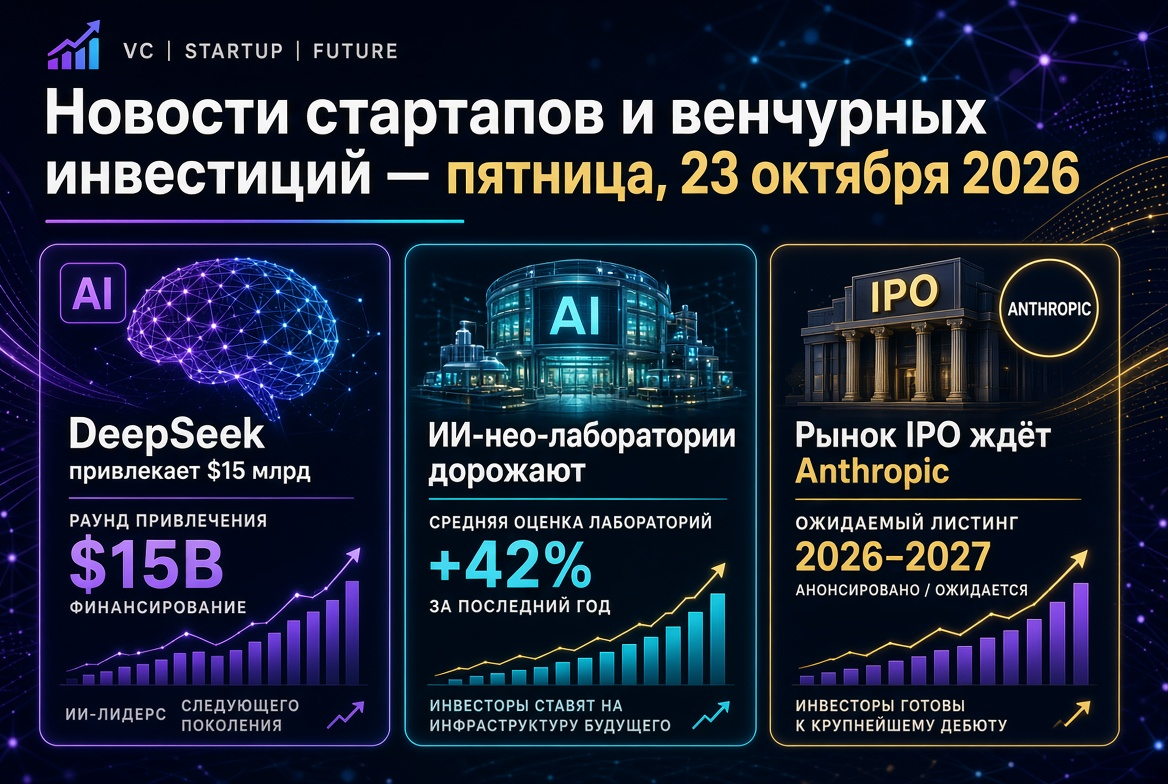
Another important storyline is the resurgence of the exit theme. There is renewed interest in public offerings, especially in jurisdictions and sectors where companies already have scale, a clear cash profile, and a growth history. However, the IPO window in 2026 remains selective: it is primarily open for mature, disciplined, and strategically clear companies.
Signals indicating a market revival of exits are already visible:
- some large tech companies are preparing or discussing listings;
- in India, the IPO exit market remains an important channel for capital return;
- pressure is mounting on the private market, as the volume of private capital in startups is now too large to indefinitely postpone liquidity.
For venture funds, this signifies that 2026 could become a turning point: not a mass return of IPOs, but the beginning of a new disciplined wave of exits where companies with actual scale—not merely high valuations—will prevail.
What This Means for Venture Investors and Funds
As of April 2, 2026, the startup and venture capital market appears strong, yet far from uniform. Capital is present, and risk appetite has returned, but money is flowing primarily into those companies that meet at least one of three criteria:
- building critically important AI infrastructure;
- operating in strategic sectors like defence tech, semiconductors, and enterprise AI;
- demonstrating a clear trajectory toward scaling or exit.
For funds, this is a market where significant bets can once again be made, but superficial selection cannot be afforded. The next phase of the global venture cycle will likely belong not to the loudest stories but to those startups that combine technological depth with commercial applicability and strategic demand.
Therefore, the main theme of the day is not just the growth of venture capital but its new quality. The market increasingly rewards not noise but infrastructural value. For investors, this means that the best opportunities of 2026 lie where startups are tackling systemic problems of large markets and are capable of becoming part of the next technological contour of the global economy.