Current Startup and Venture Investment News as of April 5, 2026: Growth in AI Infrastructure and Emerging Investment Trends
The global market for startups and venture investments enters April 2026 in a fundamentally new state. Formally, the first quarter has been a record-breaking period in terms of capital raised, but within this outcome, there is an increasing concentration of funds around major AI companies, computational infrastructure, defense technologies, and new financial platforms. For venture investors and funds, this signals a simple yet tough reality: the market is once again open to large checks, but access is limited to teams capable of proving technological superiority, infrastructure significance, or direct alignment with national and corporate priorities.
Against this backdrop, the news on startups and venture investments for April 5 is shaped around several key lines: the overheating and simultaneous institutionalization of AI, heightened interest in chips and data centers, a new wave of defense tech, growth in fintech based on stablecoins, and the gradual return of discussions about exit windows and IPOs. Below is a structured snapshot of the day for a global audience of investors.
The Market Has Entered a Phase of Record Volumes, but Funds Are Concentrated Among the Few
The main characteristic of the current cycle is that headline figures look impressive; however, a broad and even recovery of the venture market has not yet occurred. Capital is actively returning but predominantly into the largest deals where the scale of the platform, access to computation, and the strategic importance of the business converge.
For the venture investment market, this creates a dual effect:
- On one hand, there is a renewed appetite for large rounds and late-stage investments;
- On the other hand, the gap between top-tier assets and the rest of the ecosystem is widening;
- Valuations in the AI segment have become a new point of reference for the entire startup market.
This is precisely why investors are increasingly evaluating not just revenue growth but also a company's ability to become a part of the new infrastructural architecture: models, GPUs, data centers, defense stacks, digital calculations, and enterprise automation.
AI Remains the Main Magnet for Capital, but the Focus Is Shifting from Models to Infrastructure
Whereas previous quarters concentrated attention primarily on foundation models, venture capital is now increasingly moving to the next tier—where physical and software capacities for artificial intelligence operations are built. This implies that the strongest beneficiaries are not only developers of models but also providers of computational bases, energy platforms, chips, orchestration solutions, and specialized software stacks.
For startups, this signals an important shift. The narrative is no longer simply "AI inside the product," but rather companies that:
- Reduce computation costs;
- Accelerate AI deployment in corporate environments;
- Create scarce infrastructure;
- Ensure security, control, and predictability in model usage.
In practice, this leads to an increase in capital-intensive rounds and a strengthening of the role of strategic investors, banks, sovereign funds, and corporations. The market is becoming less "garage-like" and more industrial.
Infrastructure Deals Set the Tone for the Entire Venture Cycle
Recent notable startup news confirms this pivot. The European AI developer Mistral has secured significant debt financing for building computational capabilities, effectively demonstrating that the next stage of AI competition is not only about models but also about proprietary infrastructure. Concurrently, interest is growing in exotic yet strategically significant bets: from new data center architectures to space computing solutions.
The venture market is also closely monitoring AI chip manufacturers and alternative semiconductor ecosystems. The rising valuations in this segment indicate that investors are willing to pay a premium for any technology that can reduce dependence on a narrow circle of global suppliers.
For funds, the conclusion is clear: the infrastructure layer is becoming one of the most attractive areas in venture investments for 2026, despite the high CAPEX and longer capital return horizons.
Defense Tech Has Fully Transitioned from the Periphery to the Mainstream
Another key theme of the day is the rapid growth of defense and dual-use startups. For the global market, this is no longer a niche segment but a full-fledged capital magnet. Investors are willing to finance companies working at the intersection of autonomous systems, simulation, drones, computer vision, edge AI, and critical infrastructure security.
The reasons for this shift are clear:
- Governments and major contractors are accelerating procurement of new solutions;
- Military conflicts have become real testing grounds for rapid technology validation;
- Defense has transformed into a long-term structural trend rather than a temporary anomaly.
In such an environment, defense tech becomes particularly attractive for late stages: demand is steady, budgets are large, and the technological moat is often higher than in traditional SaaS. For venture funds, this means an expansion of mandates and a reevaluation of previous restrictions on investments in military and dual-use software.
Fintech is Transforming: Focus on Settlements, Stablecoins, and Embedded Credit
Fintech in 2026 no longer resembles its previous narrative about neobanks and consumer apps. The most interesting startups in this segment are building infrastructure for cross-border settlements, platforms for corporate payments, credit mechanics within ecosystems, and services that utilize stablecoins as a technological layer rather than as a speculative asset.
It is precisely for this reason that the market positively perceives large rounds in companies simplifying international transfers and reducing the settlement cycle from days to minutes. Additional momentum is also provided by regulatory evolution: large digital platforms increasingly look towards licensed financial services, lending, and their own payment instruments.
For investors, this means that venture investment news in fintech will increasingly be tied not to consumer growth at any cost, but to liquidity infrastructure, compliance, settlements, and financial embedded-layer.
Cybersecurity is Again Becoming a Must-Have Bet for Funds
In light of the proliferation of AI agents, acceleration of corporate automation, and the rise of digital attacks, cybersecurity is presented with a new window of opportunity. Investors are returning to this segment not only due to steady corporate demand but also because security is increasingly integrating into the architecture of AI products.
As a result, heightened interest is being observed in several subcategories:
- AI-native security;
- Automated threat response;
- Application security for rapidly growing development teams;
- Corporate platforms for access control and data protection.
For venture investors, this is one of the few segments where strong client purchasing power, high revenue repeatability, and a clear scenario for strategic exit to major acquirers coexist.
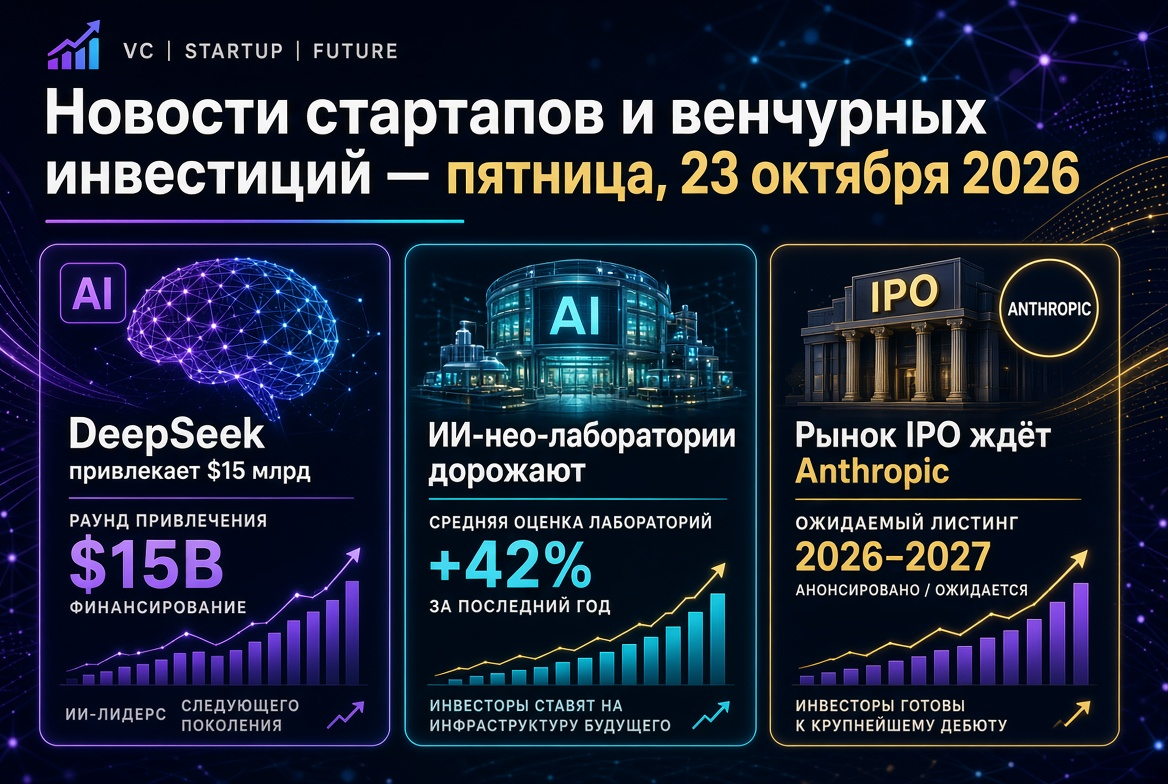
The IPO Window is Cracking Open, and the Market is Again Looking at Exits
After a prolonged period of uncertainty, the discussion about exits is returning to the forefront. Potential large placements of tech companies are viewed as a test for the public market’s readiness to absorb new mega-deals. For private companies, this represents an important psychological signal: the market is beginning to evaluate not only the viability of the next round but also the realism of the path to liquidity.
However, this window remains selective. Currently, the best positions are held by:
- Platforms with massive revenues;
- AI companies with infrastructural status;
- Defense tech and industrial tech with a long contract portfolio;
- Fintech players capable of demonstrating sustainable unit economics.
For earlier startups, this does not mean an immediate opening of the exit market but sets a new benchmark for timelines, multiples, and investor expectations.
What This Means for Funds and the Startup Market in the Second Quarter
The current landscape is pushing funds toward stricter selection criteria. In 2026, capital will flow toward areas of strategic necessity rather than merely promising growth decks. Teams capable of articulating their indispensability in the new economy of AI, defense, financial infrastructure, and corporate software will prevail.
For market participants, this implies several practical conclusions:
- Seed and Series A rounds will remain active, but demands for team quality and rapid validation of demand will increase;
- Mega-rounds will continue to skew the overall market statistics;
- Europe and Asia will actively promote their own tech champions;
- Infrastructure and strategic segments will continue to displace "non-essential" software from the investors' spotlight.
For Investors: Capital Has Returned, but the Era of Easy Money Has Not
The news on startups and venture investments as of April 5, 2026, illustrates that the global market is once again capable of generating record volumes, but this capital is distributed extremely selectively. The primary trend is the transformation of venture funding from a market of mass risk to one of strategic concentration, where the highest valuations go to companies controlling infrastructure, security, defense technologies, and new financial rails.
For global venture funds, this means the necessity to look beyond growth rates to assess a company's position in the value chain. In the coming months, this will determine who secures the next major round and who remains outside the new cycle. Whereas in the past investors sought merely strong product stories, the market now demands more: technological depth, systemic significance, and the ability to become part of the new industrial framework of the digital economy.