Today's Highlights: Key Events in the Venture Market
- Cognition AI, the developer of the AI programming agent Devin, closes a round of approximately $1 billion at a valuation of about $47 billion—investor interest in the deal approached $10 billion.
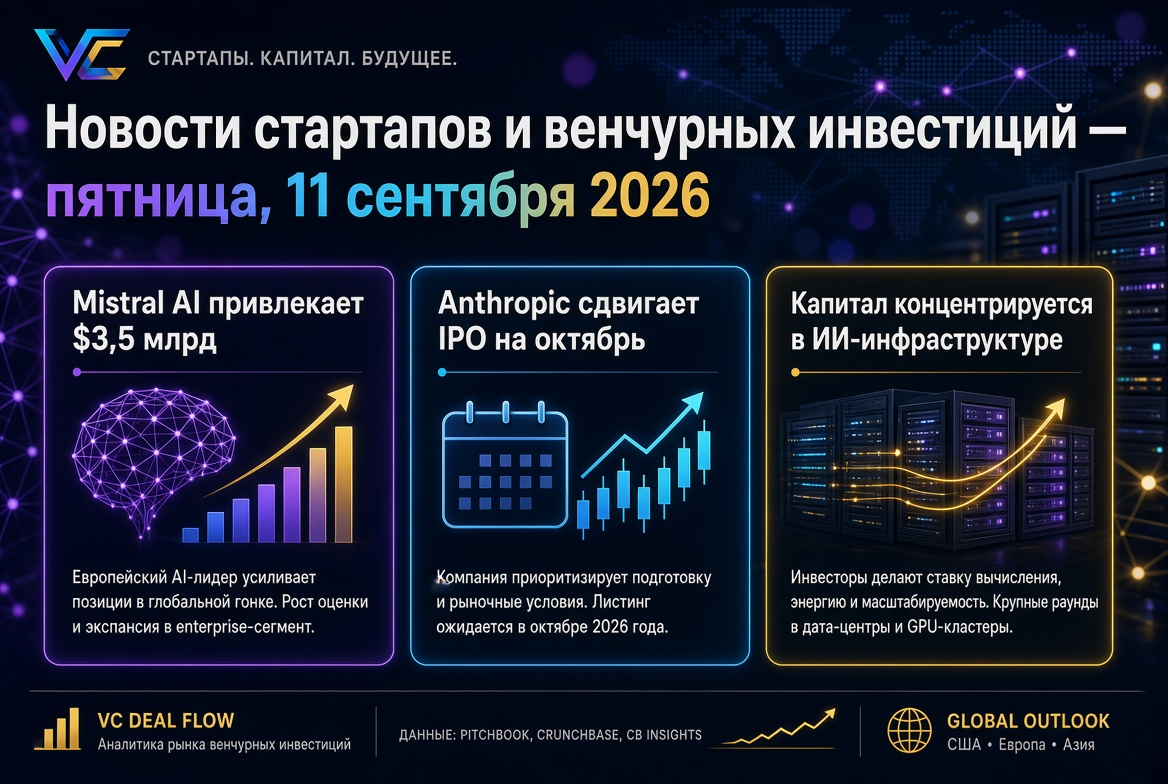
- Crusoe, an AI infrastructure and data center operator, raised over $3 billion at a post-investment valuation of approximately $30 billion from Atreides Management, Valor Equity Partners, and Mubadala Capital.
- Mega-funds with assets exceeding $1 billion control 72% of the total value of venture deals in 2026, compared to 25% a year earlier.
- Over 70% of global venture capital in the second quarter has been directed towards AI companies—a historic peak of concentration.
Cognition AI: $47 Billion Valuation and the New Economy of AI Agents
The central deal of the week is the funding round for Cognition AI. The startup behind the autonomous AI programmer Devin is raising around $1 billion, bringing its valuation to approximately $47 billion. Notably, the demand from investors to participate in the round nearly exceeded the target volume by ten times: the company received bids totaling almost $10 billion.
For venture funds, this deal signifies a shift in capital from basic language models to applied AI agents with measurable revenue. Cognition is demonstrating one of the fastest ARR growth rates in the industry's history, and investors are willing to pay a premium for confirmed monetization—something not available to companies with "conceptual" products. Funding rounds of this magnitude in the AI coding segment are setting a new pricing benchmark for the entire category of development tools.
AI Infrastructure: Crusoe, Gimlet Labs, and the Battle for Computing Power
The infrastructure segment remains the second major magnet for capital after applied AI. Key deals in recent days include:
- Crusoe has completed financing of over $3 billion at a valuation of around $30 billion. The funds are directed towards building data centers and expanding cloud capacities for AI workloads.
- Gimlet Labs raised $300 million in a round led by Andreessen Horowitz at a valuation of $3 billion. New investors include Arm Holdings and Microsoft’s venture arm M12. The company is developing software for distributing AI workloads across different types of processors—a critical technology amid the fragmentation of computing infrastructure.
- HiddenLayer, specializing in the security of agent and generative AI applications, closed a $100 million Series B round—the AI security segment is becoming a mandatory line item in fund theses.
The rationale for investors is clear: as the cost of training and inference models grows, companies that reduce computation costs or enhance efficiency gain structural advantages and predictable corporate demand.
Mega-funds Reshaping the Industry: 72% of the Market Controlled by Giants
A structural shift in 2026 is the total dominance of mega-funds. According to PitchBook data, funds with assets exceeding $1 billion accounted for 72% of the total value of venture deals in the first half of the year, while a year ago this figure was just 25%. Mega-funds attracted $50 billion in new capital over six months, compared to $8 billion in the same period last year, with 73% of all new LP commitments coming from just five management companies.
Among the largest closures are Thrive Capital with the $10 billion Thrive X fund, Sequoia Capital with a late-stage AI fund of $7 billion, and Andreessen Horowitz with a growth fund of $6.75 billion—while a16z, according to market reports, is establishing an AI mega-fund of up to $20 billion. In Europe, the European Commission selected EQT as the manager for the Scaleup Europe fund of €5 billion, half of which has already been contracted with institutional investors, including Novo Holdings, Allianz, and APG.
Record Half-Year: $510 Billion and the Phenomenon of Two Companies
Crunchbase statistics highlight an historical anomaly: OpenAI and Anthropic collectively raised $217 billion—43% of total global venture funding in the first half of 2026. The $122 billion round for OpenAI in the first quarter became the largest private deal in history, while Anthropic, after securing $65 billion in the second quarter, topped the list of the world's most valuable private companies. In the second quarter, 16 companies closed rounds exceeding $1 billion for a total of $108.6 billion—more than half of the quarterly investment volume.
North America maintains its lead: investments in startups in the United States and Canada reached $392 billion for the half-year. Remarkably, there is a renaissance in early stages—early capital exceeded $31 billion in the quarter, almost double last year’s levels, largely thanks to a $12 billion round for Prometheus, a physical AI startup involving Jeff Bezos.
Beyond AI: Where Else is Venture Capital Working
Despite the dominance of the AI agenda, capital is finding applications in adjacent verticals:
- Defense Technologies: $12.3 billion in investments for the half-year—almost double last year's results; Anduril Industries closed a Series H round of $5 billion.
- Healthcare: AusperBio Therapeutics raised $120 million in Series C, Elucid—$55 million in Series D, Scan.com—$90 million for the development of medical imaging.
- Fintech: Ghanaian startup Moment received $22 million in Series A from Speedinvest and QED Investors to build payment infrastructure for African markets.
- Consumer Sector: Coffee chain Blank Street attracted $105 million for expansion, while travel platform WeRoad raised $58 million.
Europe and Early Stages: Selectivity Over Scarcity
The European market is showing targeted activity. Munich-based Zeit AI, founded by Palantir alumni, raised €5 million in seed investments with participation from Y Combinator and the Sequoia scout fund—the company is building an autonomous data-engineering agent that integrates with over 600 corporate systems. Brussels-based Backbone closed a pre-seed round of €4 million in the food compliance segment. Notably, the participation of strategic investors and industry players in early syndicates is becoming more frequent: corporations are increasingly entering seed stages to secure access to technologies before growth rounds.
What This Means for Investors: Three Takeaways
- The barbell market structure has solidified. Capital is being distributed between mega-rounds for leaders and selective early deals, while the middle—Series B and C for companies without outstanding metrics—is experiencing maximum pressure. Mid-sized funds require clear specialization to compete for quality deal flow.
- Due diligence is tightening across the funnel. Investors demand verified revenue, clear intellectual property structure, and understandable unit economics even at the seed stage. The premium for "AI narrative" without commercial proof is rapidly disappearing.
- Infrastructure and vertical AI are the main theses for the second half of the year. Computational efficiency, AI security, robotics, and industry agents with measurable business impact remain the most competitive segments for new allocations.
Outlook: A Season of High Stakes
September traditionally opens the business season, and 2026 will be no exception: the market anticipates new mega-rounds in the frontier AI segment, the activation of the IPO window following a strong second quarter, and continued consolidation in applied AI verticals through M&A and strategic acquisitions. For venture funds, the key question of autumn is not capital availability, but the discipline of its allocation: in a market where two issuers absorb nearly half of global investments, the quality of selection is defining portfolio returns more than ever in the last decade.