Latest Startup and Venture Capital News as of May 2, 2026: Venture Capital Re-focuses on Artificial Intelligence, Growth Funds, Medical AI Platforms, Agent Technologies, and Infrastructure Startups
The global startup and venture capital market is entering May 2026 with a high level of activity, although growth is not uniform. The main feature of the current cycle is not just a return of capital to the tech sector but a strict concentration around a limited number of areas: artificial intelligence, AI infrastructure, medical technologies, autonomous agents, corporate automation, industrial digital twins, and computational power.
For venture investors and funds, Saturday, May 2, 2026, marks a period of strategy reevaluation. Following a record first quarter, the market has confirmed that capital is eager to flow into startups, but predominantly in companies with scalable technology, high barriers to entry, access to corporate clients, and a clear path to an IPO or strategic sale. Venture capital has become larger, more institutional, and more demanding regarding asset quality.
Main Topic of the Day: Large Funds Renew Risk Appetite in the Market
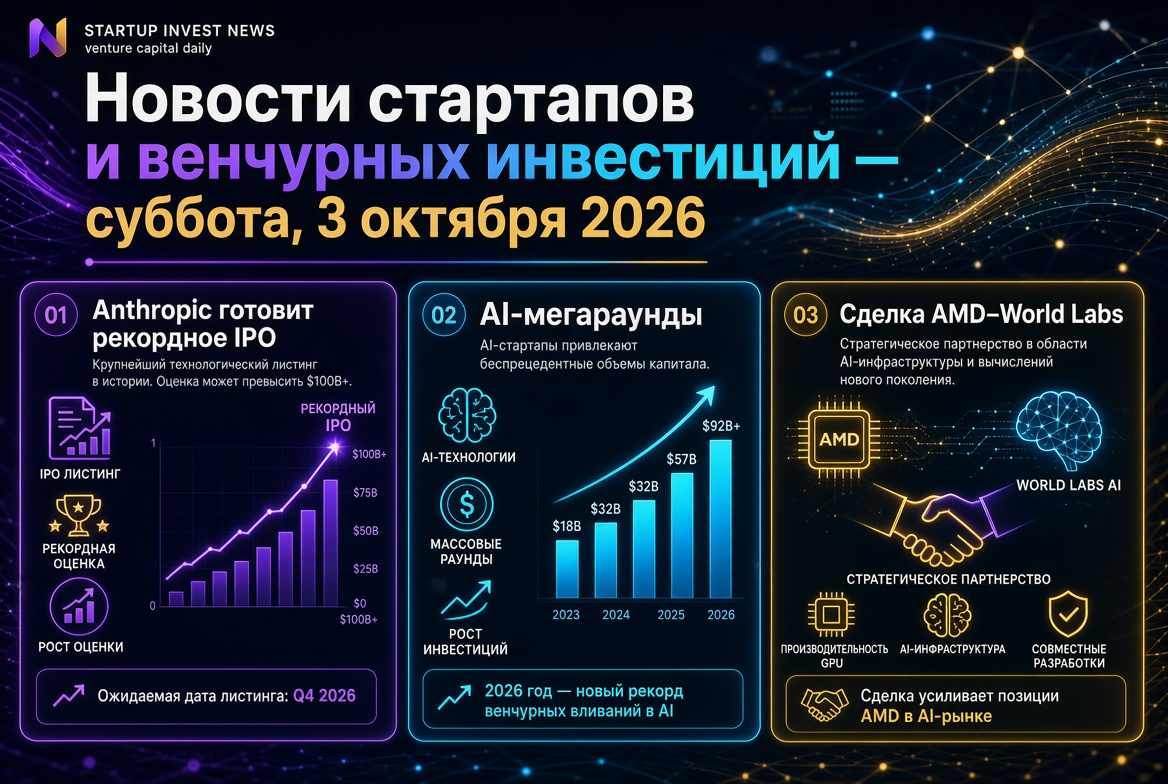
One of the key events for the venture industry has been Founders Fund's new fund raising approximately $6 billion. For the market, this isn't just another large fund; it's a signal that top players in Silicon Valley are once again ready to aggressively compete for the best late-stage companies.
Importantly, capital is not being directed to a wide array of startups but to the strongest assets capable of becoming foundational companies in the next technological cycle. This widens the gap between leaders and the rest of the market. For funds, this situation necessitates quicker decision-making, deeper analysis of technological advantages, and proactive engagement with the founders of strong companies.
Key takeaways for venture investors:
- Large funds intensify competition for AI startups and infrastructure companies;
- Valuations for top assets remain high despite talk of overheating;
- Late-stage deals are becoming a strategic battlefield among funds, corporations, and sovereign capital;
- Access to quality deals is now more important than just having capital.
AI Startups Remain the Core of the Venture Market
Artificial intelligence continues to dominate the news in startups and venture investments. After a record first quarter in 2026, investors have become more selective, yet the demand for AI companies remains strong. The most attractive opportunities are not abstract chatbots but startups that integrate AI into specific business processes: medicine, marketing, industrial design, customer service, financial analytics, and software development.
The market is gradually transitioning from broad interest in generative AI to a more mature investment model. Funds are now focusing on the following parameters:
- Presence of real corporate clients;
- Proprietary data or unique data access;
- Cost savings for the client;
- Regulatory barriers and niche security;
- Potential to become an infrastructure platform rather than a standalone application.
Therefore, venture investments are shifting towards "applied AI" and AI infrastructure. Investors are no longer willing to pay solely for attractive presentations. Revenue, the depth of integration into client processes, and the ability of the startup to maintain margins as computational costs rise are coming to the forefront.
Medical AI: Aidoc and Iterative Health Spark Interest in Healthtech
The medical AI sector has emerged as one of the most notable areas of focus in recent days. Aidoc has raised $150 million in its Series E round, which has bolstered fund interest in clinical AI platforms. The company operates in the realm of medical image analysis and is already seen by the market as a potential candidate for an upcoming public offering.
Another important example is Iterative Health, which closed a Series C round of $77 million. The startup is developing AI infrastructure for clinical trials, helping to speed up patient recruitment, enhance the efficiency of medical testing, and reduce operational delays in the pharmaceutical industry.
For venture funds, this is a significant signal. Healthtech is regaining attractiveness, but not in the format of experimental consumer applications; rather, it's emerging as a framework for hospitals, pharmaceutical companies, and research networks. Although the sales cycle for such projects is longer, they have higher barriers to entry and potentially more stable revenue streams.
Agent AI Emerges as a Distinct Investment Class
Another important trend is the rapid increase in interest in AI agents. Parallel Web Systems, founded by former Twitter CEO Parag Agrawal, has raised $100 million and achieved a valuation of around $2 billion. The company is developing infrastructure for autonomous AI agents, which can operate with web data and perform complex tasks for corporate clients.
This segment is becoming one of the most promising for venture investments as it sits at the intersection of two major markets: enterprise software and artificial intelligence. While traditional SaaS companies sold tools for employees, agent platforms are aiming to automate entire workflows.
For investors, this opens up a new investment thesis: AI agents can replace parts of traditional software while simultaneously creating demand for new levels of infrastructure—search, security, access control, task orchestration, action auditing, and integration with corporate systems.
Corporate AI: Hightouch and Netomi Demonstrate Where the Money is Flowing
Large rounds in Hightouch and Netomi confirm that corporate AI remains one of the strongest areas for venture capital. Hightouch secured $150 million for the development of its AI marketing and customer data management platform. Netomi received $110 million to expand agent AI in customer service.
Both cases are significant not only for the size of the rounds but also for the quality of the investment thesis. Funds are increasingly choosing startups that do not just offer a new interface but have a direct impact on business efficiency: reducing support costs, accelerating marketing campaigns, enhancing personalization, and helping large companies utilize their own data.
A new logic is forming in the market: the best AI startups should not entirely replace corporate software but seamlessly integrate into existing processes and quickly demonstrate economic impact. This positions B2B AI as one of the most resilient areas for venture investment in 2026.
Industrial AI and Digital Twins: JuliaHub Reinforces the Physical AI Trend
JuliaHub has raised $65 million in its Series B round and introduced an updated platform Dyad 3.0 for industrial digital twins and engineering modeling. This case illustrates how the venture market is increasingly moving beyond traditional software and consumer applications.
Physical AI is becoming a distinct area where artificial intelligence is applied to real industrial systems: energy, transportation, aerospace, infrastructure, and manufacturing. For funds, this market is more complex but potentially more secure. Here, not only algorithms matter, but also engineering expertise, industry data, trust from major clients, and the capability to shorten design timelines.
Investors should keep a close eye on startups that link AI with physical assets. Such companies could emerge as the next major platforms if the market shifts from digital automation to the automation of industrial and infrastructure processes.
IPO and M&A: Investors Again Seek Clear Exits
For venture funds, the activity in funding rounds is not the only important factor, but also the exit perspective. The IPO market in 2026 is gradually reviving; however, investors have become more cautious about companies without clear economic fundamentals. Startups with strong revenues, corporate clients, and high retention rates have better chances of a successful public debut.
Concurrently, the importance of M&A is rising. Large tech corporations and private equity funds are prepared to acquire companies that provide access to AI expertise, data, vertical markets, and engineering teams. For startups, this creates an alternative path to liquidity, especially if the IPO window remains unstable.
Likely candidates for strategic interest include:
- medical AI platforms with regulatory approvals;
- infrastructure for AI agents and corporate automation;
- data processing and marketing personalization platforms;
- cybersecurity for AI environments;
- industrial digital twins and engineering AI.
Risks for Venture Funds: Overheating, Concentration, and Computational Costs
Despite high interest in startups, the venture capital market remains ambiguous. The primary risk is the concentration of capital in a limited number of companies and sectors. If AI startup valuations continue to rise faster than revenues, funds may face challenges in subsequent rounds and exits.
The second risk is computational costs. Many AI companies require significant expenses for infrastructure, cloud services, graphics processing units, and data centers. This alters the traditional model of venture investing: scaling may require significantly more capital than classical SaaS companies.
The third risk is regulatory uncertainty. This is particularly relevant for medical AI, personal data handling, autonomous agents, and solutions affecting financial or legal processes. For funds, this necessitates deeper technological and legal expertise before entering deals.
What Investors Should Focus on May 2, 2026
The key takeaway for venture investors and funds is that the startup market in 2026 presents significant opportunities again but demands greater discipline. Money is returning, yet it is concentrating around companies that have the potential to become the infrastructure for the next technological cycle.
In the coming weeks, investors should watch several areas closely:
- new funds and capital reallocation to late-stage AI companies;
- rounds in medical AI, where a new wave of potential IPOs is developing;
- the evolution of AI agents as a threat to traditional corporate software;
- the growth of physical AI, digital twins, and industrial automation;
- M&A activity, which may become the primary liquidity channel for venture funds.
The startup and venture investment news for Saturday, May 2, 2026, indicate that the global venture ecosystem is entering a new phase. This is no longer a mass funding market for any technological ideas but rather a market focused on capital, data, infrastructure, and strategic control over future platforms. Funds that will succeed will not simply invest in artificial intelligence but will be those who can distinguish between a long-term technological monopoly and a temporary investment hype.