Startup and Venture Capital News for 7 June 2026: Global Funds Increase Bets on Artificial Intelligence, Infrastructure, Space, Fusion Energy and Tech IPOs
By 7 June 2026, the global venture capital market has entered a new phase: money is again flowing into startups, but distribution remains highly uneven. The main stream of capital is concentrated around AI infrastructure, corporate artificial intelligence, deep tech, space technologies, data-centre energy, and fintech platforms with clear monetisation. For venture investors and funds, this signals not merely a renewed interest in risk assets, but a shift to a far more disciplined project selection model.
Startup and venture capital news for Sunday, 7 June 2026 shows: the market is prepared to fund large rounds if the company solves an infrastructure problem, enjoys strategic corporate demand, and can become part of a new technology value chain. Startups without proven revenue, a strong team, and a scalable business model still face fund caution.
Key Venture Market Themes on 7 June 2026
- AI infrastructure remains the top destination for large venture investments.
- Deep-tech startups in energy, quantum computing and space land mega-rounds.
- Fintech becomes attractive again when the product involves business automation and artificial intelligence.
- The tech IPO market is reviving and becoming a key exit indicator for funds.
- Venture investors are tightening requirements around unit economics, corporate demand, and margin protection.
AI Infrastructure: Money Flows Not Only into Models, but into the 'Rails' of the New Economy
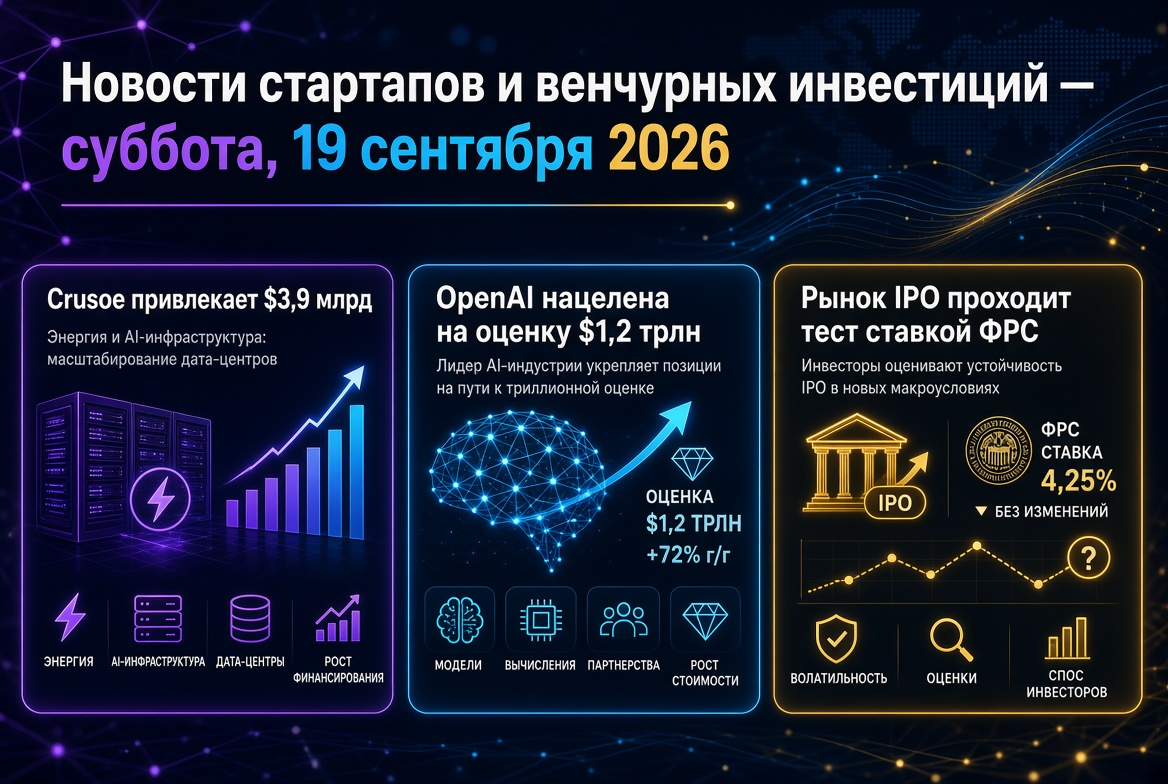
The main takeaway of the week for the venture market: investors are increasingly funding not just developers of large language models, but the infrastructure surrounding artificial intelligence. This includes networks, data centres, monitoring systems, corporate AI platforms, security tools, and solutions for automating internal processes.
A large round from DriveNets was one of the notable signals: demand for network infrastructure is growing in step with the load from AI services. For venture funds, this is an important direction because the AI market requires not only software products, but also the physical and digital base to scale. Startups that help reduce computing costs, accelerate data transfer, or improve the efficiency of corporate AI adoption gain a strategic advantage.
Of particular interest are companies that help businesses move from experimenting with generative AI to real-world deployment. Corporate AI startups become attractive to investors when their product is embedded in clients' operational processes, boosts productivity, and creates a measurable economic impact.
Mega-Rounds in Deep Tech: Energy, Space and Quantum Technologies
Venture investments are noticeably shifting toward capital-intensive deep-tech areas. The market recognises that future technology competition will not only revolve around applications, but also around energy, computing power, space logistics, quantum architectures, and industrial automation.
The Helion round was one of the week's major events. The fusion energy startup secured large-scale funding to accelerate commercial deployment and expand manufacturing capacity. For funds, this indicates that the energy base of artificial intelligence is becoming a standalone investment category. The more demand grows for data centres, the greater the interest in companies that can offer new energy sources.
Impulse Space also demonstrates that the space sector is no longer a niche. Investors are increasingly looking at startups that build infrastructure beyond launch: satellite manoeuvring, payload delivery, orbital logistics, and spacecraft servicing. This is no longer just a launch market, but a full service chain for the new space economy.
European deep tech received an added boost from the round of French quantum startup Quobly. Quantum computing remains a long-term bet, but fund interest in this sector is intensifying amid the race among the US, Europe and Asia for technological sovereignty.
Fintech and AI: Investors Are Again Willing to Pay for Growth
The fintech market is returning to the venture investor spotlight, but no longer in the old 'growth at any cost' format. Platforms that combine financial services, automation, expense analytics, cash flow management, and AI tools for business are now taking the lead.
The Ramp round confirmed that large funds are willing to pay high valuations for companies with strong revenue, a clear customer base, and the ability to embed artificial intelligence into corporate finance. For the venture market, this is an important signal: fintech is interesting again if it becomes part of companies' operational infrastructure, rather than just another payment interface.
For startups in this sector, three criteria become critical:
- reducing client costs through automation;
- increasing retention and expanding average deal size;
- integration with the financial, accounting and management systems of the business.
Generative AI Moves Beyond Text
AI startups are increasingly developing not only in the direction of chatbots and corporate assistants, but also in music, apps, creative tools, and user-generated content. The Suno round shows that investors continue to believe in generative AI as a standalone consumer and professional market.
At the same time, funds carefully assess regulatory and legal risks. In creative AI services, not only the speed of audience growth and product quality matter, but also the model's resilience amid disputes about copyright, data licensing, and the commercial use of generated content.
The Sekai startup reflects another trend: building apps through text commands. This direction could reshape the no-code and low-code platform market if users can quickly create mini-applications without a development team. For venture investors, this involves not just technology, but also the potential to create new social mechanics around digital product creation.
IPO Window: Funds Await Liquidity and New Valuation Benchmarks
The revival of the IPO market is shaping up as one of the key themes for venture funds. Potential listings of the largest technology companies could set new valuation benchmarks for the entire private market. If public investors confirm strong demand for AI companies and space infrastructure, this will support later-stage rounds, secondary transactions, and new growth funds.
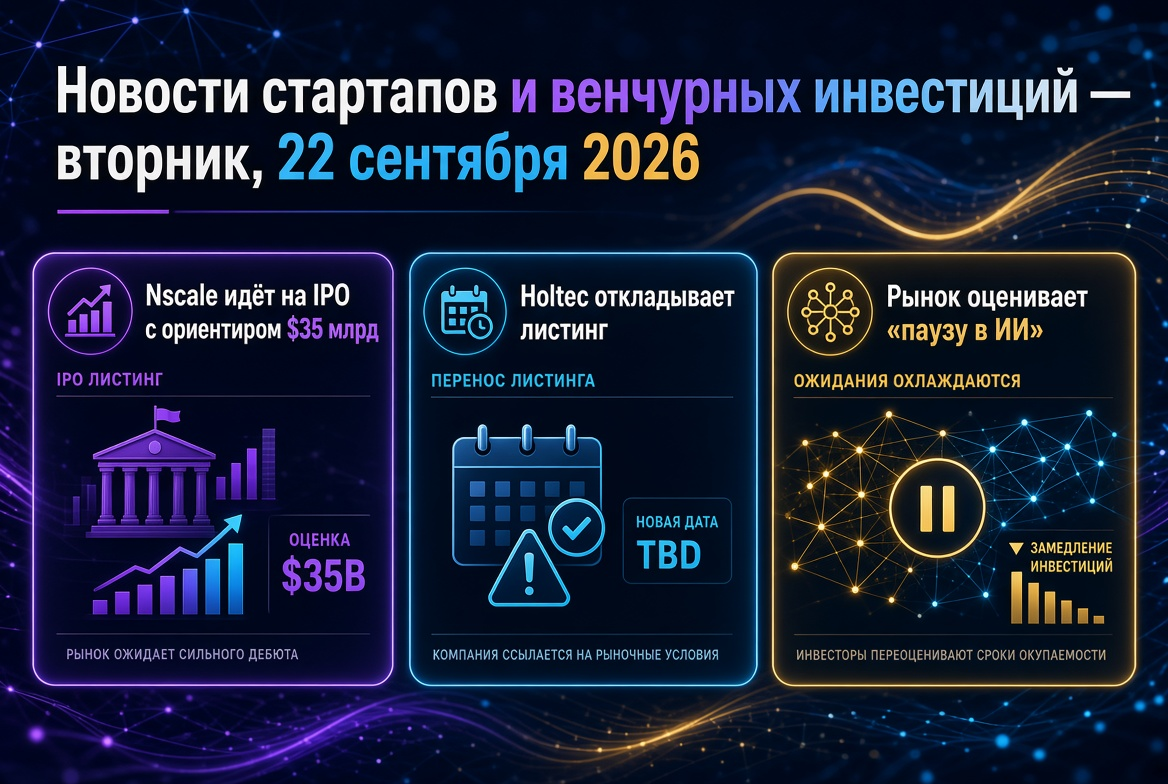
The most significant signal is the movement of major AI companies toward the public market. For the venture industry, this is not just a listing story, but a possible launch of a new exit cycle. After a period of weak liquidity, funds need successful exits to return capital to LP investors and raise new funds.
However, risks are growing too. Trillion-dollar valuations, enormous computing costs, and infrastructure dependency make future IPOs not only an opportunity, but also a test of maturity for the entire AI sector.
Europe and Asia: The Fight for Technological Sovereignty
The European venture market is strengthening its position in AI, quantum technologies, industrial software, and energy infrastructure. For European funds, an important advantage is government support for strategic technologies, particularly in segments tied to computing, defence, energy, and industrial independence.
In Asia, investor attention is focused on artificial intelligence, consumer platforms, fintech, and local technology ecosystems. Chinese AI companies continue to attract large capital despite restrictions on access to advanced chips. The Indian market is developing more selectively: investors back projects with clear domestic demand, strong distribution, and the ability to scale beyond a single city or niche.
What This Means for Venture Investors and Funds
Startup and venture capital news on 7 June 2026 shows that the market is active again, but has not become easier. Capital is available, yet it concentrates with companies that have infrastructure significance, a strong technology base, and a clear path to monetisation.
For funds, the key directions in the coming months remain:
- AI infrastructure and corporate deployment of artificial intelligence;
- energy for data centres and industrial computing;
- space logistics and satellite services;
- quantum computing and technological sovereignty;
- fintech with proven revenue and high operational value;
- startups capable of going public or becoming strategic acquisition targets.
Main Takeaway for 7 June 2026
The global venture market is entering a phase of quality selection. Mega-rounds are returning, but they are no longer going to all technology companies indiscriminately – instead, they go primarily to those building critical infrastructure for the new economy. Artificial intelligence remains the main magnet for capital, yet investors are increasingly looking not just for AI applications, but for the platforms, networks, computing, energy, and business models without which the next phase of the digital economy will be impossible.
For venture investors and funds, this is a period of great opportunities, but also of heightened analytical demands. The winners will be those who can distinguish genuine technological foundations from temporary market hype.