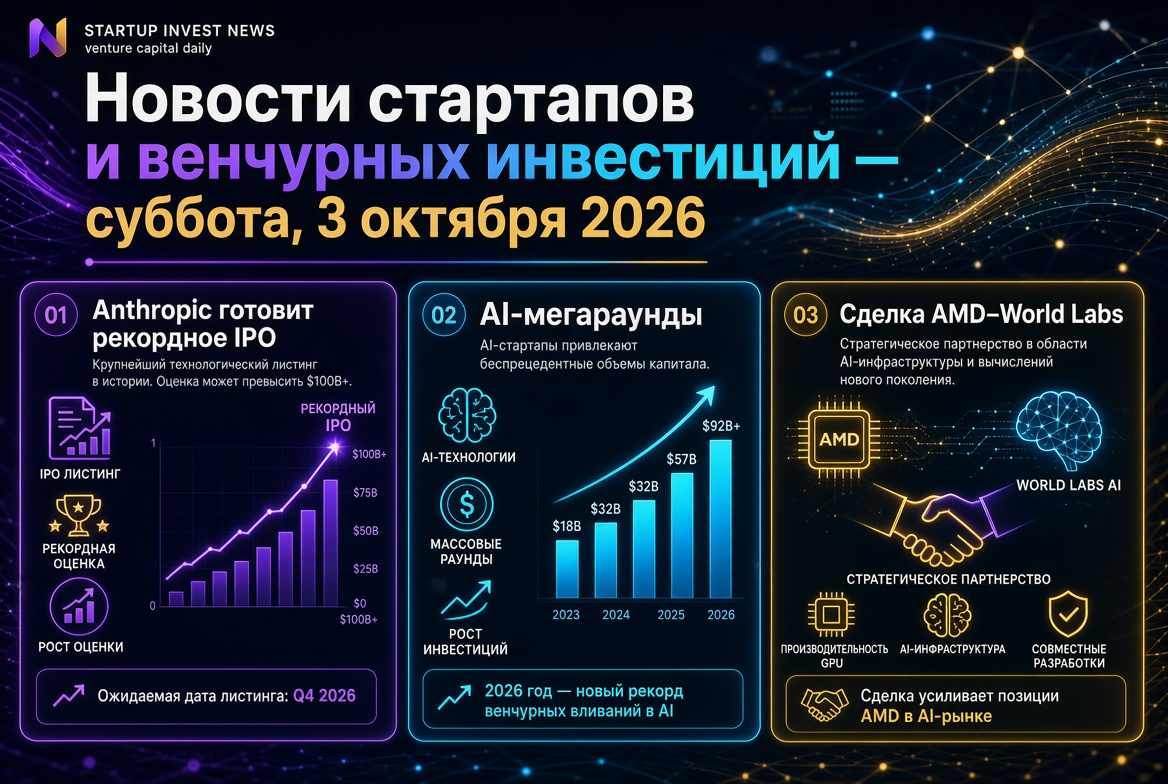
Global Startup and Venture Investment Market, Wednesday, April 29, 2026: Analysis of AI Mega-Rounds, IPOs, and Key Trends in the Global Market
Wednesday, April 29, 2026, marks a pivotal moment for the global venture market, characterized by a sharp concentration of capital around artificial intelligence, computing infrastructure, autonomous systems, and technology companies exhibiting proven growth economics. Following a record-breaking first quarter, investors are increasingly focused not only on the size of funding rounds but also on revenue quality, access to computational capabilities, business model resilience, and startups' ability to achieve liquidity through IPOs or strategic deals.
For venture investors and funds, the main theme of the day is the market's transition from broad recovery to a more selective capital allocation. Venture investments are growing again, but the growth is uneven: AI startups are securing the largest checks, infrastructure companies are becoming strategic assets, and deals involving technology from China are facing increased regulatory scrutiny.
The Global Venture Market Remains Robust, Yet Increasingly Concentrated
Reports from startups and venture investments on April 29, 2026, indicate that the market is in an unusual phase: while overall capital volume appears record-high, a significant portion is concentrated in a limited number of major deals. This signals an important shift for funds: formally, venture capital has returned to aggressive growth, but access to funding remains selective.
Notable areas of interest for investors include:
- artificial intelligence and foundational AI models;
- data center, chip, and computing infrastructure;
- robotics and autonomous systems;
- climate technologies and new energy;
- fintech and digital lending in Asia;
- consumer service startups with high usage frequency.
For venture funds, this implies intensified competition for desirable assets. Startups with strong teams, technological barriers, and access to major corporate clients are receiving valuation premiums. Conversely, companies lacking a clear monetization strategy are facing stricter unit economics requirements.
AI Startups Remain the Main Capital Magnet
Artificial intelligence continues to dominate the venture market agenda. Following a wave of investments in generative models, capital is shifting toward deeper areas: reinforcement learning, autonomous training, AI agents, data infrastructure, computational optimization, and corporate AI platforms.
For funds, this is no longer just a trend bet. The market is beginning to categorize AI companies into several tiers:
- Frontier AI — companies creating foundational models and vying for global leadership.
- AI Infrastructure — chips, data centers, interconnects, cloud capabilities, and computational optimization systems.
- Vertical AI Applications — solutions for healthcare, finance, HR, industry, logistics, and the legal sector.
- AI Agents — products that automate complex business processes and potentially replace segments of operational labor.
The key takeaway for venture investors is that simply labeling as "AI" no longer guarantees high valuations. Premiums are awarded to startups with access to unique data, strong research teams, patentable technology, and a clear path to scalability.
Ineffable Intelligence Sets a New Benchmark for the European AI Market
One of the most notable pieces of news has been the deal involving UK-based AI startup Ineffable Intelligence, founded by former DeepMind researcher David Silver. The company attracted approximately $1.1 billion at the seed stage with a valuation of around $5.1 billion. For Europe, this event carries significant implications: such a scale for an early funding round effectively changes the perception of the European artificial intelligence ecosystem.
The market sees several important signals:
- Leading researchers from major AI labs can immediately create companies with multi-billion valuations;
- European AI startups are becoming competitors to American frontier AI companies;
- Public capital and strategic investors are increasingly participating in shaping national AI infrastructure;
- Venture funds are willing to finance not only product companies but also long-term research platforms.
For venture funds, this indicates increased competition for access to scientific teams. Investments in AI are increasingly resembling strategic technological infrastructure financing rather than classic SaaS rounds.
The Meta-Manus Deal Inflates Risk Premiums in Cross-Border M&A
A second significant topic of the day is regulatory risk in transactions involving AI assets. The saga surrounding Meta and the AI startup Manus demonstrates that cross-border acquisitions of technology companies are becoming more complex. According to market reports, Chinese regulators have requested a review of the deal related to acquiring Manus, signaling to investors that the origins of the team, IP, data, and engineering resources may now hold equal importance to the legal jurisdiction of the startup’s registration.
For venture investors and funds, this creates a new risk assessment matrix:
- Where is the development team actually located;
- Which jurisdictions could claim control over intellectual property;
- Can the company be sold to a strategic buyer freely;
- Will national security become an obstacle for investors;
- How clearly are rights to code, data, and models structured.
Where a global structure previously aided startups in attracting capital, it may now become a source of uncertainty. This is particularly important for funds investing in AI, semiconductors, cybersecurity, defense technologies, and infrastructure software.
India Strengthens Its Position in Consumer and Fintech Startups
The Indian market remains one of the most active destinations for venture capital. The example of Snabbit, a home assistance service, illustrates that investors are again willing to fund consumer models if the company features a high order frequency, clear demand, and scalability potential in major cities.
For venture funds, the Indian ecosystem presents interest for three key reasons:
- a large domestic market with a growing middle class;
- rapid development of digital payments and fintech infrastructure;
- the potential to build mass services with relatively low customer acquisition costs.
However, investors must also consider the flip side: in segments like on-demand services, delivery, domestic services, and fintech, high competition often necessitates considerable marketing expenses. Therefore, a key criterion becomes not only GMV growth but also the ability to achieve positive margins at the city or cluster level.
IPO Window Opens Selectively: The Public Market Demands Scale
Amidst a robust venture quarter, investors are closely monitoring the IPO market. Public offerings are gradually coming back, but the market remains selective. Successful deals predominantly involve companies with scale, clear demand, strategic relevance, and substantial institutional investors.
A notable example is the listing of X-Energy, a developer of small modular nuclear reactors, supported by large corporate investors. The interest in such companies is linked to the energy demands of data centers, AI infrastructure, and cloud platforms. This reinforces the connection between venture investments, energy, and artificial intelligence.
What This Means for Funds
- Liquidity is returning, but not for all portfolio companies.
- The public market demands a proven business model and strategic significance.
- Companies in AI, energy, infrastructure, and fintech have greater chances of achieving premium valuations.
- Late-stage companies will increasingly be evaluated through the lens of potential IPO discounts or M&A scenarios.
Venture Capital Becomes More Disciplined
Despite record investment amounts, the market is not reverting to the logic of 2021. Venture funds have become more demanding concerning deal structures, liquidation preferences, investor rights, and reporting quality. Even rapidly growing startups must increasingly demonstrate not only revenue growth but also controlled scalability economics.
For founders, this signifies the need to prepare companies for due diligence in advance. For investors, it presents the opportunity to invest in strong assets while conducting a deeper risk assessment. The following parameters are becoming particularly significant:
- Revenue quality and the proportion of recurring revenue;
- Customer acquisition cost and payback period;
- Dependence on cloud expenses and computational infrastructure;
- Team resilience and control over key intellectual property;
- A realistic exit scenario through IPO, M&A, or secondary transactions.
Considerations for Venture Investors on April 29, 2026
The main takeaway of the day is that the venture market remains strong but has become more polarized. Capital is concentrating around artificial intelligence, energy infrastructure, fintech, autonomous systems, and companies capable of becoming strategic assets for large corporations or states.
Venture investors and funds should pay close attention to several areas:
- AI Infrastructure — data centers, chips, computational optimization, corporate AI platforms.
- Regulatory Risks — particularly in transactions involving Chinese, American, and European technology assets.
- Late Stages — companies with a clear path to IPO or strategic sale.
- India and Southeast Asia — markets with strong consumer demand and growing fintech infrastructure.
- Climate and Energy Technologies — a sector receiving an additional boost due to rising energy demands for AI.
For the global startup market, April 29, 2026, marks a day when investors are looking beyond mere growth to the quality of assets. AI continues to be the primary theme of venture investments, but real premiums will accrue to companies capable of combining technological leadership, strong economics, legal clarity of structure, and a clear liquidity scenario.