Latest Startup and Venture Capital News as of 31 May 2026: AI Startups, Mega-Rounds, Venture Funds, Deep Tech, Fintech, Climate Technologies, and Regional Competition for Capital
The global venture market is approaching the end of May 2026 in a state of sharp polarisation. On one hand, investors continue to channel record amounts of capital into artificial intelligence, AI infrastructure, defence technology, fintech, and deep tech. On the other hand, outside a narrow circle of the largest technology companies, startups still face high capital costs, rigorous selection by funds, and the demand to prove commercial viability more quickly.
The main topic for venture investors and funds on Sunday, 31 May 2026, is a new phase of the AI boom. Financing for the largest AI companies is already moving beyond classic venture capital: equity rounds are being supplemented by debt financing, strategic partnerships with cloud providers, agreements with chip manufacturers, and long-term infrastructure contracts. This is changing the very structure of the startup ecosystem and widening the gap between market leaders and second-tier companies.
Anthropic Becomes a Symbol of the New Era of AI Mega-Valuations
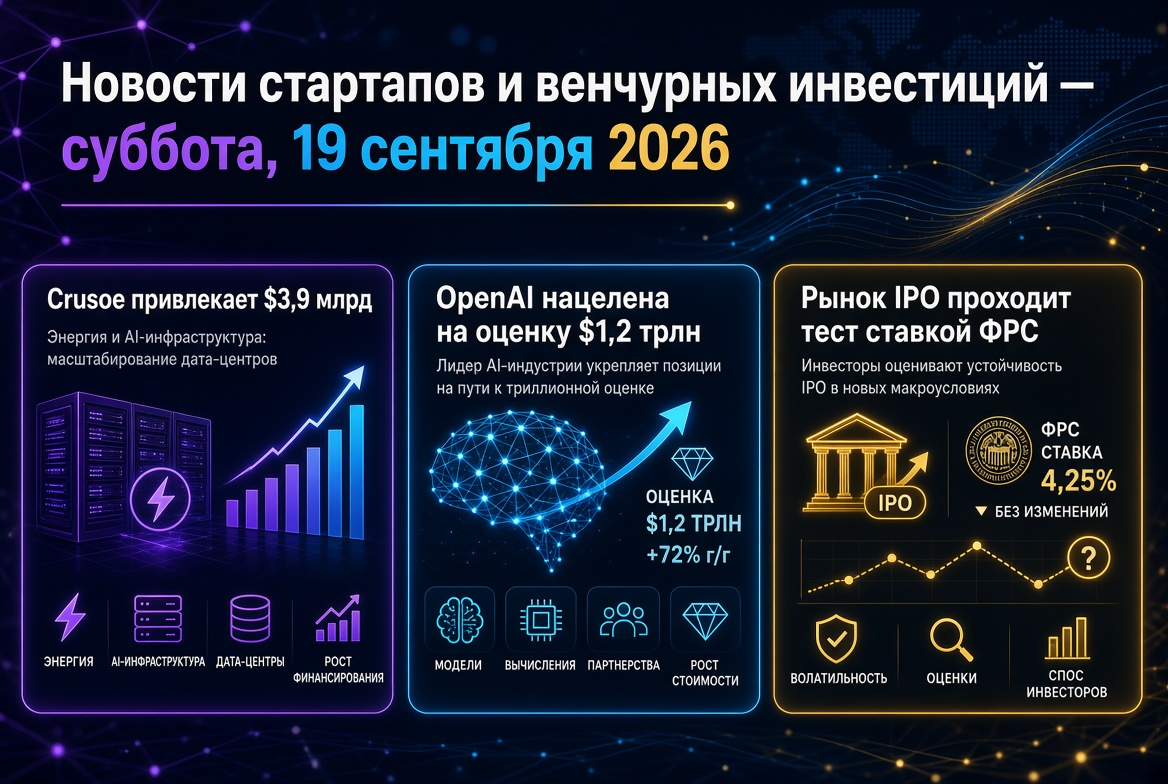
The key event of the week was Anthropic's new valuation, which after a large funding round approached the one trillion dollar mark. For the venture market, this is not just another large round but an important signal: investors are ready to value artificial intelligence leaders not as ordinary startups, but as future infrastructure platforms of the global economy.
For venture funds, this deal is important for three reasons:
- it confirms that capital continues to concentrate in the largest AI startups;
- it intensifies competition among Anthropic, OpenAI, xAI, Google, Amazon, and Microsoft;
- it shows that the market is ready to finance not only AI models but also the computing infrastructure around them.
In effect, venture investments in AI are moving from the product experiment stage to the industrial scaling stage. Now the key question for investors is not just the quality of the model, but also access to data centres, chips, corporate clients, and distribution channels.
AI Infrastructure: From Venture Rounds to Debt Financing
One of the most important trends in late May has been the involvement of major financial groups in financing artificial intelligence infrastructure. Large debt deals are being discussed around Anthropic, related to the purchase and lease of specialised computing capacity. This shows that AI startups are starting to use financial instruments characteristic of telecommunications, energy, and industrial infrastructure.
For venture investors, this means a change in the startup valuation model. If previously the main focus was on user growth, ARR, product adoption rates, and market potential, now the analysis centres on:
- the cost of computing and access to GPUs or TPUs;
- long-term commitments to cloud partners;
- the margin of AI products after accounting for infrastructure costs;
- the company's ability to turn a technological advantage into sustainable cash flow.
This is particularly important for late-stage funds, which assess not only growth but also the likelihood of a future IPO.
Fintech and Insurtech Remain Attractive for Funds
Despite the dominance of artificial intelligence, the venture market is not limited to AI models. In recent days, the insurtech sector has shown notable activity: insurance platform Corgi raised new capital and received a valuation of several billion dollars. Investor interest is explained by the fact that insurance, lending, and financial infrastructure remain large markets with high automation potential.
For funds, this is an important signal: venture investments are returning to fintech, but in a more mature format. Investors prefer not abstract 'financial applications' but platforms that:
- reduce operational costs for banks, insurers, and corporate clients;
- use artificial intelligence for scoring, underwriting, and servicing;
- operate in segments with clear monetisation;
- have the potential to scale across multiple markets.
This approach makes fintech and insurtech more resilient areas for venture funds amid high competition for quality deals.
Deep Tech and Energy Technologies Gain New Momentum
Venture investors are increasingly looking at deep tech, including nuclear fusion, space technologies, new materials, and climate solutions. Thea Energy's round of about $100 million shows that funds are ready to finance capital-intensive projects if they are linked to long-term technological advantage and strategic infrastructure.
At the same time, large technology companies and investors are launching initiatives around data centres and climate technologies. This is particularly important against the backdrop of rising energy consumption due to artificial intelligence. A new market is opening for startups: solutions for data centre cooling, energy grid optimisation, energy storage, water conservation, and emissions reduction.
Thus, the AI boom is creating demand not only for software products but also for physical infrastructure. This expands opportunities for venture investments in industrial technologies.
Defence Technologies Establish Themselves as a Separate Venture Class
Defence tech remains one of the fastest-growing areas of the venture market. Anduril's large round earlier in May confirmed fund interest in autonomous systems, sensors, defence software, robotics, and dual-use technologies.
For venture funds, this sector is becoming increasingly institutional. If a few years ago defence startups were seen as a niche market, now they compete for capital with AI, fintech, and cybersecurity. The reason is growing defence budgets, geopolitical tensions, and demand from states for rapidly deployable technology solutions.
The main risk for investors is high dependence on government contracts and regulation. However, the potential scale of the market makes defence tech one of the key areas for late-stage funds.
Europe Strengthens Its Position: London Regains Leadership
The European startup ecosystem continues to restructure. London is once again solidifying its status as Europe's leading technology hub, ahead of Paris in overall attractiveness for startups, investors, and technology companies. The main drivers are artificial intelligence, deep tech, fintech, cybersecurity, and the presence of mature financial infrastructure.
For venture funds, this means that Europe is no longer exclusively an early-stage market. More and more companies are able to scale within the region, attract international capital, and prepare for an IPO without necessarily relocating to the US.
Key European areas for investors:
- AI applications for business and the legal sector;
- fintech infrastructure and payment solutions;
- climate technologies and energy;
- cybersecurity;
- automation tools for the corporate market.
Asia: India, China, and Space Technologies
In Asia, high activity continues in AI, space technologies, and digital infrastructure. India's Skyroot Aerospace became one of the most notable examples of space sector growth: the company achieved the status of India's first space-tech unicorn. For investors, this shows that India is moving beyond traditional IT outsourcing and consumer internet.
The Chinese market, despite regulatory constraints and geopolitical risks, continues to actively finance AI startups, robotics, and semiconductor technologies. At the same time, capital is increasingly state-backed or strategic in nature. For global funds, this creates a complex picture: the market's potential is enormous, but cross-border deals are becoming more sensitive to national security and restrictions on foreign investment.
What Matters for Venture Investors and Funds
As of 31 May 2026, the venture market looks strong but uneven. Capital is available, yet it is distributed very selectively. Leaders in AI infrastructure, defence technologies, fintech platforms, deep tech, and climate solutions gain an advantage, while startups without clear monetisation face tougher valuations.
Venture investors and funds should take note of several takeaways:
- AI remains the main direction, but the market is quickly dividing into infrastructure leaders and niche applications.
- Valuations of the largest startups require deeper analysis of unit economics and computing costs.
- Fintech, insurtech, and B2B SaaS retain potential if the product solves a specific corporate problem.
- Deep tech and defence tech are becoming long-term areas for institutional capital.
- The geography of venture investments is expanding: the US leads, but Europe, India, China, and the Middle East are strengthening their positions.
The main conclusion for the startup and venture capital market: 2026 is becoming a year of capital concentration around technology infrastructure. Funds are investing less in abstract growth and more in companies that can become critical elements of the new digital economy.