Startup and Venture Capital News for 2 September 2026: The AI IPO Race, Valuations Nearing a Trillion Dollars, Record Funding for Defence and Physical AI Technologies, New Megafunds and Autumn Trends in the Global Venture Market
As September 2026 begins, the global venture market enters its decisive phase of the year. The main point of intrigue for autumn is the race for public market dominance between Anthropic and OpenAI: both companies have filed confidential IPO applications and are preparing for listings that could be the largest in the history of the technology sector. Valuations of the leading artificial intelligence companies have edged closer to the trillion-dollar mark, while venture investment in the US has already exceeded $440 billion since the start of the year.
In parallel, the market is showing structural shifts: capital is increasingly flowing into defence technology, physical AI and robotics, and energy infrastructure for data centres. The number of new 'unicorns' is outpacing last year's pace, and venture funds are closing multi-billion-dollar capital pools in preparation for the next investment cycle.
Key topics on the venture agenda for Wednesday, 2 September 2026:
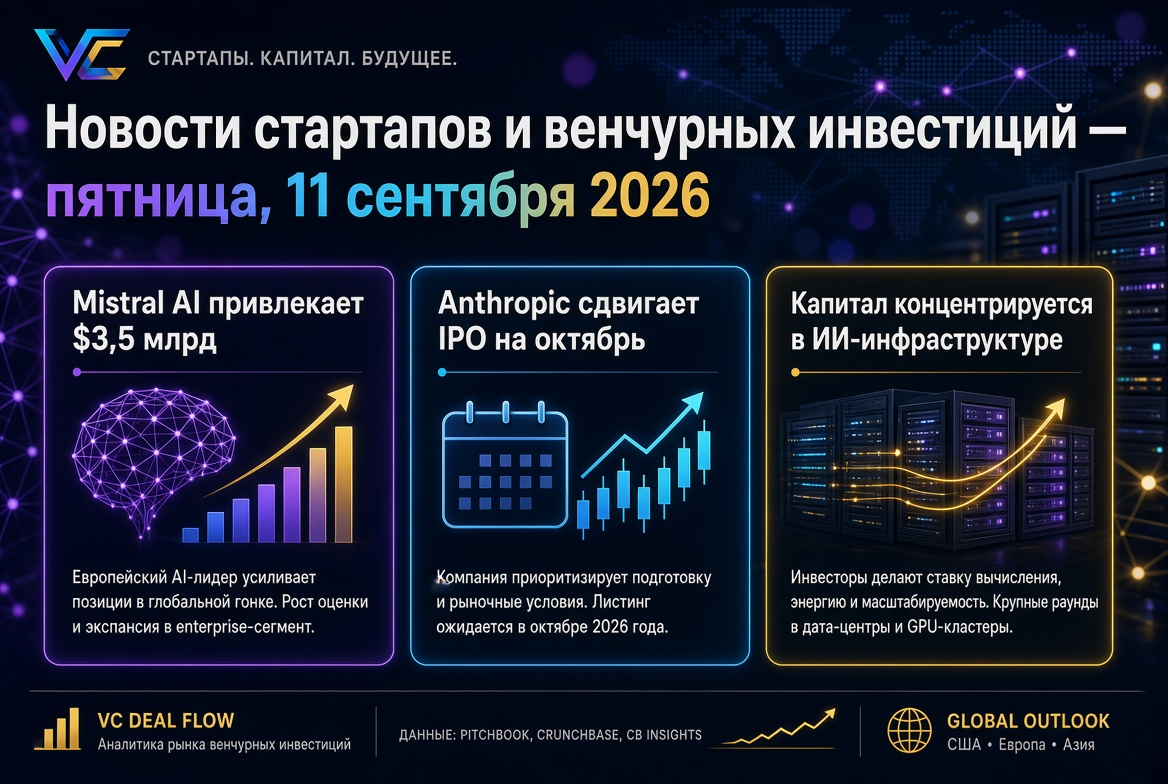
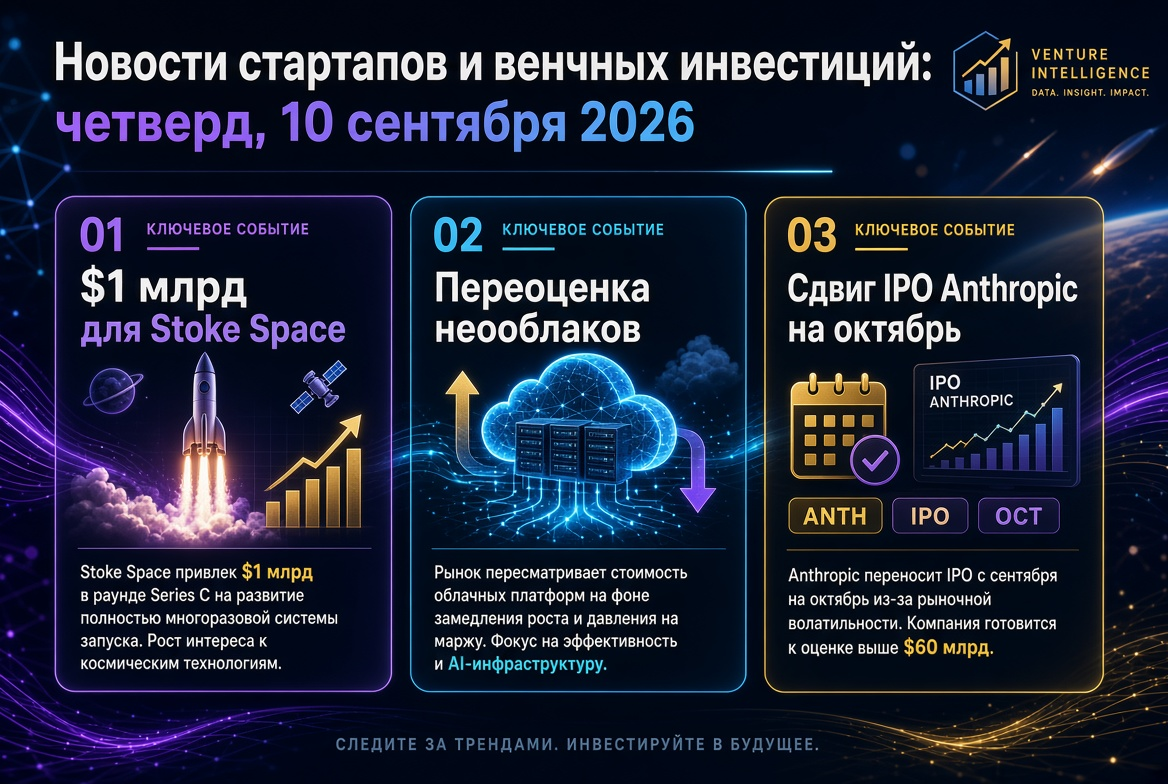
- The Anthropic-OpenAI IPO race. Both companies have filed applications with regulators; Anthropic, following a $65 billion round at a $965 billion valuation, is preparing for a Nasdaq listing as early as this autumn.
- Trillion-dollar valuations in the AI segment. The combined value of the world's two largest private AI companies is approaching $2 trillion.
- Record defence technology performance. Venture investment in defence tech reached $12.3 billion in the first half of the year—nearly double last year's level.
- The physical AI and robotics boom. Investment in the segment totalled $47.4 billion over six months, while funding for humanoid robotics companies hit an all-time high.
- New megafunds. Accel, Khosla Ventures, MGX and dozens of European managers are accumulating unprecedented volumes of capital.
- An accelerating unicorn pipeline. Since the start of the year, 250 startups have achieved unicorn status, compared to 193 for the whole of 2025.
The IPO Race: Anthropic and OpenAI Enter the Home Stretch
The central event of autumn is the contest between the two AI leaders for exchange supremacy. Anthropic filed a confidential IPO application in early June, with OpenAI following exactly a week later. Wall Street's largest investment banks are organising both listings, and each transaction is expected to raise at least $60 billion.
Anthropic, the developer of the Claude model family, looks like the race favourite. The company completed a record Series H round of $65 billion at a $965 billion valuation—the largest private venture deal in history—and, according to market reports, is already holding investor meetings, targeting a Nasdaq listing in October. The company's annualised revenue has exceeded $47 billion, up from $10 billion a year earlier—an unprecedented trajectory for enterprise software.
OpenAI, which raised $122 billion in February at an $852 billion valuation, is taking a more cautious approach: the company's chief financial officer has not ruled out a postponement of the listing to 2027, emphasising that the company is 'running its own race'. For venture funds, the outcome of this race is critical: successful listings by the industry's two flagship companies could unlock a wave of exits across the AI portfolio.
The SpaceX Lesson: Euphoria and Sobriety in Public Markets
Investor sentiment towards the upcoming listings is shaped by the experience of SpaceX—the largest IPO in history. The company listed in June at a valuation of approximately $1.77 trillion, with its market capitalisation peaking at $2.5 trillion on a minimal free float, but after the first public earnings report revealed the scale of capital expenditure on AI, the share price corrected to $1.4 trillion.
This is an important signal for the venture community: the public market is willing to pay a premium for leaders in the technology race but demands transparency regarding spending on computing infrastructure. Funds planning IPO exits are incorporating more conservative post-listing scenarios into their models.
Defence Technology: A Historic Funding Record
The defence tech segment is experiencing its best year on record. Key indicators:
- Venture investment in defence startups reached $12.3 billion in the first half of 2026—nearly double the figure for the whole of 2025 ($9.6 billion).
- More than 100 venture rounds have been announced in the sector since the start of the year, with Anduril Industries remaining the largest recipient of capital.
- Cybersecurity is receiving an 'AI boost': startups training models for cyber defence are attracting substantial seed rounds from top-tier funds.
Europe is keeping pace: new funds from Earlybird, Keen Venture Partners and Polish managers are backing defence and dual-use technologies, while counter-drone startups are closing rounds worth hundreds of millions of dollars. Investors are increasingly viewing the defence segment as an independent asset class, with government contracts serving as anchor revenue.
Physical AI and Robotics: Capital Goes into Hardware
The second structural trend of the year is the flow of venture capital from pure software solutions into physical AI. Global investment in the segment totalled $47.4 billion across 521 deals in the first half of 2026, while funding for humanoid robotics startups set a new historical record.
Recent transactions are telling: automated factory manufacturer Hadrian raised $1.37 billion, autonomous trucking company Gatik closed a $200 million round with participation from Qatar's sovereign wealth fund, and energy startup Joulent, which services AI computing infrastructure, secured $1.75 billion. Investors are financing not just technological promises but the complex challenges of physical deployment—manufacturing, logistics and energy.
Megafunds: Capital Markets for the Next Cycle
Fund managers are actively replenishing their war chests. Notable closings in recent months include:
- Accel raised $5 billion through its Leaders Fund V for 20–25 investments in the world's fastest-growing AI companies, with an average ticket size of approximately $200 million.
- Khosla Ventures is in talks to raise up to $5.5 billion across a new fund line-up.
- Abu Dhabi's MGX closed its debut fund at $49 billion, exceeding its $45 billion target, and is building Europe's largest AI campus outside Paris.
- European managers—Mouro Capital ($400 million), Earlybird (€360 million), Seedcamp ($320 million)—have formed new pools for early-stage investments.
The influx of institutional capital into large platforms confirms the trend: limited partners prefer managers capable of supporting portfolio companies from seed stage to liquidity and participating in megadeals with elevated entry thresholds.
The Unicorn Pipeline Accelerates
Since the start of 2026, 250 companies have achieved unicorn status—compared to 193 for the whole of last year. Robotics and artificial intelligence lead the way, but new billion-dollar valuations are also emerging in fintech, energy and space technology. Recent examples include stablecoin neobank Fasset ($68 million raised at a $1 billion valuation) and AI privacy platform Venice ($65 million raised at a $1 billion valuation just two years after founding). The speed at which billion-dollar valuations are reached is shrinking: companies are moving from launch to unicorn status in 18–24 months.
Regional Overview: From Europe to Central Asia
Venture activity is expanding geographically. In Europe, dual-use technologies and AI dominate the strategies of new funds, while Central and Eastern European countries are increasing government support for the venture sector. Central Asia is building its own ecosystem: Uzbekistan is establishing a $50 million venture fund for fintech innovation, with plans to attract $1 billion by 2030, while Kazakh AI startup Nace.AI has received investment from Intel's CEO. The Middle East, through sovereign structures, continues to strengthen its position in global AI infrastructure.
The Regulatory Factor: The State Enters the Game
The relationship between technology leaders and the state is becoming an independent risk-and-opportunity factor. In the US, mechanisms for state equity participation in key AI companies are under discussion, and the summer episode involving temporary export restrictions on Anthropic's latest models demonstrated that national security can directly impact the product cycles of private companies. For venture investors, this means the need to factor a regulatory premium into valuations of companies operating at the intersection of AI, defence and critical infrastructure.
Outlook: An Autumn of Decisive Listings
September 2026 opens the busiest season in the history of the venture market. The anticipated release of Anthropic's prospectus and the possible commencement of its roadshow within the coming weeks will set valuation benchmarks for the entire AI industry. Investors remain selective: capital is concentrating in companies with proven revenue, contractual bases and solutions to real infrastructure challenges. The market is entering a phase where trillion-dollar ambitions will be tested by the discipline of public reporting—and it is this test that will determine the trajectory of the venture cycle for years to come.