Latest Startup and Venture Capital News for Saturday, 16 May 2026: AI Infrastructure, Mega Valuations, IPOs, Fintech, Energy Tech and Key Trends for Venture Funds
Saturday, 16 May 2026, is shaping up as a day of sharp capital concentration for the startup and venture capital market. Investors are once again willing to pay high multiples, but not for just any technology story. The primary demand is centred around artificial intelligence, computing infrastructure, energy for data centres, autonomous systems, fintech built on stablecoin infrastructure and platforms capable of rapid global scaling.
For venture investors and funds, the current agenda matters not only because of individual large rounds. It signals a structural shift: the market increasingly resembles not a broad tech sector recovery, but a contest for a limited number of companies that could become the infrastructure layer of the new economy. Startups without a clear technological advantage, robust revenue or a strategic role in the AI value chain find it harder to raise capital, while leaders gain access to mega-funds, late-stage rounds and premium valuations.
Headline of the Day: AI Once Again Dictates Terms to Venture Capital
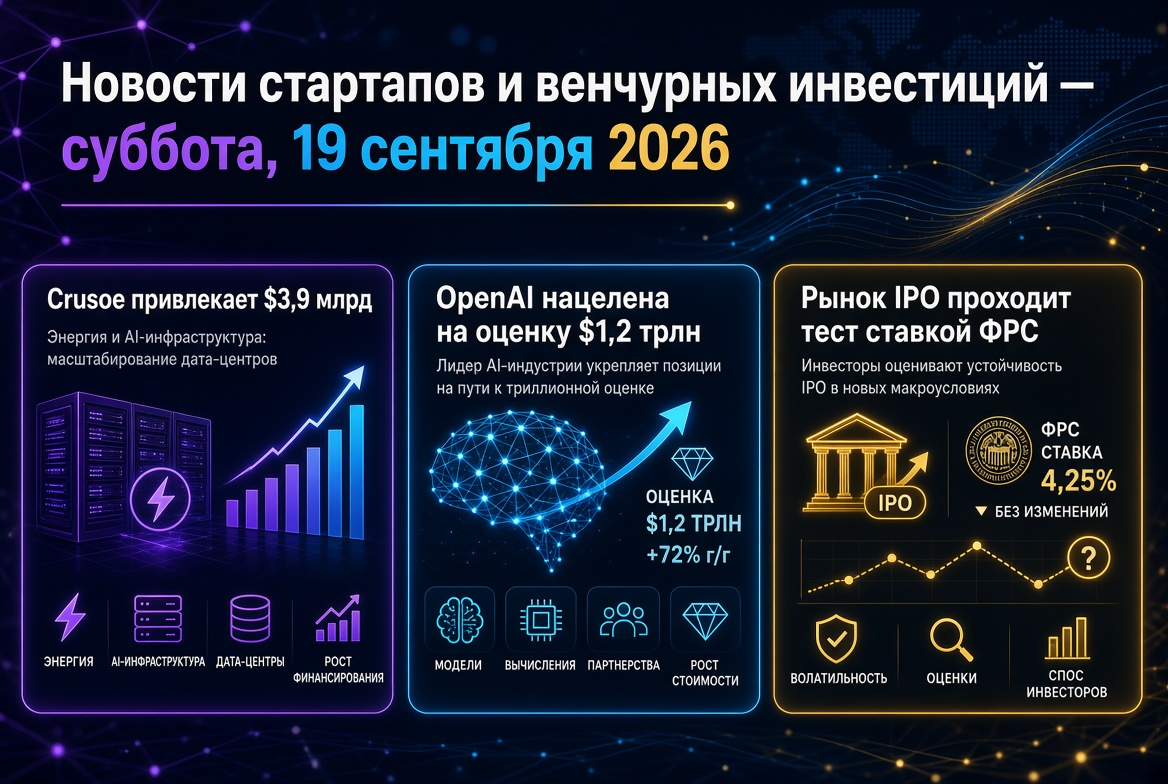
The key news for the startup and venture capital market remains a renewed wave of interest in the largest AI companies. The much-discussed deal involving Anthropic at tens of billions of dollars, with a valuation many times above previous levels, has become a symbol of the new phase in the race for frontier AI. For funds, this is a signal: the market is still willing to finance companies that control models, compute, corporate demand and a long-term technology roadmap.
However, such dynamics heighten the risk of overheating. Mega valuations require not just rapid revenue growth, but the ability to sustain margins amid enormous spending on compute capacity, data centres, security and corporate support. Consequently, venture funds increasingly evaluate AI startups not as classic SaaS companies, but as capital-intensive technology platforms with elements of an infrastructure business.
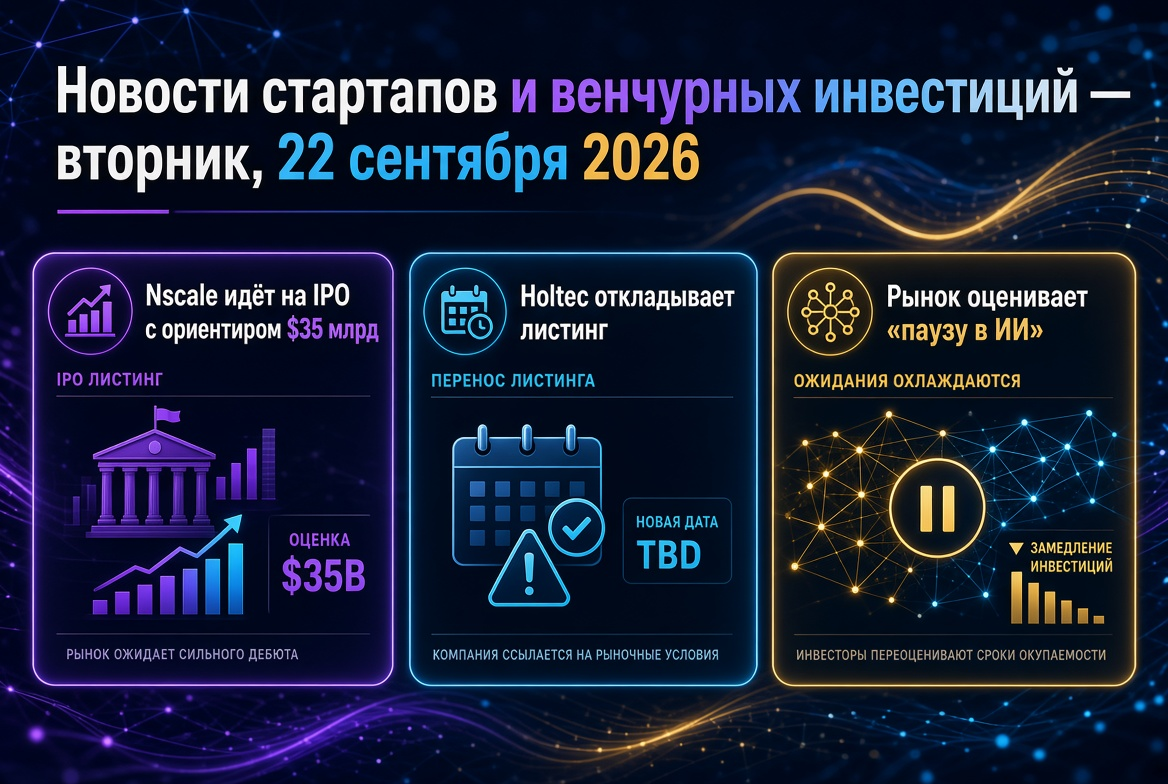
Cerebras and the IPO Window: Public Market Tests AI Stories Again
The successful public debut of AI chipmaker Cerebras has become an important indicator for the venture industry. The strong investor response to the IPO shows that the public market is ready to embrace technology companies clearly tied to AI infrastructure. For early investors, this creates hope for a thaw in liquidity after several years of cautious sentiment toward tech listings.
For venture funds, this matters for three reasons:
- It provides a benchmark for pricing late-stage AI rounds;
- It increases the likelihood of further IPOs among infrastructure and AI-adjacent companies;
- Fund limited partners gain an argument to continue allocating capital to venture.
At the same time, investors will closely watch the stability of share prices after the first days of trading. If AI companies can sustain their market capitalisation post-listing, this will strengthen confidence in new offerings. If the market quickly begins to take profits, funds will revert to a stricter assessment of revenue, gross margin and customer concentration.
India Strengthens Its Position: Rapido Raises Capital to Scale Its Mobility Platform
One of the notable deals of the day is Rapido raising new capital at a valuation of around $3 billion. The Indian mobility platform is developing in a competitive ride-hailing segment where key factors include trip pricing, driver network density, local regulation and the ability to operate not only in the largest cities but also in fast-growing regional markets.
For global funds, this deal is important as confirmation of continued interest in India. The market remains challenging due to pricing competition and driver acquisition costs, but the scale of demand makes it strategic. Rapido shows that investors are willing to finance not only AI startups, but also platforms with real operational density, local advantages and potential to expand into adjacent services.
Stablecoin Fintech: Fasset Highlights Demand for New Payment Rails
The fintech space also remains in focus. Fasset raised $51 million to develop a stablecoin-oriented neobank model targeting emerging markets, cross-border payments and small businesses. This deal reflects a broader trend: investors are seeking companies that use blockchain not as a speculative asset, but as a payment and settlement infrastructure.
For venture funds, stablecoin fintech is interesting for several reasons:
- It solves the real problem of expensive international transfers;
- It can scale in countries with insufficient banking infrastructure;
- It allows building credit, trade finance and treasury products on top of a payment base.
The main risk remains regulation. As a result, the most attractive startups are those combining technological speed with a transparent compliance model, licences and partnerships with institutional investors.
Energy Tech and Data Centres: Electricity Becomes the New Bottleneck for AI
The growth of the AI industry is increasingly constrained not only by chips, but also by access to electricity. GridCARE’s $64 million round shows that venture capital is beginning to actively finance companies that help data centres connect to power grids faster, find unused capacity and optimise infrastructure constraints.
This segment is becoming especially important for funds operating at the intersection of AI, climate tech, energy and industrial software. Whereas investment logic was previously built around models and applications, physical infrastructure now receives much more attention: power grids, cooling, generation, storage, data centre connectivity and software systems for load management.
An additional signal is Lightrock’s new $500 million fund focused on clean energy in Asia and Africa. This shows that the energy transition and access to affordable electricity are becoming not only an ESG theme, but an investment necessity for the digital economy.
Workforce AI: Corporate Training Becomes a Standalone Investment Category
Multiverse’s $70 million round at around $2.1 billion valuation underscores growing interest in platforms that help companies adapt their workforce to the new AI economy. The workforce transformation theme is becoming increasingly investment-relevant: businesses need not only AI tools, but also employees capable of using them in sales, operations, finance, logistics and customer service.
For venture investors, this space is interesting because it sits between edtech, enterprise software and consulting. Winners may be companies that do not simply sell courses, but integrate into corporate processes, measure employee productivity and demonstrate the economic impact of AI skills.
Capital Geography: US Leads, but Asia and Europe See Targeted Demand
The global venture capital market remains asymmetrical. The US continues to concentrate the largest AI rounds and infrastructure deals, yet India, Europe, Asia and Africa attract capital in categories with strong local demand. India draws investment into mobility and fintech, Europe into workforce AI, blockchain analytics and clean energy, while emerging markets attract funding for payments and energy infrastructure.
This means that funds need to assess not only technology, but also regional market structure. In some countries, the advantage lies in access to corporate clients; in others, low banking penetration; in still others, energy deficits or rapidly growing consumer demand.
What Matters for Venture Funds in the Coming Weeks
For venture investors and funds, the agenda on 16 May 2026 yields several practical takeaways. First, AI remains the main magnet for capital, but simple positioning in the theme is no longer sufficient. What is needed is demonstrable revenue, an infrastructure role, a strong team and a clear scaling economics.
Second, the market is again beginning to view IPOs as a viable liquidity path. This could improve conditions for late-stage rounds and secondary deals, but simultaneously raise demands for transparency in financial metrics. Third, capital is flowing more actively into adjacent sectors: energy for AI, stablecoin payments, workforce transformation, mobility and industrial automation.
Conclusion: The Venture Market Has Recovered, but Has Become More Selective
The startup and venture capital news on Saturday, 16 May 2026, reveals a market that is no longer in deep freeze, yet has not returned to the broad euphoria of past cycles. Capital is available, large deals are happening, the IPO window is cracking open, but money is distributed with extreme selectivity.
The main takeaway for funds: the winners of the current cycle are startups that control the critical infrastructure of the new economy — AI models, chips, power grids, payment rails, corporate training, mobility and software platforms capable of global scaling. For investors, the coming months will be a test of discipline: it is not enough to simply participate in a trending theme; one must select companies where technological advantage translates into sustainable market power.