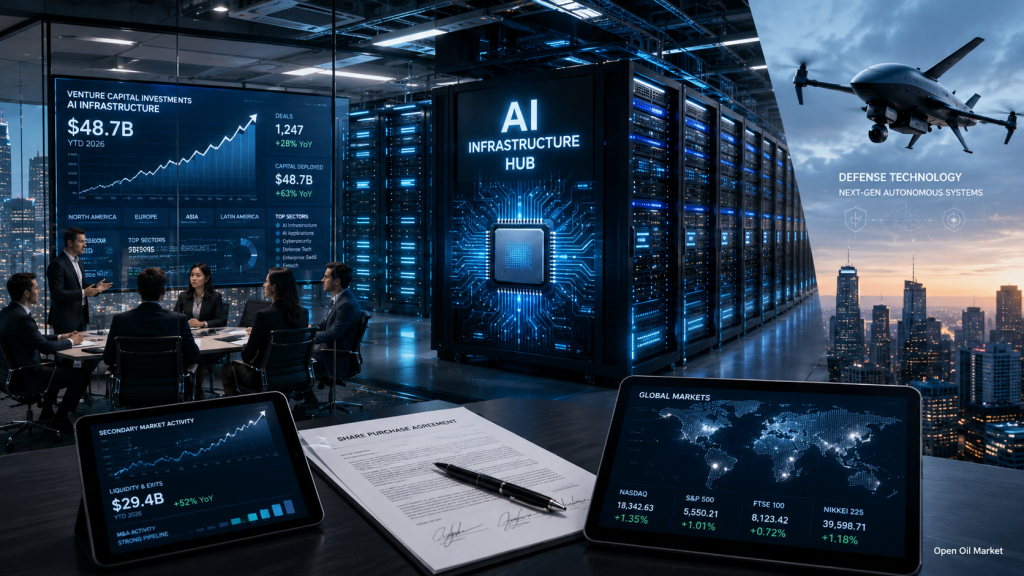
Current Trends in Startups and Venture Investments as of July 6, 2026: Record Capital in AI, Mega-Rounds, Growth in Defence Tech, Secondary Transactions and the Return of Exit Markets
The global market for startups and venture capital enters July 2026 with robust, albeit highly uneven, growth. Formally, the venture market appears over-heated again: funding volume in the first half of the year has reached historic highs, major funds are actively returning to deals, and tech companies are once again receiving valuations characteristic of peak market phases. However, an important feature within this upturn is noticeable: capital is not being distributed throughout the startup ecosystem; rather it is concentrated around several key areas—artificial intelligence, AI infrastructure, chips, autonomous systems, defence tech, robotics, video analytics, and enterprise AI platforms.
For venture investors and funds, the critical question now is not whether the market is growing but rather where sustainable value is forming. Startups that can demonstrate revenue, technological advantage, access to computing infrastructure, and a clear scaling model are receiving capital even amidst high valuations. Other companies face stricter due diligence, increasing demands for unit economics, and dwindling interest in stories lacking commercial validation.
Defining Trend of the Day: Capital Flows into AI Infrastructure, Not Just AI Applications
Venture investments in artificial intelligence continue to dominate the global agenda. However, the structure of demand from funds is changing. While in 2023–2025, a significant portion of capital was directed toward generative AI applications, chatbots, and foundation models, by mid-2026, investors are increasingly betting on the infrastructural layer.
Key areas currently receiving valuation premiums include:
- AI inference—infrastructure for deploying models in real corporate scenarios;
- chips and specialized semiconductors for artificial intelligence;
- platforms for training and deploying open-source AI models;
- video intelligence, multimodal data processing, and enterprise search;
- autonomous systems, drones, and defence tech;
- tools for reducing computation costs.
This is why recent startup news indicates that venture funds are not simply looking for “another AI application,” but rather for companies that control critical elements of the new technological chain—computation, data, models, security, integration, and industrial application.
Together AI: Open Models Become an Investment Theme
One of the largest events for the venture market was the new $800 million round for Together AI, which was valued at approximately $8.3 billion. The company is building a platform that enables businesses to train and deploy AI workloads based on open models. For funds, this sends an important signal: the market is searching for alternatives to closed ecosystems and aims to reduce dependence on a few major providers of foundation models.
The investment logic surrounding Together AI is built on three theses:
- Lowering AI Costs. Corporate clients want to use artificial intelligence more affordably and flexibly.
- Growth of Open-Source Models. Models with open architecture are becoming a real alternative to closed solutions.
- Sovereign AI. Companies and governments are seeking greater control over infrastructure, data, and computation.
For venture investors, this implies that the infrastructure surrounding open AI may become a standalone asset class. Such startups do not necessarily need to compete directly with the largest labs; they can generate revenue through operations, optimization, integration, and cost reduction in AI implementation.
Baseten, Oxmiq and Etched: The Race for AI Computation Accelerates
AI infrastructure remains the hottest segment of venture investments. Baseten raised $1.5 billion at a valuation of around $13 billion, reinforcing the thesis that the AI inference market is becoming a significant category on its own. Demand for such solutions is growing as companies shift from AI experimentation to industrial deployment of models.
In the chip segment, investors are drawn to startups that aim to reduce market reliance on a limited number of GPU suppliers. Oxmiq secured $35 million for the development of a licensable architecture for AI chips. Etched reportedly raised $800 million for the development of specialized chips for AI inference. These deals illustrate that venture capital is increasingly delving deeper into the technology stack—from applications to hardware, computational architecture, and memory packaging.
For funds, this presents both an opportunity and a risk. On one hand, infrastructure startups can become strategic assets with high capitalization. On the other, the capital intensity of such projects is substantially higher, and the timelines for returns on investment are longer compared to traditional SaaS companies.
Quantum Systems: Defence Tech Transforming into a Full-fledged Venture Sector
German drone manufacturer Quantum Systems raised $1.2 billion at a valuation of approximately $8 billion. This is one of the most significant events for the European venture market and the defence tech sector. The company operates in the realm of autonomous systems, drones, and software for managing complex operations.
The growth of Quantum Systems reflects a broader trend: defence technology has ceased to be a niche for a narrow circle of government contractors. In Europe, the US, and the Middle East, a new class of companies is emerging that integrates software, robotics, sensors, artificial intelligence, and industrial production.
For venture funds, defence tech is becoming attractive for several reasons:
- long-term demand from governments and large defence contractors;
- the potential for rapid scaling of autonomous systems;
- the strategic significance of dual-use technologies;
- increased budgets for security and technological sovereignty;
- potential M&A deals with large industrial and defence groups.
However, investors must be cautious of regulatory restrictions, export control laws, and the political cycle dependencies of such startups.
Secondary Liquidity: ElevenLabs Sets a New Standard for Maturity
Another key topic for the venture market is the rise of secondary transactions. ElevenLabs, one of the most notable AI startups in voice synthesis, is discussing a secondary sale of shares at a potential valuation of around $22 billion. This is more significant for the market than it may appear at first glance.
Secondary deals address several issues simultaneously:
- they provide partial liquidity to employees and early investors prior to an IPO;
- they help retain key teams amid competition for AI talent;
- they establish a market benchmark for valuation without a public listing;
- they reduce pressure on companies that might not benefit from going public too early.
For venture funds, the secondary market is becoming not just a supplementary tool, but an integral part of portfolio management strategy. This is especially crucial for late-stage investments, where exit timelines have stretched, and valuations remain high.
TwelveLabs and the New Wave of Multimodal AI
Startup TwelveLabs raised $100 million in Series B for the development of video intelligence. This round illustrates how demand for AI products is evolving. The market is gradually moving beyond text models towards multimodal systems capable of understanding video, sound, images, context, and user behavior.
For the corporate market, such technologies are particularly vital in the following segments:
- media and advertising;
- security and surveillance;
- education and corporate training;
- e-commerce and personalization;
- industrial analytics;
- searching video archives and content databases.
Venture investors will closely monitor which multimodal startups can not only demonstrate their technology but also convert it into recurring revenue. In 2026, the market is increasingly reluctant to pay for beautiful demonstrations and is demanding more evidence of implementations with large clients.
IPO and M&A: Exit Markets are Again a Valuation Factor
One of the main distinctions of 2026 from previous periods is the return of liquidity. The market is once again discussing significant IPOs, tech placements, strategic acquisitions, and deals between public and private companies. For venture funds, this is critically important: without a clear exit window, it is impossible to sustain high valuations in late-stage investments.
The most promising candidates for future exits can be found in the following categories:
- AI infrastructure and foundation models;
- semiconductors and specialized computing;
- defence tech and autonomous systems;
- robotics;
- cybersecurity;
- fintech and payment infrastructure;
- healthtech and biotechnology.
However, the IPO market remains selective. Investors demand substantial revenue generation, clear margins, strong corporate governance, and a transparent path to profitability. Companies with high valuations but poor financial discipline will face discounts.
Geography of Venture Investments: The US Leads, Europe Follows, Asia and the Middle East Strengthen Their Roles
The US remains the primary center for global venture capital, especially in AI, chips, software infrastructure, and late-stage investments. However, Europe significantly enhances its position in 2026, aided by advancements in defence tech, industrial AI, climate technologies, and deeptech. The Quantum Systems deal has become a symbol of the European market's capacity to create companies with global valuations.
Asia retains strong positions in semiconductors, robotics, consumer platforms, and manufacturing technologies. Chinese and South Korean companies are active in AI video, chips, and hardware solutions. The Middle East is strengthening its role through sovereign funds, corporate venture arms, and investments in AI infrastructure. For global funds, this creates a new competitive landscape: capital is no longer solely concentrated in Silicon Valley.
For investors from the CIS and emerging markets, this opens windows of opportunity in adjacent niches: B2B SaaS, fintech, logistics, energy technologies, industrial automation, cybersecurity, and applied artificial intelligence for the real sector.
What is Important for Venture Investors and Funds as of July 6, 2026
The current state of the startup and venture capital market necessitates discipline rather than euphoria. Record capital volumes do not imply that all startups will once again easily obtain funding. On the contrary, the gap between leaders and the rest of the market is widening.
Venture investors should pay attention to several factors:
- Quality of Revenue. It is essential to differentiate between rapid ARR growth and sustainable demand along with repeatable sales.
- Cost of Computation. For AI startups, infrastructure costs have become a key factor for marginability.
- Technology Protectiveness. Funds will pay a premium for startups with unique data, chips, models, or distribution.
- Path to Exit. IPOs, M&A, and secondary transactions should again be considered in the investment thesis.
- Geopolitical Factor. Defence tech, sovereign AI, and local computing platforms are becoming integral parts of the investment strategy.
The main takeaway for Monday, July 6, 2026, is that the venture market has entered a new phase of growth, but this growth has become more concentrated, capital-intensive, and technologically complex. The best opportunities are found where a startup addresses an infrastructural challenge in a large market, demonstrates proven commercial traction, and holds the potential to become a strategic asset for corporations, governments, or public investors.
For funds, this is no longer a market of mass optimism but rather one of selective picking. Those investors who can distinguish a true technological platform from a fleeting AI hype earlier than others will prevail.