Current News on Startups and Venture Investments as of July 11, 2026: Venture Capital Re-Focuses on AI, Deep Tech, Cybersecurity, Quantum Computing, and AI Infrastructure
The global venture market enters mid-July 2026 with heightened activity: major funds are returning to aggressive capital deployment, AI startups continue to attract mega-rounds, and the IPO and M&A market is becoming an important liquidity channel for venture investors once again. For venture funds, family offices, institutional investors, and corporate strategists, the key question now is not whether there is capital in the market but where the risk of overheating is already too high and where the next wave of technological value is forming.
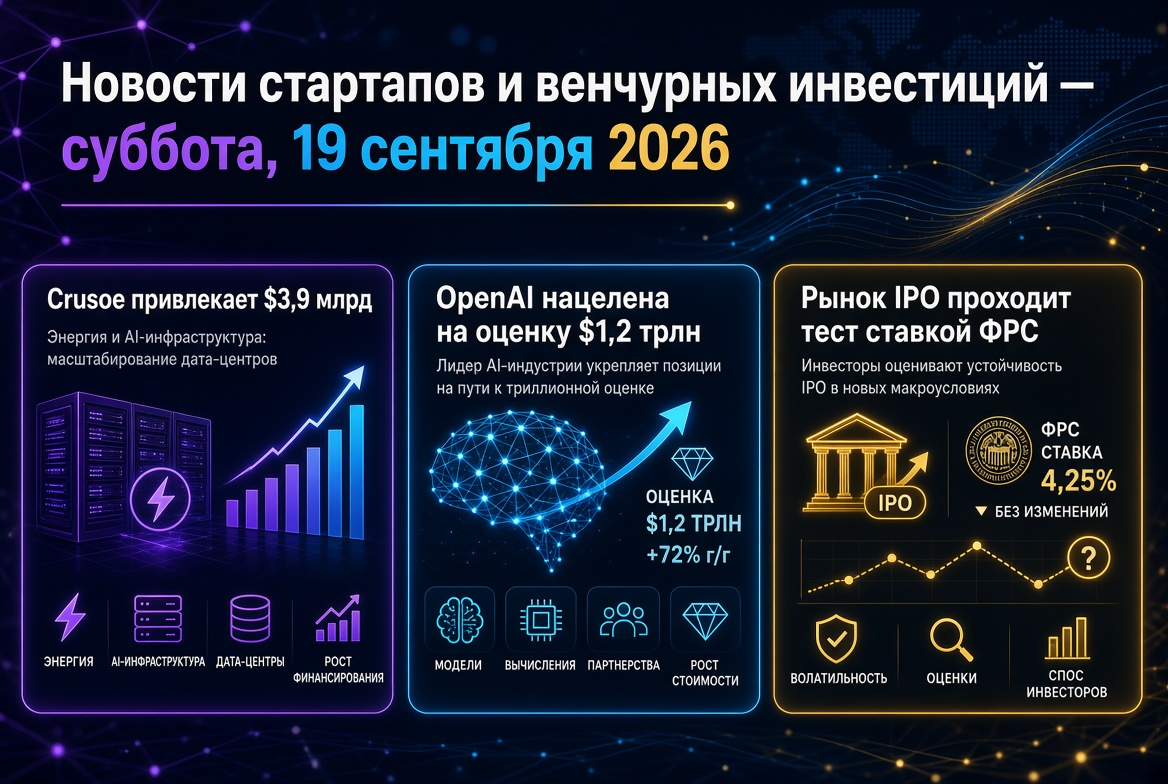
The main topic of the day is the increasing demand for AI infrastructure. Investors are becoming more active in financing not just AI model developers but also companies that create computing power, chips, developer tools, cybersecurity, data, voice AI, legal AI, and corporate process automation. Venture investments are becoming more concentrated: the best startups are receiving large checks, while companies lacking revenue, technological advantages, and clear unit economics face stricter selection criteria.
Today's Major Trend: Capital Flowing into AI Infrastructure
Startups related to AI infrastructure remain a central direction for venture capital. There is an increasing demand for solutions that enable companies to train models more cheaply, launch inference workloads faster, control corporate data, and reduce dependence on closed AI ecosystems.
For investors, this means a shift from the emotional demand for "any AI startup" to a more mature investment logic. The most interest is directed toward projects that address fundamental market constraints:
- the shortage of computing power and GPUs;
- the rising cost of training and operating models;
- the need to protect corporate data;
- the transition from AI experiments to industrial implementation;
- demand for automation of legal, financial, and operational processes.
This is why venture funds are increasingly looking at infrastructure startups as "shovel providers" for the new technological economy.
Weekly Mega-Rounds: SambaNova, Keyfactor, and the Large Check Market
A notable signal for the market is the return of large deals. Among the week’s largest rounds are SambaNova's funding of approximately $1 billion in the AI infrastructure sector and Keyfactor's deal of around $1 billion in cybersecurity and digital identity management. These rounds indicate that investors are willing to pay a premium for companies at the intersection of AI, security, enterprise software, and critical infrastructure.
For venture investors, this is an important indicator: capital is once again available for late-stage investments, but only if there is a strong technological position, a large addressable market, and a clear role in the value chain. Unlike the boom of 2020-2021, the 2026 market demands that startups not only grow but also prove their product's strategic necessity.
Quantum Computing: Oratomic Attracts Attention from Deep Tech Investors
A separate focus of the day is quantum technologies. Startup Oratomic has raised around $300 million in a Series A round for the development of a commercially viable quantum computer. For the deep tech market, this is an important signal: investors are once again willing to fund complex scientific projects with a long payback horizon if the team demonstrates technological breakthroughs and potentially asymmetric returns.
Quantum computing remains a high-risk direction, but its investment attractiveness is growing amid demand from pharmaceuticals, chemicals, logistics, cryptography, materials science, and artificial intelligence. For funds, this is not a mass bet but a portfolio option on the technological shift of the next decade.
Open-Source AI and Developer Tools: Ollama Strengthens the AI Tooling Market
Another important segment is developer tools and open-source AI. Ollama has raised $65 million in Series B and has become a notable example of how open AI infrastructure is evolving into a standalone asset class. The company is developing tools that allow developers to run open-weight models both locally and in the cloud, lowering the barriers to AI adoption.
For venture funds, this segment is interesting for several reasons:
- developers are becoming a key channel for distributing AI products;
- open-source ecosystems rapidly form network effects;
- enterprise clients seek more control over models and data;
- monetization can be structured through cloud services, subscriptions, and enterprise features.
AI tooling remains one of the most competitive but also one of the most promising areas of the venture market.
Europe Gaining Momentum: UK, Germany, France, and the AI Ecosystem
The European venture market is showing its strongest dynamics in several years. In the second quarter of 2026, European startups raised a significant amount of capital, with the UK maintaining its role as one of the main centres for tech funding. Germany, France, Sweden, and the Netherlands are also strengthening their positions through robotics, biotech, quantum, semiconductor, AI labs, and energy tech.
Investor interest is particularly focused on European AI. Paris-based AI voice startup Gradium secured about $100 million in seed funding with major tech investors participating. This confirms that Europe is attempting to compete not only in applied products but also in foundational AI models, voice interfaces, and infrastructure for corporate use.
Asia and Hong Kong: MiniMax, Shein, and the Return of Tech IPOs
The Asian agenda remains busy as well. Chinese AI company MiniMax announced plans to raise about $2.05 billion through equity sales and the issuance of convertible bonds. The funds will be directed towards research, commercialization, hiring, and developing its AI business. This shows that Hong Kong is once again becoming an important hub for tech companies, especially in the sectors of artificial intelligence, semiconductors, and advanced manufacturing.
An additional signal for the market is Shein's advancement towards an IPO in Hong Kong. Despite regulatory and reputational risks, the potential listing of a large consumer tech company could support the late-stage market and provide venture investors with more benchmarks for valuing growth companies.
Legal AI, Compliance, and Automation: Capital Flows into Regulated Industries
The legal AI and compliance automation segment is becoming one of the most attractive directions for B2B startups. Norm AI secured a large round and achieved a valuation above $1 billion, underscoring the corporate demand for automation of legal and regulatory processes.
For venture funds, this sector is important as it combines three qualities: a high level of customer pain, recurring revenue, and product replacement difficulty. With increasing regulation of AI, financial markets, personal data, and corporate reporting, the demand for legal tech and compliance AI may remain steady even amid a cooling appetite for risk.
India and New Funds: Institutional Capital Returns to the Growth Market
The Indian venture ecosystem also demonstrates signs of revival. The launch of the new Fundamentum fund, approximately $200 million in size, shows that local funds continue to raise capital for investment in Series B and later stage startups. This is particularly important for India: the market is gradually evolving from a "growth at any cost" model to a more mature approach that values revenue, operational discipline, scalability, and profitability capabilities.
Investors are closely observing Indian fintech, SaaS, consumer tech, and digital infrastructure companies. Against the backdrop of growing domestic markets and digital infrastructure, India remains one of the key regions for global venture strategies.
What Matters to Venture Investors and Funds on July 11, 2026
For venture investors, the current agenda leads to several practical conclusions. First, AI remains the primary driver of venture investments, but infrastructure and B2B models show the greatest resilience. Second, deep tech is again receiving large checks but requires high expertise and a long investment horizon. Third, the IPO and M&A market is gradually restoring its liquidity function, which is important for funds with portfolios from 2019-2022.
Key areas to watch:
- AI infrastructure, inference, GPU cloud, and open-source models;
- cybersecurity and digital identity management;
- quantum computing, robotics, and semiconductor startups;
- legal AI, compliance automation, and enterprise software;
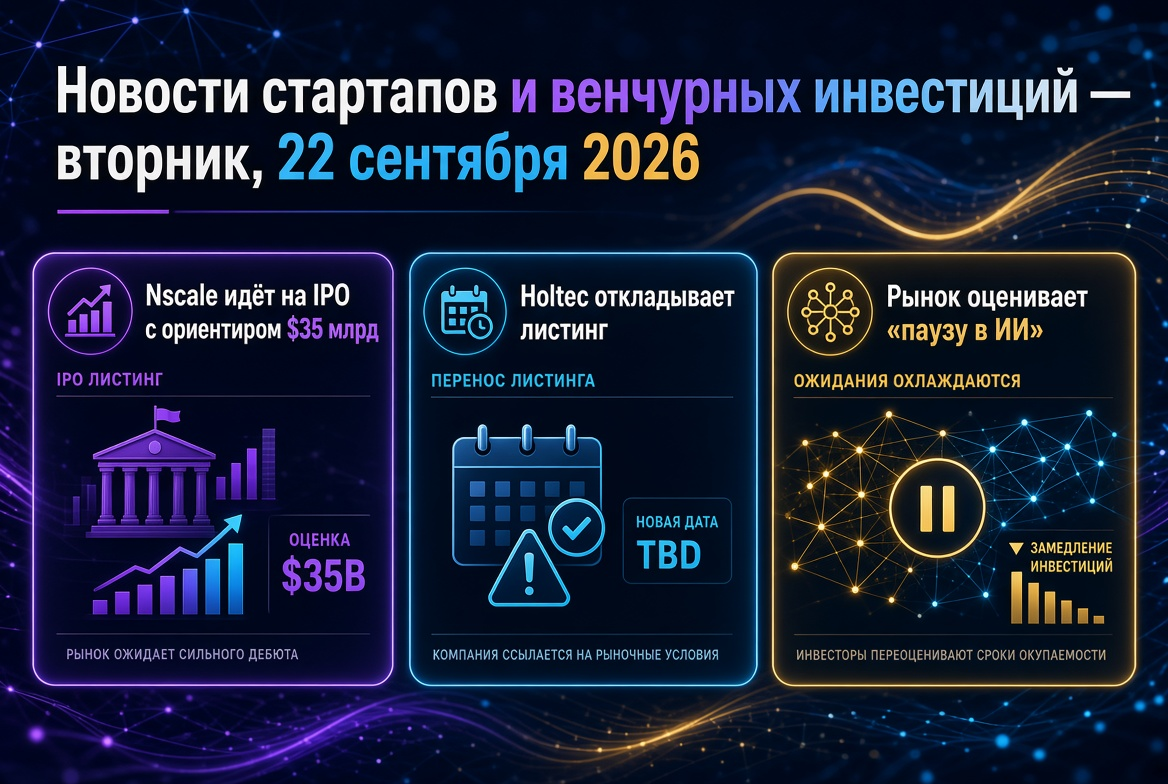
- IPOs in Hong Kong, the USA, and Europe;
- new funds in India, Europe, and the Middle East.
The main takeaway: the venture market of 2026 no longer appears to be a simple recovery cycle following a downturn. It is becoming more concentrated, technologically complex, and institutional. It is not the loudest startups that win but rather the companies that control critical elements of the new AI economy: computing, data, security, automation, and access to corporate clients.