Current Cryptocurrency News as of April 22, 2026: Bitcoin's Surge, ETF Inflows, Ethereum's Development, and the Growing Role of Stablecoins in the Global Market
The global cryptocurrency market approaches Wednesday, April 22, 2026, in a more organized state than at the beginning of the month. Following a volatile first quarter, the cryptocurrency market is regaining support from several directions: institutional capital is returning through ETFs, major corporations are continuing to increase their Bitcoin holdings, and regulators and banks are increasingly discussing the future of stablecoins and tokenized settlements. For investors, this signifies that cryptocurrency news is once again shaped not only by speculative demand but also by structural shifts in the global financial system.
Bitcoin Sets the Tone for the Entire Market
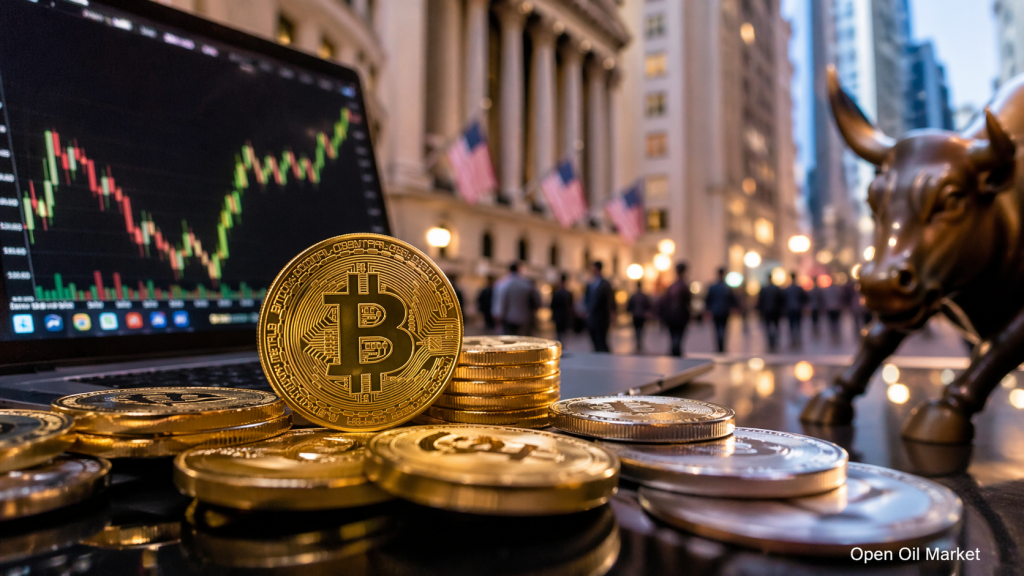
Bitcoin remains the primary driver of the global cryptocurrency market. It shapes investor sentiment, retains capital within digital assets, and continues to attract the majority of institutional demand. Following a challenging start to the year, the market is gradually returning to a logic where Bitcoin is viewed not just as a speculative asset but as the key benchmark for the entire crypto industry.
In this context, it is particularly important that Bitcoin's rise is accompanied by a combination of factors:
- a revival of global risk appetite;
- steady inflows into crypto ETFs;
- new corporate purchases of BTC;
- a sustained high share of Bitcoin in overall market capitalization.
For global investors, this signals that cryptocurrencies are currently once again concentrating around the largest asset, and only thereafter capital begins to gradually redistribute into Ethereum and select altcoins.
Strategy Doubles Down on BTC, while Institutions Support the Momentum
One of the key news items in the cryptocurrency realm ahead of April 22 is a substantial Bitcoin acquisition by Strategy. Such transactions are significant not only in themselves but also as a market indicator: major public capital continues to see dips as an opportunity to build positions rather than a signal to exit the market.
When companies of this scale increase their BTC reserves, it influences multiple areas:
- it reduces the available supply of coins on the market;
- it supports the confidence of long-term investors;
- it enhances Bitcoin's status as a corporate reserve asset;
- it lays the groundwork for a new round of interest from funds and family offices.
This is why the cryptocurrency market is currently reacting not just to the price of BTC but also to the demand structure itself. When the growth is supported by ETFs, public companies, and banking products, the market becomes more mature and less reliant on short-term retail euphoria.
ETFs Remain the Main Bridge Between Wall Street and the Crypto Market
Another important topic for investors is the increasing significance of exchange-traded funds (ETFs). Cryptocurrency news in April more frequently revolves around ETFs, as this channel brings in the most predictable and large-scale capital. Nearly a billion dollars in weekly inflows into American spot Bitcoin ETFs indicates that the interest of major investors has not waned, despite the volatility at the start of 2026.
The expanding product lineup of major financial groups adds further significance. The launch of new ETF solutions and applications from traditional banks implies that cryptocurrencies are firmly establishing themselves within the classic investment infrastructure.
This creates several consequences for the market:
- it enhances the liquidity of major crypto-assets;
- it lowers the entry barrier for conservative capital;
- it increases the likelihood of more stable medium-term trends;
- it widens the gap between market leaders and weaker altcoins.
In other words, the global cryptocurrency market is increasingly split between institutionally supported assets and all other projects.
Ethereum Strengthens Fundamentals, Although Market Attention Remains Focused on Bitcoin
Ethereum enters mid-April with a stronger fundamental picture than may have been suggested by price dynamics. Network activity is rising, the number of transactions is increasing, and interest in the ecosystem remains robust due to stablecoins, DeFi, and asset tokenization. This is particularly significant at a time when a substantial portion of capital is temporarily concentrated in Bitcoin.
For investors, Ethereum presently appears as a second-tier asset by market cap but a first-tier asset by infrastructure significance. If Bitcoin remains the digital reserve of the market, Ethereum continues to serve as the fundamental financial layer for smart contracts, settlements, and the issuance of tokenized instruments.
In the short term, this means that ETH may lag in media attention but retain strategic strength. For long-term portfolio strategy, this is one of the most critical signals across the entire cryptocurrency market.
Stablecoins Enter the Center of Global Competition
Another theme that investors cannot overlook is the rapid rise in the significance of stablecoins. Previously, stablecoins were primarily seen as tools for crypto trading; however, they are increasingly transitioning into international settlements, banking competition, and monetary policy.
European authorities and major banks are already stating directly the need to strengthen the euro's position in digital payment systems. This indicates that the stablecoin market will grow not only due to crypto exchanges but also due to competitive international currency zones vying for influence in the new financial architecture.
The key takeaways for investors here are:
- the stablecoin sector is becoming a systemically important part of the cryptocurrency market;
- competition between the dollar and euro is increasingly shifting into the digital realm;
- banks and regulators no longer view stablecoins as a peripheral issue;
- the future of the crypto market is becoming closely tied to payment infrastructure.
Regulation No Longer Hinders the Market but Begins to Shape It
The role of regulators in the global cryptocurrency market is also changing. Where previous stages of industry development were marked by bans, legal disputes, and regulatory uncertainty, the focus is now shifting towards setting the rules of the game. In the US, discussions by the SEC continue around oversight, privacy, tokenization, and the interaction between traditional finance and DeFi. In Europe and international institutions, the main focus has shifted towards stablecoins, settlements, and financial stability.
This represents a positive shift for professional investors. Strict regulation is not necessarily a bullish factor, but clear frameworks typically make the market deeper, more accessible, and easier to understand for large capital. This is precisely what is happening now on a global scale.
Top 10 Largest Cryptocurrencies by Market Capitalization at the Time of Publication
Below is the current snapshot of the largest cryptocurrencies in the global market. This list is significant as it highlights where the main liquidity, institutional interest, and attention from global investors are concentrated.
- Bitcoin (BTC) — the primary reserve asset of the crypto market and the main beneficiary of ETF inflows.
- Ethereum (ETH) — the key infrastructure network for smart contracts, DeFi, and tokenization.
- Tether (USDT) — the largest stablecoin and a vital source of dollar liquidity in the crypto economy.
- XRP — an asset maintaining a significant role in international remittances and payment infrastructure.
- BNB — a major ecosystem token supported by the scale of exchange and network infrastructure.
- USDC — the second-largest dollar stablecoin, closely tied to the institutional segment.
- Solana (SOL) — one of the leading platforms for high-speed applications, DeFi, and consumer crypto services.
- TRON (TRX) — a notable player in transfer infrastructure and stablecoin circulation.
- Dogecoin (DOGE) — a highly liquid meme asset that retains market recognition and speculative demand.
- Hyperliquid (HYPE) — one of the most notable new entries near the top of the rankings, reflecting growing interest in derivative crypto markets.
It is worth noting that Cardano currently sits just outside of the top ten. This is an important point for understanding how rapidly the structure of the global cryptocurrency market is evolving in 2026.
What Investors Should Monitor on Wednesday, April 22
For the upcoming session, investors should pay attention not only to the price of Bitcoin but also to the quality of market movements. At this stage, it is more important for cryptocurrencies to have their growth sustained by ETF inflows, corporate demand, and improvements in the fundamental indicators of major networks, rather than just the fact of rising prices.
In focus for April 22:
- whether inflows into spot Bitcoin ETFs will persist;
- whether Ethereum will receive additional momentum amid rising network activity;
- whether there will be an increased capital rotation from Bitcoin into major altcoins;
- whether there will be new signals regarding stablecoins and regulation in the US and Europe;
- whether the market will be able to maintain a positive momentum without a sharp decline in global risk sentiment.
The conclusion for investors is as follows: cryptocurrency news on April 22, 2026, indicates a more mature phase of the market, where movements are increasingly defined by institutional demand, ETFs, regulation, and financial infrastructure, rather than merely short-term hype. For the global market, this is one of the most crucial signals of the current week.