Overview of the Global Cryptocurrency Market - July 12, 2026: Bitcoin, Ethereum, Top 10 Coins, ETFs, DeFi, and Stablecoins
The global cryptocurrency market enters Sunday, July 12, 2026, in a state of cautious recovery following a volatile week. Bitcoin holds steady near the psychologically significant $64,000 mark, while Ethereum maintains its position as the second key institutional asset. Investors are increasingly scrutinizing not only price dynamics but also capital flows into spot ETFs, stablecoin regulations, the advancement of real asset tokenization, and the resilience of DeFi infrastructure.
For global investors, cryptocurrencies are increasingly appearing less as an isolated speculative segment. The digital asset market is becoming more intertwined with stock indices, the Federal Reserve's monetary policy, demand for dollar liquidity, geopolitical risks, and regulatory developments in the US, Europe, and Asia. The main theme of the day is not a sharp rise in Bitcoin but rather an assessment of the maturity of the crypto market: can it retain capital even amid ambiguous ETF flows and heightened regulatory oversight?
Bitcoin Remains the Key Risk Indicator
Bitcoin continues to serve as the fundamental indicator of market sentiment in the cryptocurrency realm. As of the time of this publication, BTC is trading around $64,000, positioned within a range where investors are closely monitoring the balance between buyers on dips and profit-takers following a local recovery.
A key intrigue for investors is whether Bitcoin can establish itself above the resistance zone and transform the recovery into a sustained trend. Currently, the market structure appears mixed: on one hand, the decline from peak values continues to exercise caution; on the other, the lack of a panic sell-off indicates that institutional and long-term investors are not fully abandoning the asset.
- Bullish scenario: Bitcoin holds above a key technical zone and demand returns to ETFs.
- Neutral scenario: Movement within a sideways range amid low weekend volumes.
- Bearish scenario: A new wave of selling amid a deteriorating global risk appetite.
Ethereum: Focusing on Infrastructure, ETFs, and Tokenization
Ethereum remains the second most significant asset in the cryptocurrency market and the primary beneficiary of the tokenization, DeFi, staking, and smart contract narratives. ETH is trading in the range of $1,600 to $1,800, but for investors, the focus is not solely on price; rather, it's on Ethereum’s institutional role as an infrastructure for digital finance.
Interest in Ethereum is bolstered by three factors. First, the market is evaluating the prospects of ETH-backed ETF products. Second, major financial players continue to test tokenized bonds, money market funds, and payment instruments on blockchain rails. Third, Ethereum sustains a network effect: despite competition from Solana, BNB Chain, and other ecosystems, it remains the foundational platform for a significant portion of institutional tokenization.
ETF Flows: The Primary Barometer of Institutional Demand
ETFs remain a key channel for traditional capital entering cryptocurrencies. This is fundamentally important for global investors: spot funds render Bitcoin, Ethereum, and some major altcoins more comprehensible to portfolio managers, family offices, and institutional investors.
Recent data indicates that the ETF market is heterogeneous. On some days, Bitcoin funds experience outflows, while Ethereum and certain altcoin products show localized demand. This does not reflect a total withdrawal of capital from cryptocurrencies but rather a more intricate rotation within the digital asset sector.
- Bitcoin remains the foundational asset for macro investors.
- Ethereum receives support as an infrastructure asset.
- XRP, Solana, and certain new tokens attract capital as part of thematic rotation.
- ETFs amplify the connection between cryptocurrencies and traditional capital markets.
Stablecoins: USDT and USDC Become Integral to Global Financial Infrastructure
Stablecoins continue to be one of the most significant segments of the cryptocurrency market. USDT and USDC are among the top five largest digital assets by market capitalization, underscoring their role not only in trading but also in cross-border payments, dollar liquidity storage, and operations on cryptocurrency exchanges.
For investors, stablecoins are important for two reasons. First, they demonstrate real demand for dollar liquidity within the crypto market. Second, a new regulatory framework is forming around stablecoins: authorities in the US, EU, and other jurisdictions are increasingly demanding transparency in reserves, issuer controls, and consumer protections.
USDC is garnering additional attention due to the shift toward a more regulated model, while USDT maintains scale and liquidity in global trading. The competition among stablecoins is evolving from a mere fight among issuers to a part of a broader process—integrating digital assets into the traditional financial system.
Regulation: The US and Europe Set the Tone for the Crypto Market
Regulatory agendas remain a primary topic for cryptocurrencies in July 2026. In the US, investors are closely monitoring the development of legislative initiatives regarding digital assets, including issues of regulatory power delineation, token status, rules for exchanges, ETFs, DeFi, and stablecoins.
In Europe, the MiCA framework continues to establish unified rules for participants in the crypto assets market. This is crucial for the global market: the European model is gradually becoming a benchmark for licensing crypto services, disclosure, and oversight of token issuers.
For investors, this creates a dual effect. On one hand, regulation restricts some speculative models and raises costs for crypto companies. On the other hand, it reduces legal uncertainty and paves the way for larger institutional capital.
Top 10 Most Popular Cryptocurrencies for Investors
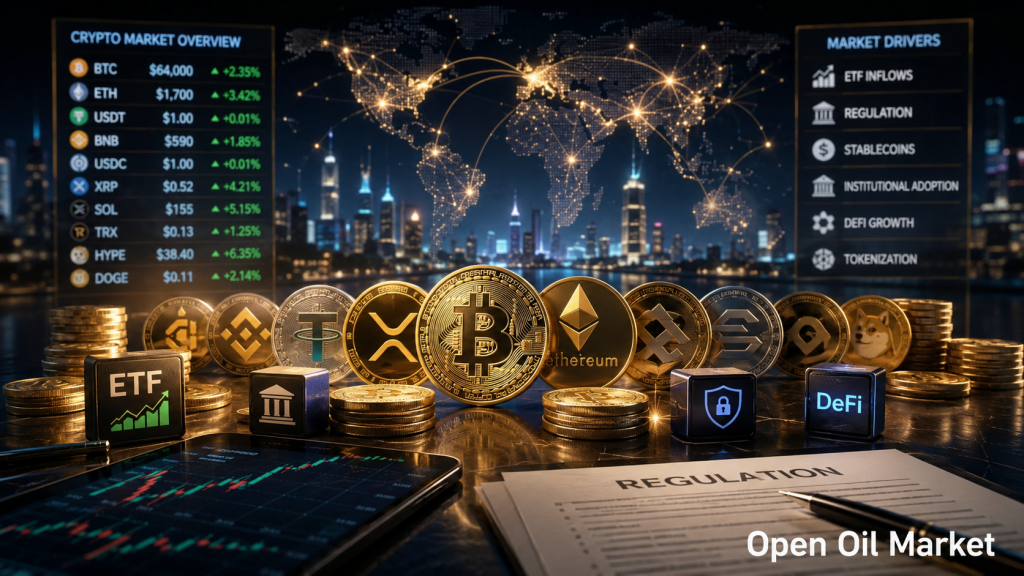
As of July 12, 2026, the top ten largest and most tracked cryptocurrencies reflect the structure of the global market: Bitcoin's dominance, Ethereum's strong position, the significant role of stablecoins, and the gradual expansion of interest in infrastructure and exchange tokens.
- Bitcoin (BTC) — the main reserve asset of the crypto market and the primary indicator of risk appetite.
- Ethereum (ETH) — an infrastructure platform for DeFi, tokenization, and smart contracts.
- Tether (USDT) — the largest stablecoin and a key liquidity instrument.
- BNB (BNB) — token of the Binance ecosystem and one of the largest exchange assets.
- USDC (USDC) — a regulated dollar stablecoin with an institutional focus.
- XRP (XRP) — an asset linked to cross-border payment and ETF interest narratives.
- Solana (SOL) — a high-performance network for applications, DeFi, and consumer crypto services.
- TRON (TRX) — a network with high activity in stablecoin transfers.
- Hyperliquid (HYPE) — one of the most notable new assets in the decentralized trading segment.
- Dogecoin (DOGE) — the largest meme token sensitive to retail demand and market sentiment.
Altcoins: Rotation Instead of Broad Rally
The altcoin market remains selective. Unlike classic "altseason" phases, where the entire sector rises, the current structure resembles more of a targeted rotation. Investors are opting for assets with a clear narrative: ETFs, payments, exchange infrastructure, DeFi, tokenization, stablecoins, and real use cases.
Solana is in focus due to its network speed and developer activity, XRP attracts attention against the backdrop of institutional and regulatory narratives, TRON benefits from USDT usage, while Hyperliquid reflects demand for new decentralized trading models. However, risks in altcoins remain higher than in Bitcoin and Ethereum: liquidity is narrower, volatility is stronger, and dependence on news events is greater.
DeFi and Security: Investors Refocus on Infrastructure Risks
The DeFi sector remains a vital part of the cryptocurrency economy, yet its investment attractiveness is increasingly assessed through the lens of security. Attacks on protocols, oracle errors, bridge vulnerabilities, and risk management issues remind investors that yields in DeFi are always associated with technological and operational risks.
For professional investors, key criteria now include not just TVL and returns but also audit quality, protocol architecture, oracle resilience, pool liquidity, and management transparency. In 2026, DeFi is gradually maturing: the market is less reactive to promises of high returns and more focused on the sustainability of business models.
Investor Considerations
Sunday, July 12, 2026, does not appear to be a day for aggressive risk-taking. The cryptocurrency market is in an assessment phase: Bitcoin is holding a key zone, Ethereum retains its infrastructural appeal, ETF flows remain the primary indicator of institutional demand, and the regulatory agenda sets long-term rules of engagement.
Investors should pay close attention to several factors:
- Bitcoin's dynamics around the $64,000 zone;
- Inflow and outflow trends in spot Bitcoin and Ethereum ETFs;
- News regarding cryptocurrency regulation in the US and EU;
- The positioning of USDT and USDC as indicators of dollar liquidity;
- Capital rotation into XRP, Solana, TRON, Hyperliquid, and other major altcoins;
- Risks in DeFi, including protocol security and oracle resilience.
The main takeaway for the global investor is that the cryptocurrency market in July 2026 can no longer be analyzed solely through Bitcoin's chart. Cryptocurrency news is increasingly influenced by ETFs, regulations, stablecoins, institutional infrastructure, and global risk appetite. These factors will determine whether the current recovery marks the beginning of a new momentum or remains a technical rebound within a broader range.