Latest Cryptocurrency News as of April 10, 2026, with Market Analysis, Bitcoin Insights, and Top 10 Digital Assets
The cryptocurrency market approaches Friday, April 10, 2026, with a sense of cautious optimism. After several months of high volatility, market participants are increasingly focusing not only on short-term impulses but also on the quality of demand. For global investors, the primary question remains not just the direction of Bitcoin's movement, but the sustainability of capital inflows into digital assets amid a changing macroeconomic and regulatory landscape.
The current market configuration indicates a significant shift. Capital is once again concentrating in the largest cryptocurrencies, primarily Bitcoin and Ethereum, while more speculative segments of the market are receiving selective interest. This suggests that the crypto market in 2026 is increasingly resembling a mature financial ecosystem, where liquidity, institutional infrastructure, regulation, and the ability of projects to maintain genuine user interest are paramount.
What Currently Drives Market Sentiment
The main theme for crypto investors globally is the institutionalization of demand. Spot Bitcoin ETFs continue to serve as an indicator of trust among major market players. Even on days of mixed inflows, the mere existence of this investment channel supports the perception of Bitcoin as a strategic asset, rather than just a tool for speculation.
The market is currently influenced by several factors:
- the dynamics of inflows into cryptocurrency ETFs;
- regulatory signals from the US and Europe;
- capital redistribution within the top 10 cryptocurrencies;
- growing interest in stablecoins and tokenization;
- the assessment of demand sustainability amid global macroeconomic uncertainty.
For investors, this means that the digital asset market remains sensitive to news, but is no longer solely driven by speculative hype. Liquidity, infrastructure quality, and the capability of major networks to retain network effects are taking center stage.
Bitcoin Remains the Main Benchmark for the Entire Crypto Market
Bitcoin maintains its dominant position in the cryptocurrency market and continues to set the tone for most segments of digital assets. It is the focal point of institutional interest and remains the primary benchmark for risk assessment across the entire crypto sector.
For Friday, April 10, 2026, three key takeaways about Bitcoin can be highlighted:
- Bitcoin continues to attract capital amidst uncertainty, reinforcing its role as the "core" of the crypto market.
- Inflows into ETFs and corporate purchases support interest in the asset even in a volatile external environment.
- Bitcoin's movements influence the valuation of all other cryptocurrencies, particularly altcoins within the top 10.
From a strategic perspective, this means that Bitcoin is once again viewed as the most predictable instrument in the cryptocurrency portion of portfolios. For global investors, it remains the main avenue for participating in the digital asset market without incurring increased technological and regulatory risks associated with secondary assets.
Ethereum Seeks a New Growth Driver While Maintaining Systemic Importance
Ethereum continues to play a central role in the crypto economy, despite the market imposing more stringent requirements on it in 2026. For Ethereum, its status as a technological platform is no longer sufficient. Investors want to see growth in user activity, an expanded role of the network in stablecoins, tokenization, and decentralized services.
Currently, Ethereum finds itself in a dual position. On one hand, it is the second most significant digital asset globally and a vital infrastructure network. On the other hand, the market is assessing it more critically than Bitcoin, as not only capital inflows but also operational metrics of the ecosystem are of importance here.
For cryptocurrency investors, this creates an important practical takeaway: Ethereum remains a key asset for diversification within the top 10 cryptocurrencies, but its potential in 2026 is more dependent on fundamental usage of the network than on overall market optimism.
Regulation Becomes a Standalone Market Driver Rather Than a Background Factor
Another significant topic of the day is the strengthening of the regulatory factor. In the US, discussions continue about establishing a clearer legal framework for digital assets, while in Europe, a structured MiCA regime is already changing operational rules for the crypto business across the region.
This has several implications for the market:
- Large capital gains more grounds for entering cryptocurrencies through regulated instruments;
- Exchanges, custodians, and stablecoin issuers are forced to operate in a more transparent model;
- The quality of projects and transparency of tokenomics become more important than aggressive marketing;
- The gap between regulated and unregulated platforms will widen.
For the global crypto market, this is a positive, albeit not always rapid, process. Stricter regulation might hinder speculative growth of individual tokens, but in the long term, it enhances trust in the digital asset sector and makes cryptocurrencies a more comprehensible asset class for institutional investors.
Stablecoins and Tokenization Strengthen the Foundation Beneath the Market
In 2026, the growth of stablecoins' significance remains one of the most underrated topics in the crypto market. They have long ceased to be merely a technical tool for trading. Today, they represent a key bridge between traditional finance and digital assets.
Why this topic is particularly important now:
- Stablecoins provide liquidity for trading Bitcoin, Ethereum, and altcoins;
- They are becoming the foundation for international settlements and on-chain operations;
- Through them, the tokenization of financial instruments and new forms of digital capital is evolving;
- The growth of this segment supports the infrastructural value of the largest blockchains.
For investors, this means that the cryptocurrency market should not only be assessed based on the price dynamics of coins but also based on how the usage of digital dollars and other tokenized forms of value is expanding. This topic is especially relevant for Ethereum, TRON, and several networks that benefit from increased transaction activity.
Top 10 Most Popular Cryptocurrencies: Where Investor Attention is Currently Focused
When looking at the most discussed and systemically significant cryptocurrencies, the largest digital assets with high liquidity, brand recognition, and developed infrastructure remain at the center of global market attention. For investors, this is not just a list of leaders but a map of capital distribution in the sector.
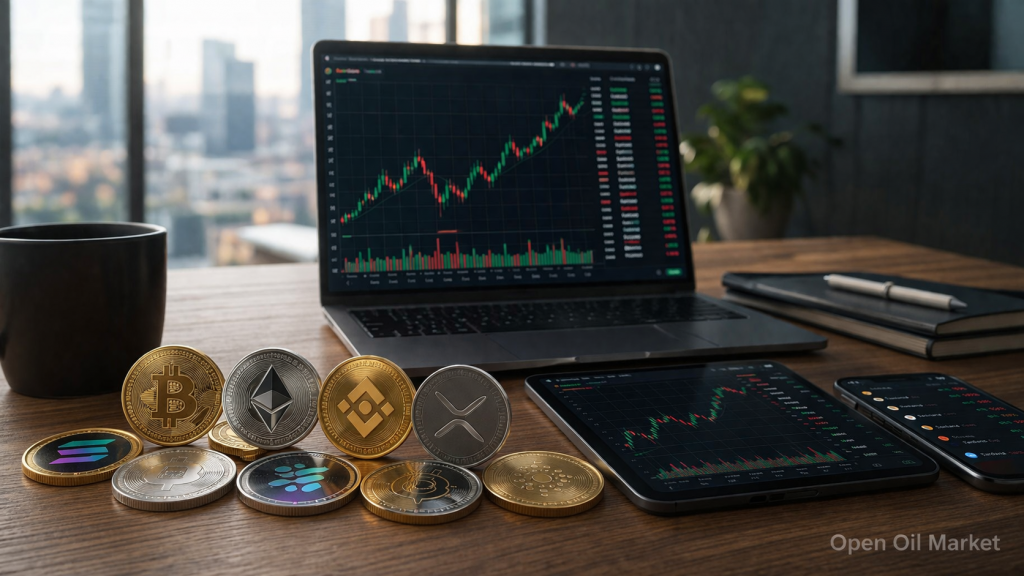
At present, the following cryptocurrencies are in the market's spotlight:
- Bitcoin — the main defensive and institutional asset of the crypto market;
- Ethereum — foundational infrastructure platform for DeFi, stablecoins, and tokenization;
- BNB — a significant ecosystem asset with strong exchange support;
- XRP — one of the beneficiaries of expectations around cross-border settlements and regulated infrastructure;
- Solana — a high-beta bet on performance and user activity;
- TRON — an important player in the stablecoin and on-chain transfer segment;
- Dogecoin — a barometer of retail interest and speculative appetite;
- Cardano — an asset that the market continues to assess through the lens of technological discipline and ecosystem scalability;
- Toncoin — a project being monitored for its potential to integrate digital services and a large user base;
- Chainlink — critical infrastructure for data and connecting blockchains to the external world.
This composition shows that in 2026 investors prefer a combination of three criteria: liquidity, infrastructural usefulness, and the likelihood of long-term institutional interest.
Altcoins No Longer Move as a Unified Front
One of the significant features of the current cycle is that the altcoin market has ceased to move as a single block. Whereas previously capital inflows into cryptocurrencies spread rapidly across almost all major tokens, investors are now acting with notable selectivity.
This is expressed in several trends:
- Capital is concentrating in assets with strong branding and high liquidity;
- Networks lacking clear user demand find it increasingly challenging to maintain valuation;
- Memecoins and high-risk tokens are more dependent on retail market sentiment;
- Infrastructure projects are receiving a premium for real utility.
For crypto investors, this necessitates a more rigorous selection process. A bet on the market as a whole no longer yields previous results. Instead, a focus on specific themes is more effective: Bitcoin as an institutional asset, Ethereum as infrastructure, stablecoin ecosystems as the transactional layer, and select high-beta projects as tactical risk instruments.
What Matters to Investors on Friday, April 10, 2026
In the upcoming session and the end of the week, investors should look not only at price reactions but also at the quality of market signals. For the global cryptocurrency market, it is more crucial now to confirm sustained interest from large capital rather than to see a one-time impulse.
Key points to observe:
- Whether demand for Bitcoin is sustained through ETFs and corporate purchases;
- If Ethereum can solidify its fundamental narrative through increased network activity;
- Whether the role of stablecoins as a foundation for the crypto market will continue to strengthen;
- Which altcoins from the top 10 will show relative strength against Bitcoin;
- Whether new regulatory signals will lead to capital redistribution between market segments.
The main takeaway for April 10, 2026, is that the cryptocurrency market remains appealing to investors but is becoming increasingly professional and demanding of asset quality. Bitcoin retains its status as a central instrument, Ethereum maintains systemic significance, and altcoins must reprove their investment viability. For market participants, this is not a weakness of the sector but a sign of its maturation.