Latest Startup and Venture Capital News as of April 9, 2026, Including Growth of AI Infrastructure, Robotics, Fintech, and Global Venture Market Trends
The global startup and venture capital market is entering April 9, 2026, in a noticeably stronger shape than just a few quarters ago. After a period of caution, capital is once again flowing actively into technology companies, but the nature of this growth has changed. Whereas the market was previously broad in the number of directions it pursued, it is now more focused on several segments where investors are willing to pay a premium for scale, speed, and strategic significance. Primarily, these are artificial intelligence, computational infrastructure, robotics, cybersecurity, and next-gen financial technologies.
For venture investors and funds, this indicates a transition to a new phase in the cycle. There is more money in the market, but it is being allocated more selectively. The largest funding rounds are not just going to AI startups but to companies building computing power that accelerates model training, automates security, and creates infrastructure for corporate AI implementation. Concurrently, demand for clear exit scenarios is intensifying: the M&A market has revived, and the window for individual public offerings is gradually opening. In this configuration, startups that either become systemically important to the new AI economy or quickly evolve into platforms capable of global scaling stand to gain the most.
The Venture Market Kicked Off the Year with Record Volumes, But Growth is Highly Concentrated
The key signal for the global startup market is the powerful start to 2026 in venture funding volumes. However, this growth should not be interpreted as a uniform recovery of the entire ecosystem. On the contrary, the market has become noticeably more polarized: enormous sums are being attracted by a few major tech companies, while many late-stage and mid-sized startups are still facing tough capital-raising conditions.
For funds, this is an important marker. Venture investments have scaled up again, but the price of mistakes is higher than in previous cycles. Investors prefer projects that can quickly occupy a critically important position in the AI value chain, rather than merely demonstrating user growth. As a result, the startup market is divided into two layers: a narrow segment of companies with nearly unlimited access to capital and a broad segment where unit economics, sales efficiency, and speed to revenue remain key requirements.
AI Infrastructure has Become the Main Magnet for Capital
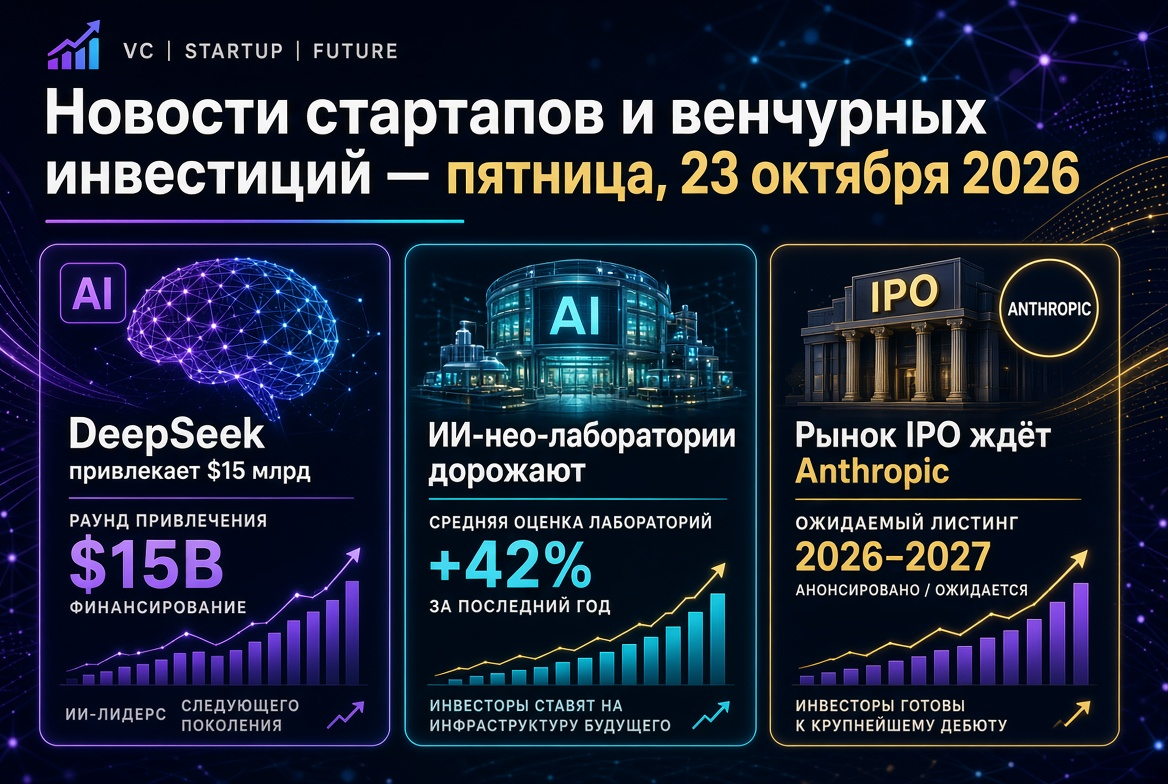
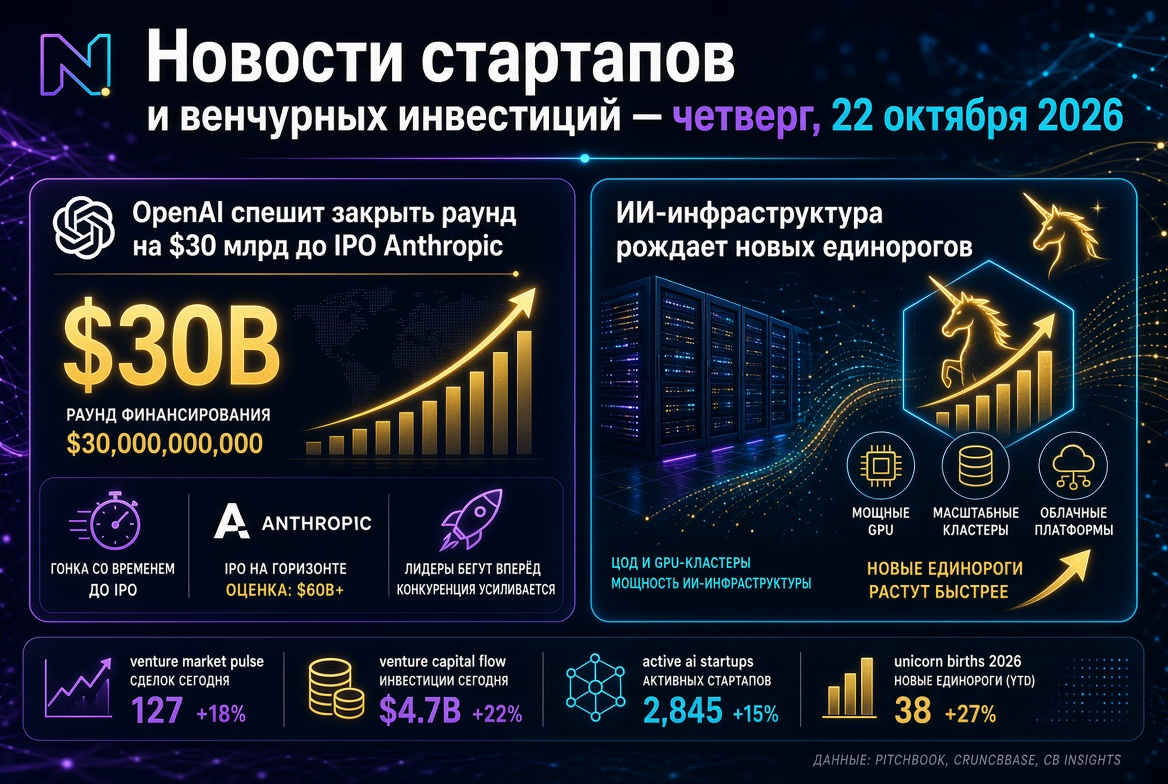
The most current topic as of April 9 is not just artificial intelligence per se but the infrastructure surrounding it. Venture investors are increasingly funding startups that provide computing power, network bandwidth, cloud capabilities, model optimization, and specialized data centers. In other words, capital is increasingly flowing into the "foundation" of AI, rather than just the "showcase," as growth in the industry would otherwise hit a resource deficit.
This shift is well illustrated by the new logic of the market:
- Value is derived not only by model developers but also by infrastructure providers;
- Funding rounds are increasingly justified by future capacity utilization rather than just current revenue;
- Strategic investors are beginning to play a role no less significant than traditional venture funds;
- Access to chips, electricity, networks, and corporate contracts has become a key competitive advantage.
For the startup market, this means that the next wave of unicorns will be formed not only among application creators but also among companies building the "shovels and pickaxes" for the AI boom.
Europe Strengthens Its Position through Sovereign Computing and Own AI Platforms
The European startup landscape in 2026 appears more confident than many funds anticipated just a year ago. The region is increasingly promoting the idea of technological sovereignty: capital is directed towards domestic AI companies, semiconductor projects, data centers, and infrastructure platforms. This creates an important counterbalance to the dominance of the U.S. and partially alters the perception of Europe as a market strong in research but weak in scaling.
This is particularly evident in segments that require not just models but also physical infrastructure. For European startups, venture investments are increasingly linked to the theme of strategic autonomy, expanding the pool of potential investors to include banks, state development institutions, and corporate partners. For international funds, this enhances the attractiveness of deals in Europe: startups receive not only capital but also political support, government demand, and access to long-term programs.
China Shows Its Own Model of Venture Growth — Through State Capital and Deep Tech
In the Asian direction, a major trend is the acceleration of venture activity in China. However, this is not the classical story of the private market following the American model. The new wave of funding largely relies on state and quasi-state sources of capital, with priorities given to AI, robotics, quantum technologies, and other strategic industries.
For global investors, this is a signal of a dual nature. On the one hand, the Chinese startup market is becoming large-scale in terms of capital attraction again. On the other hand, the increasing role of politics in capital allocation means heightened risks of distorted valuations and reduced transparency in market benchmarks. Nevertheless, ignoring this market is impossible: in the coming quarters, China may become one of the largest generators of new deep tech companies with global ambitions.
Robotics Moves Out of the “Long Bets” Category into Practical Scaling
Another important shift in the startup market is the acceleration of robotics, particularly at the intersection of AI and industrial automation. Venture funds are increasingly financing companies that can demonstrate not just technological novelty but also concrete contracts in logistics, manufacturing, warehousing infrastructure, and corporate services. This is especially crucial in the context of the global labor shortage and rising business costs.
The investment logic here is changing. Previously, a robotics startup was seen as a capital-intensive project with distant payback periods, but now strong players present a more compelling investment case:
- AI enhances the quality of environmental perception and decision-making by machines;
- Corporate clients are willing to pay for automation faster than before;
- Large industrial partners are simultaneously becoming customers and investors;
- The exit market for such companies is gradually expanding through strategic buyers.
For venture investors, this opens up a new tier of deals between software and hardware, where multiples can remain high in the presence of clear industrial demand.
Cybersecurity Solidifies as One of the Most Resilient Sectors in the Venture Market
Cybersecurity remains one of the few areas where startups can attract significant capital regardless of overall market sentiment. The reason is clear: with the growth of AI, automation, and cloud infrastructure, the attack surface expands, and corporate demand for protection becomes non-cyclical. Thus, for funds, security deals look like a more defensive element of the portfolio compared to purely consumer tech bets.
Currently, the focus is on startups that:
- Automate SOC and response processes;
- Mitigate risks in AI development and AI-assisted coding;
- Integrate into large corporate platforms;
- Can scale quickly through B2B sales and channel distribution.
For the global market, this means that cybersecurity remains one of the most disciplined segments of startups, where venture investments are often backed by understandable revenue and high-quality clients.
Fintech Returns with Momentum, But in a Different Configuration
Fintech has not disappeared from the agenda, but it has significantly changed. In 2026, capital is primarily flowing to companies solving infrastructure challenges: cross-border payments, currency liquidity, integrating stablecoins into transactions, corporate platforms for international transfers, and B2B financial automation. The “growth for the sake of growth” model, characteristic of parts of the fintech boom in previous years, is giving way to a more pragmatic approach.
This aligns well with the overall trend: a startup must not only attract users but also reduce operational costs, speed up the flow of capital, and improve the clients’ financial infrastructure. For venture funds, this makes the best fintech companies attractive again, especially if they are building a global product and rapidly achieving corporate revenue.
The Exit Window Gradually Opens: M&A is Already Stronger than IPO
For the venture market, the exit question remains key. Here, in 2026, practical progress is evident. Activity in mergers and acquisitions is growing faster than the IPO market, and strategic buyers are once again willing to pay for mature assets with critically important technologies. This marks an important shift after a period where many startups could attract capital but lacked a clear exit scenario.
At this stage, the most realistic picture for funds looks like this:
- Major tech corporations continue to acquire infrastructure and security assets;
- The public market is opening selectively, primarily for companies with quality growth stories;
- Secondary transactions and partial liquidity are becoming increasingly important for late-stage deals;
- The startup's valuation is increasingly dependent on how understandable it is to potential buyers.
This is why startups that build not just fashionable products but strategic assets for the large market appear stronger than others today.
What This Means for Investors and Funds
As of April 9, 2026, the startup and venture investment market appears strong but uneven. Capital has returned; however, its cost and distribution are defined by a new hierarchy. At the top of the market are AI infrastructure, cybersecurity, robotics, sovereign computing, and mature B2B fintech. Below are startups without a pronounced technological advantage, finding it increasingly difficult to justify high valuations.
For venture investors, this means the need to more accurately select segments and not confuse overall market volume growth with a broad recovery of the entire startup landscape. The main theme in the coming months will be the competition for infrastructure assets and companies that can become the foundational layer of the new AI economy. This is where the primary potential for the next wave of large rounds, strategic deals, and future exits is being formed.