Current Cryptocurrency News as of April 17, 2026: Bitcoin, Ethereum, Altcoins, ETFs, Stablecoins, and Top 10 Most Popular Cryptocurrencies
The global cryptocurrency market approaches Friday, April 17, 2026, in a state of cautious equilibrium. Following a volatile first quarter, the crypto market is showing signs of stabilization: Bitcoin retains its leadership, Ethereum and the largest altcoins strive to regain momentum, with institutional decisions becoming increasingly significant. For investors, this is an important signal: the cryptocurrency sector is increasingly transforming from a speculative environment into a fully-fledged segment of global finance, where ETF fluctuations, regulatory developments, the growth of stablecoins, and actions by major exchange and banking players significantly impact price dynamics.
Key Highlights of the Day
- Bitcoin remains the primary indicator of sentiment in the global cryptocurrency market, holding a significant share of the overall market capitalization.
- Ethereum maintains its status as the main platform for smart contracts, but lags behind Bitcoin in trend strength.
- Institutional investments in cryptocurrencies gain new momentum through ETFs and transactions by traditional financial players.
- Cryptocurrency regulation has become a key issue in the US and the UK, reducing long-term uncertainty for the market.
- Stablecoins are solidifying their position as the settlement and liquidity infrastructure of the global digital market.
Bitcoin Remains the Market's Main Benchmark
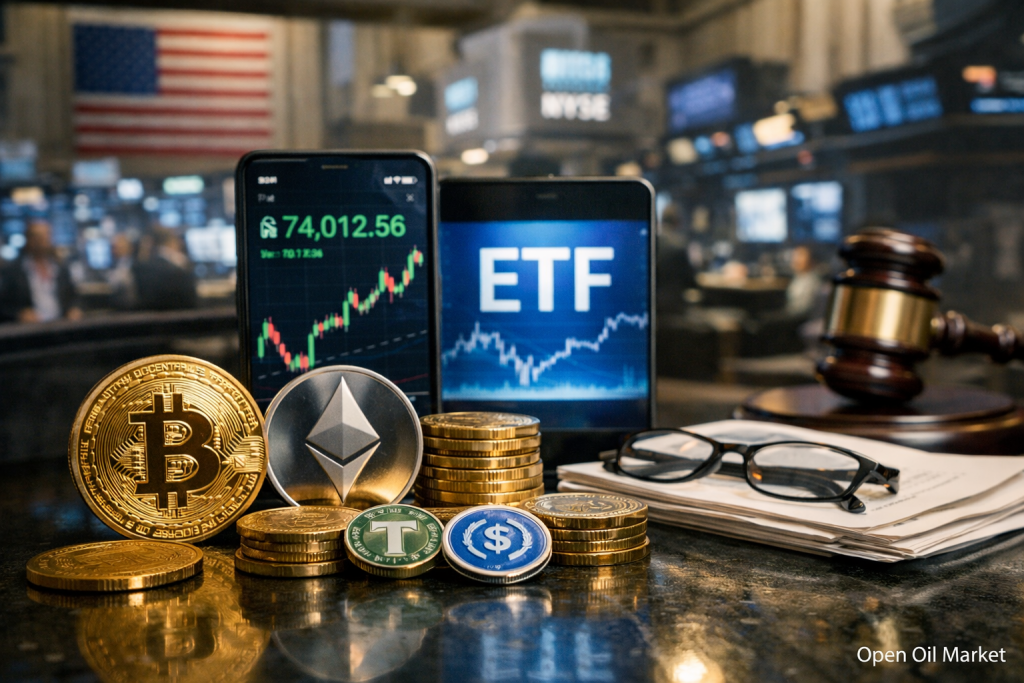
Investors' attention continues to focus on Bitcoin. BTC sets the tone for the entire cryptocurrency market and determines how sustainable demand for risk in digital assets can be. At the time of preparing this review, Bitcoin is trading around the $74,000 mark, maintaining its leadership by capitalization and dominating most altcoins. For the global pool of investors, this is an important signal: capital is not leaving the sector entirely, but instead concentrating in the most liquid and institutionally recognized asset.
The high dominance of Bitcoin indicates that the cryptocurrency market has not yet returned to broad speculative rally mode. On the contrary, capital is acting selectively. Market participants prefer larger assets with clear liquidity, developed storage infrastructure, and access through exchange instruments. This positions Bitcoin not only as the main asset of the crypto market but also as a digital indicator of global risk appetite.
Ethereum and Major Altcoins Seek New Growth Points
Ethereum remains one of the key assets for investors; however, its dynamics appear more restrained compared to Bitcoin. This reflects the current demand structure: the market recognizes the fundamental importance of Ethereum for DeFi, tokenization, and smart contracts, yet it has not yet priced in as robust a protective status as BTC. For institutional participants, Ethereum remains a strategic asset of the second tier in the crypto market, particularly in light of interest in infrastructure blockchain solutions.
Among the largest altcoins, XRP, BNB, and Solana stand out. XRP benefits from steady demand for cross-border payment scenarios and remains one of the most liquid assets outside the BTC/ETH pair. BNB maintains strong positions due to the large-scale Binance ecosystem, while Solana is still one of the market’s main bets on rapidly growing infrastructure for applications and trading solutions. Simultaneously, TRON and Dogecoin confirm that liquidity in the market is not only favoring technological stories but also established, widely traded assets.
Institutional Capital is Changing Demand Structure Again
One of the main news topics in the cryptocurrency agenda is the increasing role of traditional financial institutions. The market is integrating more actively into the classical financial architecture through ETFs, custodial services, regulated trading platforms, and partnerships among major exchange groups. This is no longer a peripheral topic but one of the key factors in assessing the cryptocurrency market in 2026.
For investors, it is especially important that the launch and expansion of ETF products for Bitcoin and other digital assets continue to change the structure of demand. The focus is not only on the quotations themselves but also on the quality of capital entering the sector. In the past, market growth was often driven mainly by retail speculation, whereas now banks, asset managers, and institutional platforms play an increasingly significant role. This elevates market maturity but also makes it more susceptible to macroeconomic factors, interest rates, and overall risk on global platforms.
The deepening ties between the traditional exchange industry and the crypto sector carries additional significance. When major infrastructural players enter the capital of cryptocurrency exchanges or expand joint projects in regulated digital assets, the market receives an important long-term signal: the institutionalization of cryptocurrencies continues even amid unstable price dynamics.
Cryptocurrency Regulation Becomes a Global Driver
Another defining theme for the cryptocurrency market is the acceleration of regulatory agendas. In the US and the UK, the crypto market is moving increasingly towards a more formalized model of oversight. For short-term trading, this may mean heightened sensitivity to political headlines, while for long-term investors, it signifies reduced legal uncertainty that previously hindered broader institutional demand.
The American discussion is currently focused on regulations for digital assets and stablecoins. This is crucial for the entire global industry because the US sets the tone for the largest ETFs, custodians, public companies, and exchange providers. If the regulatory architecture is refined, the market may gain a new fundamental driver. Conversely, if the process drags on again, cryptocurrencies will remain hostages to the political cycle and debates over the boundaries of the banking and digital financial sectors.
In the UK, the regulatory framework is also becoming more concrete. This creates a favorable long-term backdrop for the global market, as the largest financial jurisdictions gradually cease to view cryptocurrencies as a temporary phenomenon and transition to detailed regulation of trading platforms, storage, staking, and issuance of individual digital instruments.
Stablecoins Become the Infrastructure of the Global Crypto Market
If a few years ago stablecoins were primarily seen as auxiliary elements for trading, they are now emerging as a core layer of financial infrastructure. A significant portion of liquidity in the cryptocurrency market now passes through stablecoins, as well as an increasing share of settlements, cross-exchange transfers, and digital payment scenarios. For the global market, this represents one of the most crucial shifts of 2026.
From an investment perspective, the rising role of stablecoins implies two things. First, the cryptocurrency market is increasingly embedding itself in payment and banking logic. Second, the battle for the rules governing stablecoin circulation is becoming a matter not only of regulation but also of control over future digital liquidity. Therefore, it is essential for investors to monitor not only Bitcoin and Ethereum but also how capital is distributed among USDT, USDC, and other major stablecoins.
Why the Market Remains Cautious
Despite positive news in the cryptocurrency space and institutional steps, the crypto market does not appear unanimously bullish. The first quarter of 2026 showcased that the market remains vulnerable to geopolitical issues, fluctuations in global risk appetite, and capital outflows from more volatile segments. This means that the growth of cryptocurrencies in the coming weeks will depend not only on internal industry news but also on the condition of global stock markets, bond yields, dollar dynamics, and the overall level of uncertainty.
This is why the current phase looks less like a classical rally and more like a process of reevaluation. The market is testing which assets can genuinely hold capital in the new architecture of digital finance. Currently, Bitcoin, the largest stablecoins, and a limited circle of liquid altcoins are leading. For investors, this indicates the necessity of greater selectivity and a departure from the previous approach, where the entire market grew synchronously.
What Investors Should Watch on April 17
- Bitcoin Dynamics: Will BTC maintain its leadership and dominance, or will the market begin to shift liquidity towards Ethereum and other altcoins?
- ETF Agenda: Any new signals regarding ETFs and products from major banks will influence institutional expectations.
- Cryptocurrency Regulation: Comments from the US and the UK can quickly change market sentiments.
- Stablecoins: The dynamics of the largest stablecoins increasingly reveal how liquidity is redistributed within the market.
- Altcoin Status: The resilience of Solana, XRP, BNB, and TRON will indicate whether the market is ready for a broader recovery.
Top 10 Most Popular Cryptocurrencies
At the time of preparing this review, the most popular cryptocurrencies by market capitalization include the following assets:
- Bitcoin (BTC) — approximately $73,999. The main asset of the crypto market and the primary indicator of institutional demand.
- Ethereum (ETH) — approximately $2,307. The foundational infrastructure platform for smart contracts and DeFi.
- Tether (USDT) — approximately $1.00. The largest stablecoin and a key source of liquidity in the global crypto market.
- XRP (XRP) — approximately $1.40. One of the major liquid altcoins with a strong payment history.
- BNB (BNB) — approximately $618.65. The systemic asset of the largest cryptocurrency exchange ecosystem.
- USDC (USDC) — approximately $0.9997. One of the main regulation-friendly stablecoins.
- Solana (SOL) — approximately $84.88. A key market bet on fast blockchain infrastructure.
- TRON (TRX) — approximately $0.3278. A strong asset in the network transfer and stablecoin liquidity segment.
- Dogecoin (DOGE) — approximately $0.0953. Maintains mass recognition and stable market liquidity.
- Hyperliquid (HYPE) — approximately $44.54. One of the notable new major assets amid growing interest in trading infrastructure.
For Investors
As of Friday, April 17, 2026, the cryptocurrency market remains in a transitional phase. It is no longer the crypto market where sentiment was solely dictated by retail hype. Institutional investments, ETFs, cryptocurrency regulation, and the fight for control over stablecoin infrastructure are now at the forefront. For investors, this means one thing: cryptocurrencies are increasingly embedding themselves within the global financial system, and thus the market should be evaluated not only through the lens of volatility but also through capital structure, regulatory quality, and demand resilience.
In the short term, attention remains fixed on Bitcoin, Ethereum, and the largest altcoins. In the medium term, decisive factors will be regulatory clarity, ETF development, and the ongoing convergence of traditional finance with digital assets. It is these processes that are shaping the new investment map of the global cryptocurrency market.