Economic Events and Corporate Reports - Friday, April 17, 2026: Eurozone External Sector, Bank Reports, and Signals from Turkey
Friday, April 17, 2026, does not appear to be a day characterized by a single high-profile macroeconomic release, but rather a session where investors will simultaneously assess economic events, corporate reports, and geopolitical signals. This combination is significant for the global environment: Europe sets the tone through external sector statistics, the USA continues its banking reporting season, and the Russian context gains additional political backdrop through developments in Turkey. For the CIS audience, this is a day when it is particularly important to focus not only on the figures but also on how they change expectations regarding interest rates, currencies, commodities, and equities.
Brief Introduction: What Shapes the Agenda
The key feature of Friday is that the market shifts its focus from inflationary releases to the quality of external demand, the resilience of bank profits, and political signals affecting commodity markets. The economic events of April 17, 2026, are particularly important for those monitoring the S&P 500, Euro Stoxx 50, Nikkei 225, and MOEX within a unified logic of global capital.
In short, investors will need to evaluate three layers of information:
- The state of the Eurozone's external sector through the current account and trade dynamics;
- The quality of reports from major financial companies in the USA, which continue to set the tone for the S&P 500;
- The influence of the diplomatic agenda surrounding Turkey on oil, currencies of emerging markets, and overall risk appetite.
Eurozone: External Sector Takes Center Stage
The morning European data block will be crucial for assessing how resilient the Eurozone economy appears at the outset of the second quarter. The focus will be on the current account data for February. For the market, this is not just balance of payments statistics, but an indicator of how the region is navigating a combination of weak industry, high energy costs, and uneven external demand.
This is important for investors for several reasons. Firstly, a strong external sector supports the euro and alleviates concerns about the macroeconomic fragility of the region. Secondly, a stable current account is generally perceived as positive for bonds and large exporters from the Euro Stoxx 50. Thirdly, it is through the external sector that we understand how well Europe can compensate for internal weakness through trade and financial flows.
Market attention will also remain on the Eurozone's trade balance for February. Even if the main momentum from this release has already been captured earlier, on Friday investors will continue to incorporate this data into their assessments of European exporters, industry performance, and the euro exchange rate. For global markets, this is directly relevant: weak external demand in Europe rapidly translates into a more cautious view on cyclical sectors and commodity assets.
Geopolitics: Turkey, Russia, and Commodity Market Sensitivity
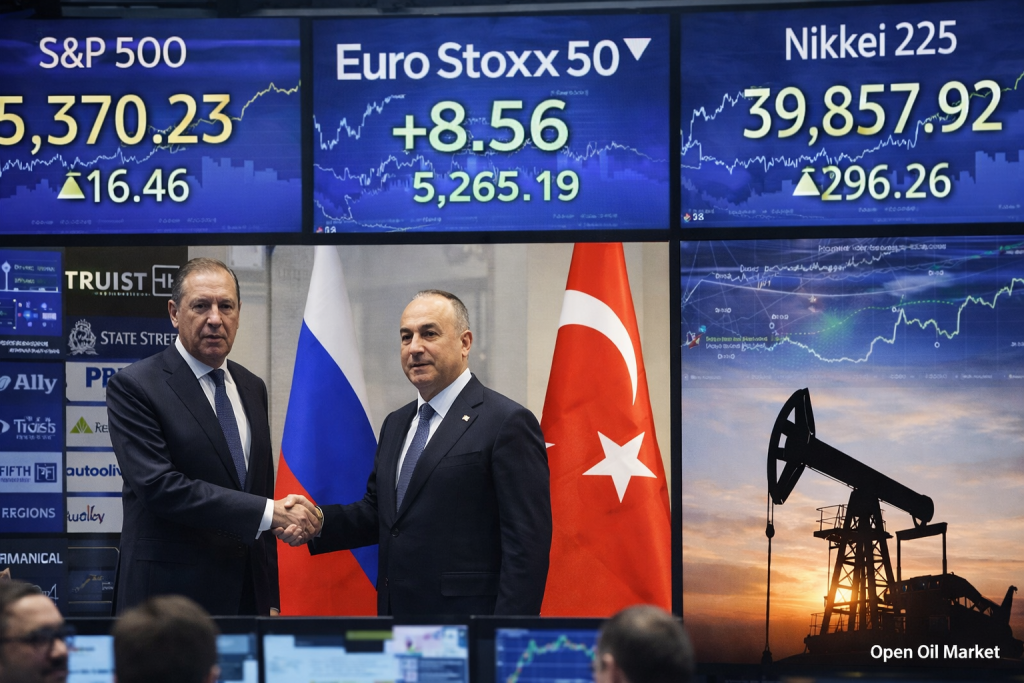
For the Russian audience, additional significance lies in the diplomatic agenda in Turkey on April 17-18. While this factor is not a classic economic release, it has the potential to change market sentiment through expectations surrounding regional stability, logistics, energy flows, and sanctions dynamics.
In practical terms, investors should monitor three channels of influence:
- The reaction of the oil market and energy companies to any new statements;
- The behavior of emerging market currencies, including the rouble;
- The changing demand for defensive assets if geopolitical rhetoric becomes harsher.
This is particularly important for the MOEX on a day when local corporate reporting is limited. In such a configuration, it is the external backdrop that is likely to have a stronger than usual impact on banks, energy, transportation, and exporters.
USA: A Key Day for Banking and Financial Segment of the S&P 500
The American block of corporate reports on Friday appears concentrated and highly indicative. Focus is on major financial firms, meaning the market will reassess net interest margins, the quality of loan portfolios, fees, and management commentary on the economy for the remainder of 2026.
Among the largest confirmed reports for the day in the USA:
- Truist Financial - an important benchmark for the regional banking sector and credit activity;
- State Street - a key barometer for the custody business, fees, and institutional inflows;
- Fifth Third Bancorp - an indicator of the state of the mid-sized banking sector and retail-corporate demand dynamics;
- Regions Financial - crucial for assessing regional lending and deposit base behavior;
- Ally Financial - of particular interest as an indicator of consumer lending and auto financing market trends.
This set of reports makes April 17, 2026, particularly significant for the S&P 500. If the results confirm sustainable profitability for banks without deterioration in asset quality, the market could receive support in the financial sector and likely develop a more confident outlook for domestic demand in the USA. Conversely, if management begins to speak more cautiously about reserves, funding costs, or credit risks, it may quickly heighten defensive sentiments.
European Companies: Ericsson and Autoliv as Indicators of the Industrial Cycle
The European corporate calendar for Friday is noticeably slimmer than that of the US, yet it is not devoid of significant names. For investors in the global market, particular interest centers around Ericsson and Autoliv.
Why This Matters:
- Ericsson provides the market with a benchmark on telecom infrastructure, operator investment pace, and the resilience of demand for network equipment;
- Autoliv helps assess the state of the global automotive industry, order structure among car manufacturers, and the dynamics of safety component supplies.
While these reports do not carry the same index weight as the largest European banks or the luxury sector in Euro Stoxx 50, they are quite useful in terms of cyclical signals. Ericsson reflects capital expenditures and digital infrastructure, while Autoliv indicates real manufacturing demand and the state of international supply chains.
Asia: Jio Financial, Kweichow Moutai, and Asian Risk Appetite
In the Asian block, investors will focus not only on Japanese indices but also on the broader regional picture. Among the large public companies falling into focus on Friday are Jio Financial Services in India and Kweichow Moutai in the Chinese consumer segment.
For the market, these are significant signals pointing in two different directions:
- Jio Financial Services showcases how quickly digital financial services are scaling in India and how investors assess the monetization of this model.
- Kweichow Moutai remains one of the most notable indicators of premium consumption in China and the resilience of domestic demand.
Though these reports do not directly determine the dynamics of the Nikkei 225, they help paint a picture of the overall quality of the Asian corporate backdrop. For global investors, this is important in the context of choosing between defensive and cyclical assets and assessing the strength of domestic demand in the largest economies in Asia.
Russia and MOEX: Local Market More Dependent on External Backdrop
In the Russian segment, Friday appears less saturated in terms of large confirmed quarterly publications compared to the USA or even Northern Europe. Consequently, the main driver for the MOEX will be the convergence of external agendas: Europe, American corporate reports, commodity prices, and news from Turkey.
For Russian investors, this signifies that particular attention should be given to the following links:
- The euro and the external sector of the Eurozone for assessing export demand;
- Reports from American banks for an understanding of global risk appetite;
- Oil and diplomatic signals for stocks in the resource sector and the exchange rate of the rouble;
- Bond yields for evaluating responses to a potential shift in the market to a more defensive mode.
On such days, the MOEX often moves not in response to domestic news, but due to a global combination of macroeconomics and earnings reports.
What Investors Should Focus on by the End of the Day
By the end of the Friday session, investors should address several key questions.
- Did the Eurozone data confirm the resilience of its external sector, or does Europe remain vulnerable to weak demand?
- Did American banks and financial firms demonstrate healthy profit dynamics without asset quality deterioration?
- Did Ericsson and Autoliv provide grounds to speak about the stability of the industrial cycle in Europe and the global automotive industry?
- Did the Asian corporate backdrop support the global risk appetite?
- Did the Turkish diplomatic track intensify uncertainty in the energy market or, conversely, ease tensions?
If the macroeconomic signals from Europe conclude the day on a neutral-positive note, and the corporate reports from the USA confirm the resilience of the financial sector, global markets may finish the week on a constructive note. However, if the Eurozone's external sector disappoints and banking commentary in the USA becomes more cautious, investors may shift to a more defensive positioning before the new week begins.
For investors from the CIS, Friday, April 17, 2026, is significant as a day of synchronizing the global picture: Europe reflects the state of external demand, the USA translates macroeconomics into the language of corporate profits, Asia adds regional growth signals, and the Russian market interprets all this through commodities, currency, and overall risk sentiment.