Cryptocurrency News for Sunday, June 28, 2026: Bitcoin Holds Steady Around $60,000 as Market Evaluates ETF Outflows, Stablecoin Regulations, and Dynamics of Ethereum, Solana, XRP, BNB, and Other Top 10 Cryptocurrencies
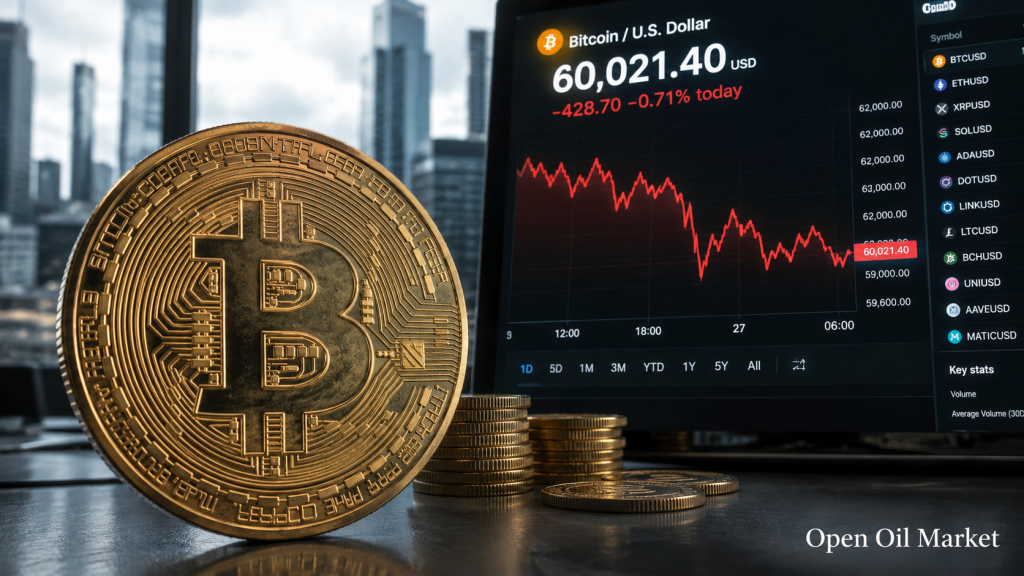
The cryptocurrency market enters Sunday, June 28, 2026, in a mode of cautious recovery following a volatile week. For investors across the globe, the main focus is not so much on short-term price movements, but rather on the resilience of demand for digital assets amid outflows from spot ETFs, a strong dollar, competition from AI stocks, and increasing regulations on stablecoins. Bitcoin remains close to the psychologically significant area around $60,000–61,000, Ethereum experiences pressure, while major altcoins show mixed dynamics.
The global cryptocurrency market capitalization remains above $2 trillion; however, the market structure has become more defensive: Bitcoin's share remains at a high level, stablecoins are taking on an increasingly significant part of liquidity, and investors are paying closer attention to the quality of blockchain ecosystems, real network usage, regulatory risks, and transparency of reserves. For the investor audience, this signifies a shift from speculative momentum to a more institutional model of cryptocurrency analysis.
Market Overview: Caution Over Aggressive Risk
Cryptocurrencies remain sensitive to global monetary policy. Rising expectations for a firmer stance from the US Federal Reserve increase pressure on risk assets, including Bitcoin, Ethereum, Solana, XRP, Dogecoin, and other digital coins. In this context, investors are reallocating capital between cryptocurrencies, tech stocks, the AI sector, bonds, and the money market.
Key factors influencing cryptocurrency news on June 28, 2026, include:
- the dynamics of spot Bitcoin and Ethereum ETFs;
- demand from institutional investors for digital assets;
- stablecoin regulations in the US, UK, and EU;
- the state of liquidity in global financial markets;
- competition between cryptocurrencies and AI stock performance;
- the security of DeFi, prediction markets, and crypto platforms.
Unlike phases of an overheated bull market, the current situation requires investors to consider not only chart evaluations but also an analysis of fundamental drivers: cash flows, regulatory status, network activity, tokenomics, and ecosystem resilience.
Bitcoin: The Key Indicator of Trust in Digital Assets
Bitcoin continues to be the main benchmark for the entire cryptocurrency market. The level around $60,000 has become an important psychological zone, creating a balance between long-term holders, institutional investors, and short-term speculators. Following a significant decline from the 2025 highs, the market assesses whether the current phase is a deep correction within a long-term cycle or a beginning of a more prolonged period of re-evaluation of digital assets.
Currently, Bitcoin serves several functions for investors:
- the foundational asset of the cryptocurrency market;
- an indicator of risk demand;
- a tool for assessing capital inflows and outflows via ETFs;
- a hedge against distrust in the traditional financial system, albeit with high volatility;
- a marker of institutional interest in digital assets.
The main risk for Bitcoin in the coming days is the continued outflow from spot ETFs. If institutional products begin to show a steady inflow of capital again, the market may receive support. Conversely, if outflows persist, pressure on the largest cryptocurrency is likely to remain, especially in the context of a strong dollar and rising bond yields.
Ethereum: Pressure on ETH and the Question of Ecosystem Value
Ethereum remains the second-largest cryptocurrency by market capitalization, but in 2026, ETH appears weaker than Bitcoin. This pressure is related to several factors: outflows from Ethereum ETFs, competition from cheaper blockchains, a redistribution of activity to L2 networks, and declining speculative interest in DeFi and NFTs compared to previous cycles.
Still, Ethereum maintains strategic significance for the digital assets market. DeFi protocols, asset tokenization, stablecoins, infrastructure solutions, and enterprise blockchain products continue to develop on its platform. Investors evaluate not just the price of ETH, but also the network's ability to generate long-term economic value.
A key question for Ethereum in the second half of 2026 is whether the network can reclaim its premium for infrastructure leadership. For this, the market needs increased on-chain activity, a revival in demand for DeFi, a clear roadmap for updates, and stabilization of cash flows into ETH-based investment products.
Top 10 Most Popular Cryptocurrencies: What Matters to Investors
Investors remain focused on the largest digital assets by market capitalization and liquidity. The top 10 cryptocurrencies reflect not only market value but also the structure of demand: Bitcoin and Ethereum represent the foundational layer, stablecoins provide liquidity, while major altcoins showcase interest in specific ecosystems.
- Bitcoin (BTC) — the primary reserve asset of the crypto market and the main indicator of institutional demand.
- Ethereum (ETH) — the leading smart contract platform, DeFi, and asset tokenization.
- Tether (USDT) — the largest dollar stablecoin and a key liquidity tool.
- BNB (BNB) — the token of the Binance ecosystem and BNB Chain.
- USDC (USDC) — a regulated dollar stablecoin favored by institutional participants.
- XRP (XRP) — an asset related to cross-border payments and regulatory clarity.
- Solana (SOL) — a high-performance network for DeFi, payments, meme coins, and tokenized assets.
- TRON (TRX) — a network with high activity in the stablecoin transfer segment.
- Hyperliquid (HYPE) — a notable DeFi asset associated with the derivatives market and on-chain trading.
- Dogecoin (DOGE) — the largest meme coin, sensitive to retail demand and overall market risk appetite.
For long-term investors, it is essential to differentiate asset categories. Bitcoin and Ethereum are assessed as systemic crypto assets, USDT and USDC as liquidity infrastructure, while BNB, XRP, Solana, TRON, and HYPE are viewed as bets on ecosystems, and Dogecoin serves as an indicator of speculative demand.
ETF Outflows: Why Institutional Flows Have Become the Main Driver
One of the key events of recent weeks has been the outflows from spot Bitcoin ETFs. Since the launch of ETFs, the cryptocurrency market has become increasingly dependent on the behavior of institutional investors. This changes the nature of cycles: now Bitcoin reacts not only to halvings, retail demand, and on-chain metrics but also to capital flows into exchange-traded funds.
ETFs have made cryptocurrencies more accessible to asset managers, pension portfolios, family offices, and individual investors via traditional infrastructure. However, this same institutionalization has heightened market dependence on macroeconomics. When investors reduce risk, they sell tech assets or move to the money market, and cryptocurrency ETFs quickly reflect this through outflows.
In the coming week, market participants will be watching for three signals:
- whether there will be a return to sustainable inflows into Bitcoin ETFs;
- whether pressure on Ethereum ETFs will lessen;
- whether signs of capital rotation from Bitcoin to Solana, XRP, DeFi, and other altcoins will emerge.
Stablecoins: The Center of Regulation and New Payment Infrastructure
Stablecoins remain one of the most important topics in the cryptocurrency market in 2026. USDT and USDC provide a significant portion of liquidity and are used in trading, international transfers, DeFi, and inter-platform settlements. The larger the capitalization of stablecoins, the greater their impact not only on the crypto market but also on traditional financial markets, including the short-term government bond market.
The UK has softened some regulations on stablecoins, moving away from strict individual limits and focusing instead on limits on issuance and reserve structure. The EU continues operating under MiCA, where crypto services, token issuers, and stablecoin providers must comply with transparency, reserve adequacy, risk management, and investor protection standards.
For investors, this means that stablecoins are becoming not just a technical tool for crypto exchanges but an essential element of the global financial infrastructure. However, there are rising demands for transparency of reserves, the quality of issuers, and the jurisdiction of issuance.
Solana, XRP, TRON, and BNB: Altcoins Undergoing Utility Evaluation
Major altcoins in 2026 are increasingly evaluated not by promises but by real usage. Solana remains one of the key networks for high-speed applications, on-chain trading, meme coins, and tokenization. XRP benefits from themes related to cross-border payments and regulatory clarity. TRON maintains strong positions in stablecoin transfers, especially in emerging markets. BNB continues to rely on the Binance ecosystem, exchange liquidity, and BNB Chain activities.
For global investors, it is essential to evaluate altcoins according to several criteria:
- whether there is stable on-chain activity;
- whether the number of users and developers is growing;
- the transparency of tokenomics;
- whether there is real demand for network fees;
- what the regulatory risks are across jurisdictions.
The market is gradually moving away from a model where any major altcoin rises alongside Bitcoin. Now investors demand evidence: protocol yields, stable liquidity, transparent governance, and real application.
Market Security: Polymarket and the Trust Risk in Crypto Platforms
Events surrounding Polymarket have reminded investors that security remains a systemic risk within the cryptocurrency industry. Incidents involving malicious code, phishing attacks, third-party supplier compromises, and user fund losses are increasing demands on platforms, wallets, DeFi protocols, and prediction markets.
For institutional investors, the issue of security is becoming as important as returns. Companies dealing with digital assets are compelled to enhance audits of smart contracts, supplier controls, insurance, asset custody, refund procedures, and monitoring of suspicious transactions.
The crypto market can no longer rely solely on the notion of decentralization. For mass adoption, operational resilience, compliance, user protection, and clear accountability of platforms are essential. These parameters will influence the assessment of crypto companies, DeFi protocols, and infrastructure tokens.
What Investors Should Focus On for June 28, 2026
On Sunday, June 28, 2026, investors should view the cryptocurrency market through the lens of liquidity, regulation, and asset quality. Bitcoin remains the primary barometer of trust, Ethereum serves as a test of demand for smart contracts, stablecoins make up the foundation of market infrastructure, while Solana, XRP, TRON, BNB, and HYPE act as indicators of interest in specific ecosystems.
Key metrics to watch in the coming days include:
- Bitcoin ETFs: will outflows continue or will the market see early signs of stabilizing institutional demand?
- Ethereum: can ETH narrow the gap with Bitcoin and rekindle investor interest in the smart contract ecosystem?
- Stablecoins: how will the new regulations in the UK, US, and EU impact USDT, USDC, and future regional stablecoins?
- Altcoins: which projects will demonstrate real use rather than just speculative volatility?
- Security: will demands on crypto platforms increase following recent incidents involving user funds?
- Macroeconomics: how will the dollar, bond yields, and expectations regarding Fed rates influence demand for digital assets?
The main takeaway for investors is that the cryptocurrency market at the end of June 2026 remains vibrant, liquid, and global, but it has become significantly more demanding regarding asset quality. The phase of easy growth for the entire market has shifted to a selection phase. The winners will not be the loudest tokens, but those digital assets that can prove a sustainable role in financial infrastructure, payments, tokenization, DeFi, and institutional portfolios.