Current Cryptocurrency News, Friday, April 24, 2026: Bitcoin Nearing the $80,000 Mark and New Institutional Momentum
Cryptocurrency news as of April 24, 2026, is dominated by a clear theme: the cryptocurrency market is once again centering itself around Bitcoin, with global investors returning to digital assets via banks, brokers, exchange products, and stablecoin infrastructure. For the global audience, this narrative no longer revolves solely around speculative demand. Cryptocurrencies are becoming part of a larger discussion regarding cross-border payments, payment infrastructure, regulation, and capital redistribution between the US, Europe, and Asia.
An important detail for investors: the current recovery appears more mature than the short-term surges of the previous year. Bitcoin is approaching a psychologically significant zone once again, Ethereum continues to play the role of a key infrastructure asset, major altcoins are trading selectively, and stablecoins are rapidly moving beyond crypto exchanges into the realm of real corporate and banking transactions. Therefore, today’s cryptocurrency news holds significance not only for traders but also for long-term investors managing capital in the global market.
Bitcoin Sets the Tone for the Entire Market Again
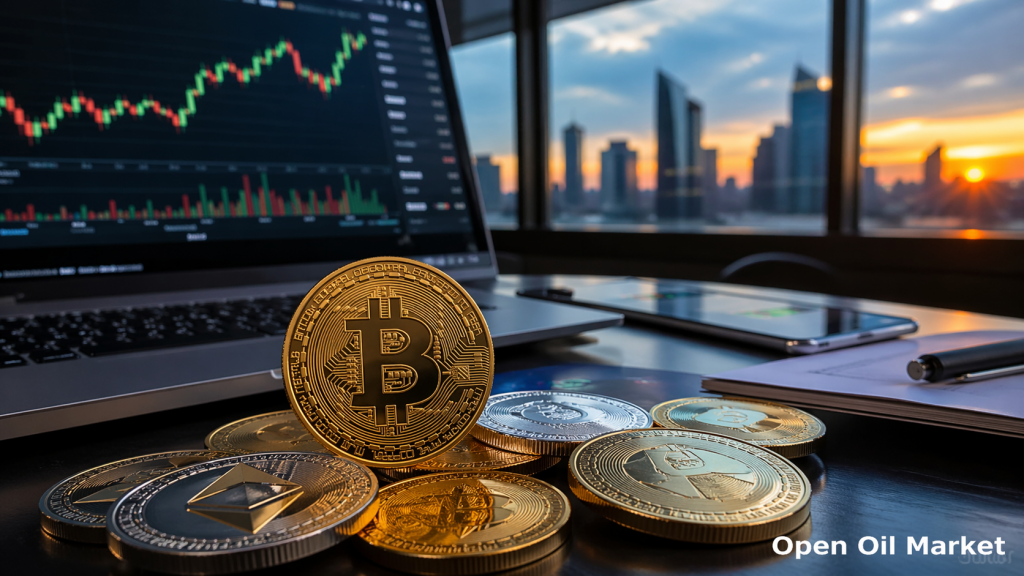
As Friday begins, Bitcoin finds itself in a significantly stronger position than just a few weeks ago. After a weak first quarter and a severe correction at the beginning of the year, the leading cryptocurrency has reclaimed a substantial portion of its losses and has returned to the spotlight for global investors. This movement is important not only in itself but also in its structure: the growth is occurring amidst improved market sentiment, a renewed interest in risk assets, and a new wave of institutional demand.
However, the market remains sensitive to geopolitical events and macro signals. In other words, the cryptocurrency market does not exist in isolation: oil dynamics, dollar liquidity, rate expectations, and global risk appetite are once again directly influencing Bitcoin's behavior. Bitcoin's dominance remains elevated, which suggests that the current phase is more about the recovery of quality and liquidity rather than a full-blown alt season.
- First signal: Bitcoin is once again the primary indicator of sentiment across the entire crypto market.
- Second signal: The growth is supported by large capital rather than solely retail speculation.
- Third signal: The high share of Bitcoin in total market capitalization indicates that investors prefer the largest and most liquid crypto assets for now.
Institutional Capital is No Longer an Episode
The main feature of late April is the accelerating institutionalization of digital assets. For the global market, this may be more significant than the current price of Bitcoin itself. Major Wall Street players and traditional finance are no longer merely testing the waters of cryptocurrency on the fringes. They are building products, infrastructure, and access channels that make cryptocurrencies a part of the standard financial offering.
Several events align with this narrative. Goldman Sachs is preparing its first Bitcoin ETF product, Charles Schwab is launching spot trading for Bitcoin and Ethereum for retail clients, Coinbase has received conditional approval for a national trust structure, and European banks are increasingly treating crypto companies as legitimate corporate clients. An emerging storyline involves the derivatives market: US platforms are gearing up for a broader launch of perpetual futures, which could significantly deepen and enhance market liquidity.
- Banks are transitioning from observation to product expansion.
- Brokers are widening access to spot trading for key assets.
- Exchanges and derivatives platforms are preparing for a new cycle of trading volume growth.
- European and Asian financial centers are intensifying competition for crypto capital.
Regulation Becomes a Growth Factor, Not Just a Risk
Another key takeaway is that cryptocurrency regulation is gradually moving away from being merely a hindrance and is increasingly becoming a condition for market expansion. In the US, regulators have transitioned to a more clear classification of digital assets, and the political agenda has shifted from confrontation to establishing a rules architecture. For investors, this signifies an increase in predictability—and predictability in the global financial market almost always enhances large players' willingness to allocate capital.
In Europe, the focus remains on MiCA. It is no longer an abstract regulatory framework but a practical quality filter for companies looking to serve clients in the EU. British authorities are likewise ramping up enforcement against illegal crypto trading. Consequently, the narrative today is that not the loudest projects win but those that are the most scalable, transparent, and legally robust.
Stablecoins Move to the Center of Global Financial Discourse
If one is to identify the most undervalued theme in the sector, it would not be meme assets or particular altcoins, but rather stablecoins. Their role is evolving visibly. Previously, they were primarily a convenient dollar equivalent within crypto exchanges. Now, they represent an infrastructural layer around which settlements, corporate liquidity, cross-border transfers, and banking experiments with tokenized money are built.
Europe is discussing the enhancement of euro-backed stablecoins, Swiss banks are testing scenarios for a franc token, and Asia is increasingly engaging with yuan-pegged digital settlement instruments. For global investors, this is particularly important, as the next phase of growth in the crypto economy may emerge not from retail trading but from payment infrastructure. In this regard, the cryptocurrency market is increasingly intersecting with the global currency and banking services market.
- Stablecoins are becoming tools for settlements, not just storage of dollar liquidity.
- Competition is increasing among dollar, euro, and potentially Asian models.
- A new class of payment infrastructure is emerging for banks and corporations.
Altcoins Rise Selectively, Not Across the Board
Against the backdrop of Bitcoin's strengthening and increased interest in stablecoins, the market for major altcoins appears more positive than it did at the beginning of the month, but the movement remains selective. Ethereum continues to serve as a key infrastructure asset for smart contracts, tokenization, and institutional on-chain segments. Solana remains one of the most notable networks in terms of trading activity and user turnover. XRP maintains a strong presence in the global investment narrative as a payment and cross-border asset. BNB and TRON leverage their infrastructure and exchange liquidity.
This is an important point for investors: the market is currently rewarding not just any alternative tokens, but primarily large and liquid cryptocurrencies with a clear case—settlements, infrastructure, application ecosystems, stable demand for the network. Thus, the phrase “altcoin rally” should be used cautiously today. The focus seems to be on a rotation within the upper echelon of the market, rather than a uniform growth of the entire spectrum of digital assets.
The Most Popular Cryptocurrencies in the World
From the perspective of global investor attention, liquidity, and role in the current cycle, the following top 10 most popular cryptocurrencies remain in focus as of the end of April 2026.
Market Core
- Bitcoin (BTC) — the primary reserve asset of the crypto market and the main indicator of global risk appetite.
- Ethereum (ETH) — the foundational infrastructure for smart contracts, tokenization, and many institutional on-chain solutions.
Dollar Liquidity and Settlement Layer
- Tether (USDT) — the largest source of dollar liquidity within the global crypto economy.
- USD Coin (USDC) — the key regulated stablecoin for institutional and corporate scenarios.
Payment, Platform, and Infrastructure Assets
- XRP — one of the most recognizable payment crypto assets with a global retail and institutional audience.
- BNB — the infrastructure token of the largest exchange ecosystem and an important liquidity element in the market.
- Solana (SOL) — a high-throughput network with strong trading activity and significant role in the application segment.
- TRON (TRX) — a major network for stablecoin transfers, particularly notable in emerging markets.
- Dogecoin (DOGE) — one of the most liquid indicators of retail sentiment and cycles of risk appetite.
- Cardano (ADA) — an asset with sustained global recognition, a strong community, and a long investment cycle of attention.
What Investors Should Monitor in the Coming Days
- Bitcoin's retention at current levels. If BTC remains near the key psychological zone, it will support the entire cryptocurrency market.
- New headlines regarding institutional products. ETFs, brokerage services, and derivatives are now influencing sentiment more than localized speculative news.
- Macro and geopolitical backdrop. Oil, the dollar, and news from the Middle East remain direct drivers of volatility.
- Regulatory signals from the US and Europe. These will determine how quickly digital assets become a part of the standard financial infrastructure.
Main Risks for the Cryptocurrency Market
- Geopolitical volatility. Any worsening of the external situation could quickly dampen demand for risk.
- Regulatory fragmentation. The US, EU, and Asia are moving towards regulations at different speeds and with different logics.
- Sanction and compliance risks. Infrastructure networks and crypto platforms are increasingly under the scrutiny of financial regulatory authorities.
- Risk of overheating in derivatives. Rapid movements in Bitcoin and major altcoins can lead to liquidations and sharp reverse impulses.
For Global Investors
As Friday begins, the main takeaway is that cryptocurrency news is once again being shaped not at the periphery of the financial system but at its core. Bitcoin is returning to its role as a global risk barometer, Ethereum and major altcoins are holding capital attention, while stablecoins are emerging as their own geopolitical topic. For investors, this signifies a shift in focus: the market is increasingly rewarding scale, liquidity, regulatory clarity, and real infrastructural value over random speculative chatter.
If external conditions do not deteriorate in the coming days, the global cryptocurrency market has a chance to solidify its April recovery. However, the key to the next movement will not be the emotions of the crowd, but the decisions of banks, regulators, brokers, and large capital holders. This is why today, the most significant elements are Bitcoin, Ethereum, stablecoins, and the upper echelon of the most liquid crypto assets.