Cryptocurrency News for Sunday, January 18, 2026: Bitcoin Surpasses $100,000, Altcoin Rally Gains Momentum, Institutional Inflows, Regulations, and Investor Outlook.
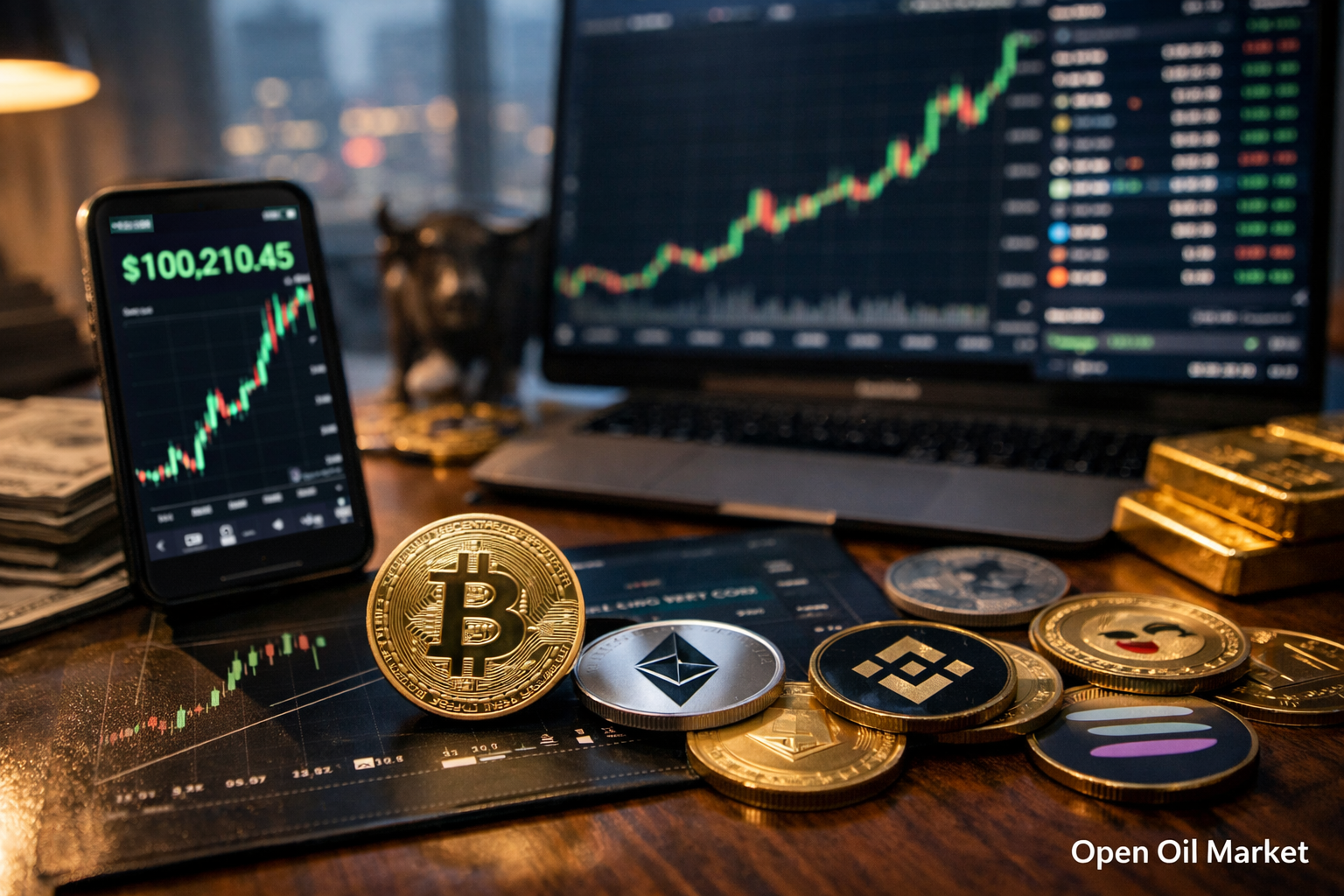
As of the morning of January 18, 2026, the global cryptocurrency market continues its upward trajectory following recent gains. Bitcoin has crossed the psychologically significant threshold of $100,000 for the first time, setting a new historic record for the crypto market. The share of the leading cryptocurrency remains around 60% of the total market capitalization, which has reached approximately $3.3 trillion, reflecting predominantly optimistic investor sentiment.
The situation is influenced by favorable macroeconomic conditions (slowing inflation and easing rate forecasts), as well as hopes for clearer industry regulations—these factors support the current rally in digital assets. Ethereum holds steady above $3,400 per coin following a recent network upgrade in early January, and major altcoins are also predominantly rising in tandem with the market leader.
Below are the key market indicators as of the morning of January 18:
- The total market capitalization of all digital assets is estimated at around $3.3 trillion.
- Bitcoin (BTC) is above the historical mark of $100,000, trading mainly in the $100,000–105,000 range. Bitcoin’s share is approximately 60–61% of the total market capitalization, affirming its status as the "digital gold" of the market.
- Ethereum (ETH) remains above $3,400, gaining about 5% over the last week. The market capitalization of Ether exceeds $400 billion (around 12% of the market), confirming its second place in significance.
- Major altcoins are exhibiting predominantly positive dynamics. Top-10 coins, such as Binance Coin (BNB), XRP, and Solana, have increased by around 4–6% in the past week, while Cardano (ADA) and Dogecoin (DOGE) have risen by approximately 7–8%.
Bitcoin Surpasses $100,000
Bitcoin (BTC) continues to lead and remains the driving force behind the current growth in the cryptocurrency market. By mid-January, its price confidently holds above the iconic mark of $100,000, having gained about 7% in recent days. This has strengthened Bitcoin’s position following a correction in late 2025 and marked a new record in value.
Institutional inflows are providing additional momentum to the largest cryptocurrency. Analysts estimate that one of the recent trading sessions saw Bitcoin ETF products attract around $843 million, while total inflows since the beginning of the year have already exceeded $1.7 billion. Investor confidence is also bolstered by significant corporate purchases: in January, MicroStrategy increased its reserves by over 13,600 BTC (approximately $1.25 billion), taking advantage of the price drop to accumulate assets.
Among traders, expectations for further growth are rising after surpassing the psychological barrier of $100,000—establishing a firm foothold above this level could act as a trigger for a new rally phase. In the short term, the key task is to maintain the price above the new level; otherwise, a consolidation of quotes at reached levels prior to another growth attempt could be likely.
Ethereum and Leading Altcoins
Ethereum (ETH), the second-largest cryptocurrency by market capitalization, is strengthening its position alongside Bitcoin's rise. In early January, a significant hard fork (BPO protocol update) took place on the Ethereum network aimed at optimizing parameters and enhancing transaction efficiency. After this upgrade, Ether is confidently trading above $3,400 per coin. Active development of Layer-2 solutions and growth in the decentralized finance (DeFi) ecosystem continue to amplify investment demand for ETH, pushing the network’s market capitalization close to $400 billion, confirming Ethereum's status as the key platform for smart contracts.
Leading altcoins, in general, are supporting the upward market trend. Binance Coin (BNB) and XRP have gained around 5% over the past week, while Cardano (ADA) and Dogecoin (DOGE) increased by about 7%. Additionally, positive news is attracting investor attention: the launch of the world's first spot ETF for Chainlink token (ticker: CLNK) on January 15 has boosted demand for LINK (its price has risen more than 8% in recent days). A combination of these factors is sustaining the positive dynamics of major alternative cryptocurrencies.
Top 10 Most Popular Cryptocurrencies
- Bitcoin (BTC) — the first and largest cryptocurrency, market leader. Price around $102,000, capitalization over $2 trillion.
- Ethereum (ETH) — leading blockchain platform for smart contracts. Price approximately $3,400, market capitalization around $420 billion.
- Tether (USDT) — the largest stablecoin pegged to the US dollar 1:1. Widely used by traders for operations on cryptocurrency exchanges.
- Binance Coin (BNB) — native token of the Binance exchange, providing discounts on fees and participating in ecosystem services. Price around $1,000, capitalization around $160 billion.
- USD Coin (USDC) — the second largest stablecoin, backed by the US dollar. Actively used in DeFi and cryptocurrency payments.
- XRP (Ripple) — token of the Ripple payment network for fast international transactions. Price around $2.30, market capitalization ~ $150 billion.
- Solana (SOL) — high-performance blockchain platform for decentralized applications. Price around $155, capitalization approximately $75 billion.
- Cardano (ADA) — next-generation blockchain with Proof-of-Stake algorithm. Price around $0.45, capitalization around $37 billion.
- Dogecoin (DOGE) — meme cryptocurrency that gained notoriety due to community support. Current price around $0.17, capitalization ~ $22 billion.
- TRON (TRX) — blockchain platform focused on the entertainment and content industry. Price around $0.32, market capitalization around $25 billion.
Institutional Investments and ETFs
Institutional interest in cryptocurrencies at the beginning of 2026 remains high. By mid-January, Bitcoin ETFs are recording record inflows: on certain days, the volume of investments reaches $800–900 million, while total inflows since the beginning of the year are around $1.7 billion. Such scale of purchases significantly boosts market confidence: large corporations and investment funds are actively increasing their positions in digital assets.
In addition to investments through funds, interest in direct ownership of cryptocurrencies remains. For example, MicroStrategy announced the purchase of approximately 13,600 BTC (around $1.25 billion) throughout January—one of the largest transactions by a public company. New products to attract institutional capital are also entering the market: on January 15, trading began for the first spot ETF on Chainlink token (CLNK) on the NYSE Arca, providing investors with direct exposure to LINK cryptocurrency. Analysts believe that the growth in volume of such funds and increased corporate investments are forming the fundamental premises for further price growth in digital assets.
Regulations and Legislation
In the realm of cryptocurrency regulation, initiatives are developing that will largely determine the "rules of the game" in 2026. In the U.S., a bill has been introduced that delineates oversight among various regulators and establishes which tokens are considered securities and which are commodity assets. The discussion of this document is expected to clarify rules for crypto companies in the American market.
Similar steps are being taken in other countries. In Russia, a law is under consideration that could legalize retail operations with cryptocurrencies from mid-2026, while in the European Union, the MiCA regulation, integrating digital assets under the supervision of financial authorities, is set to come into effect soon.
Technological Updates and Innovations
The technological infrastructure of the cryptocurrency market continues to improve. Within the Bitcoin ecosystem, development of the Lightning Network scaling solution is progressing—the total capacity of this network has surpassed 10,000 BTC for the first time, significantly expanding possibilities for fast and cheap micropayments.
In the stablecoin segment, control and responsibility are markedly increasing. Issuers are taking proactive measures against abuses: for instance, Tether has frozen over $180 million USDT on addresses suspected of fraudulent activity. Meanwhile, Western Union and Klarna have confirmed the development of their own regulated stablecoins for international payments. These steps reflect a global trend towards increased security and compliance with regulatory requirements, which enhances trust among institutional investors in digital assets.
Global Markets and Macroeconomics
The global macroeconomic environment continues to impact demand for cryptocurrencies. Global stock indices are rising, reflecting a resilient appetite for risk. In the U.S., the Federal Reserve is signaling potential easing of monetary policy amid cooling inflation—this encourages capital inflows into high-risk assets while simultaneously weakening the dollar. Furthermore, fresh economic data from China has surpassed forecasts, boosting investor confidence in global growth. Against this backdrop, some investors are increasingly using cryptocurrencies for hedging and diversification, amplifying the inflow of funds into the digital asset market.
Outlook and Forecasts
Experts remain generally optimistic regarding the further development of the cryptocurrency market. Strengthening institutional demand and progress in regulation create fundamental conditions for continued growth. The key benchmark remains the $100,000 mark for Bitcoin: according to analysts, a firm hold above this level could attract new capital inflows and open the next stage of the rally. Some forecasts allow for Bitcoin’s price to rise to $150,000–200,000 by the year-end if current trends persist.
At the same time, market participants remind us of the ongoing high volatility. Short-term corrections are still likely, especially with changes in global financial conditions or the emergence of negative news. Key growth drivers include improvements in the regulatory climate and further integration of crypto assets into the traditional financial system (through new ETFs, central bank digital currencies, and other initiatives). The return of mass interest from retail investors, which currently remains relatively subdued, could provide additional momentum to the market. In favorable circumstances, the medium-term trend is likely to remain upward; however, analysts advise investors to maintain a diversified strategy and carefully assess risks.