Cryptocurrencies: Key Market News, Institutional Signals, and Dynamics of Top 10 Digital Assets
The global cryptocurrency market approaches March 19, 2026, undergoing a significant restructuring. Following strong volatility at the beginning of the year, investors are once again focusing on liquidity quality, regulatory clarity, and the resilience of major blockchain ecosystems. The main theme for the global market has been the change in regulatory tone in the United States: this does not mean the disappearance of risks but alters the framework for assessing digital assets for institutional participants, funds, exchanges, and infrastructure solution issuers.
Main Topic of the Day: The Cryptocurrency Market Receives a New Regulatory Impulse
A key driver this week has been the emergence of a clearer position from the American regulator regarding the classification of crypto assets. This is especially important for the market for three reasons. Firstly, chronic uncertainty that has weighed on the valuation of crypto companies and tokens for years is diminishing. Secondly, the logic for institutional investors, who need clear rules for entry into the asset class, is simplifying. Thirdly, a stronger distinction is developing between quality digital assets and weaker speculative stories.
- Bitcoin benefits as the most understood and institutionally recognized asset.
- Ethereum receives additional support as the foundational infrastructure for DeFi, tokenization, and stablecoins.
- Major altcoins are now more dependent not on general hype but on their own ecosystem utility.
This is why the current cryptocurrency agenda appears less like a typical market rebound and more like a battle for capital redistribution within the sector.
Bitcoin Remains the Capital Magnet
Bitcoin retains its role as the primary asset in the crypto market and continues to serve as the main benchmark for the entire digital segment. Following the February shock, the market has seen a resurgence of interest in the largest cryptocurrency, but this demand is more rational than in the previous phase of euphoric growth. Investors are now closely assessing not only BTC's price dynamics but also its share of the total market, ETF capital behavior, flow resilience, and responses to macroeconomic signals.
For the global investor audience, Bitcoin in March 2026 is primarily:
- a defensive crypto asset within the digital market;
- an indicator of institutional confidence in the sector;
- the main asset for assessing risk appetite in cryptocurrencies.
Even with a renewed interest in altcoins, Bitcoin remains the first entry point for new capital. This makes BTC the primary reference for evaluating the future movement of the entire cryptocurrency market.
Ethereum and Infrastructure Blockchains Back in Focus
While Bitcoin remains a symbol of digital scarcity, Ethereum maintains its position as a key infrastructure platform. Against the backdrop of the new regulatory context, the market is once again focusing on ecosystems that provide real economic activity: staking, decentralized finance, asset tokenization, and the issuance of stablecoins.
In this logic, Ethereum appears more significant than many speculative altcoins, as its investment thesis is built not only on price but also on network utilization. Interest in Solana simultaneously rises, where the market continues to evaluate the combination of high throughput, user activity, and the ecosystem's ability to rapidly scale during periods of restored risk appetite.
Against this backdrop, competition among infrastructure cryptocurrencies is becoming more intense. Investors are increasingly choosing specific networks that can retain liquidity, developers, and user activity instead of opting for the “entire altcoin market.”
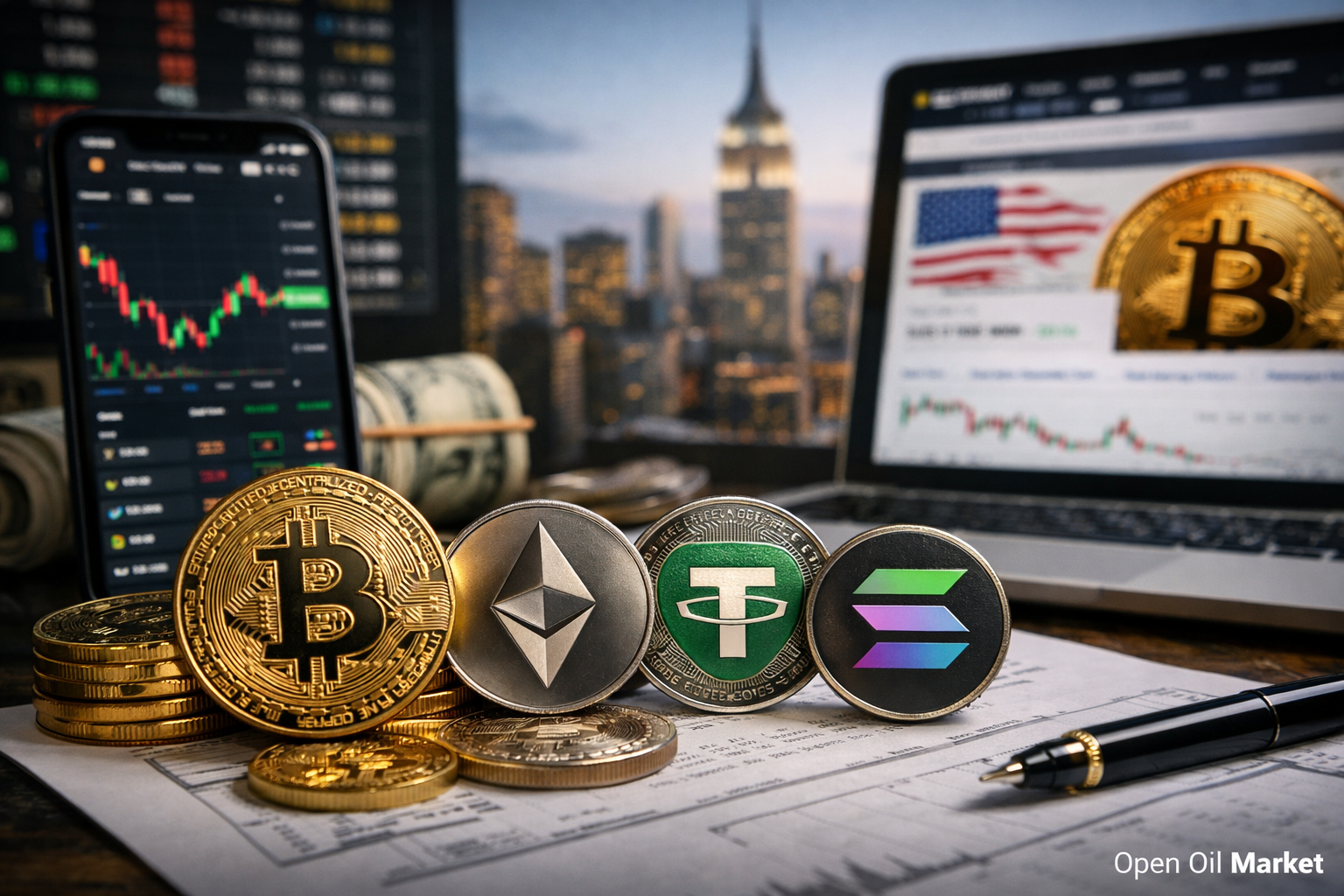
Top 10 Most Popular Cryptocurrencies: Who Shapes the Market Structure
By mid-March, the structure of the global crypto market at the upper capitalization level appears highly indicative. The leaders reflect three major directions: digital gold, infrastructure networks, and dollar stablecoins. This combination is currently defining the architecture of the cryptocurrency market.
- Bitcoin (BTC) — the main reserve asset of the crypto market.
- Ethereum (ETH) — foundational infrastructure for DeFi, tokenization, and smart contracts.
- Tether (USDT) — the largest dollar stablecoin for global liquidity.
- BNB — a large ecosystem with strong exchange and application support.
- XRP — an asset that the market continues to evaluate through the lens of payment infrastructure and regulatory normalization.
- USDC — an institutionally significant stablecoin with a growing role in digital transactions.
- Solana (SOL) — one of the main beneficiaries of the return of interest in high-performance networks.
- TRON (TRX) — a significant player in the cross-border stablecoin liquidity market.
- Dogecoin (DOGE) — still maintains mass recognition and speculative depth.
- Cardano (ADA) — remains among the largest cryptocurrencies due to a stable supporter base and infrastructural positioning.
For investors, this top ten is important not only as a ranking but also as a map of market preferences. The higher the share of Bitcoin and stablecoins, the more cautious the behavior of capital. The stronger the positions of infrastructure altcoins, the more the market is prepared for an expansion of risk appetite.
Stablecoins Emerge as a Separate Investment Theme
One of the most underrated trends of 2026 is the transformation of stablecoins from an auxiliary trading tool into a standalone element of the global financial system. Today, stablecoins are essential not only for crypto exchanges but also for cross-border transfers, tokenized financial products, digital liquidity, and new payment models.
The market increasingly sees that the struggle around crypto regulation is largely a battle for control over future monetary infrastructure. Therefore, USDT and USDC can no longer be viewed as a neutral background. They are becoming part of a broader narrative about the competition between banks, fintech companies, payment systems, and blockchain firms.
- For the crypto market, stablecoins are a source of liquidity.
- For investors, they serve as an indicator of the maturity of digital financial infrastructure.
- For regulators, they represent a sensitive topic regarding monetary sovereignty and bank deposits.
Tokenization and Institutional Infrastructure Strengthen the Long-Term Case for Cryptocurrencies
Another significant trend in March is the rapid convergence of traditional finance and blockchain infrastructure. The tokenization of stocks, bonds, and other financial instruments is gradually moving out of the experimental phase. For the cryptocurrency market, this is a fundamentally important signal: the sector is gaining not only speculative but also practical institutional functions.
When major exchange and financial platforms invest in tokenization, they essentially confirm that blockchain is seen as the future layer of market infrastructure. This supports the investment thesis for those cryptocurrencies that serve as the foundation for settlements, the issuance of digital assets, and the management of on-chain liquidity.
In practice, this means that long-term winners in the crypto market will be determined not only by marketing or meme dynamics but also by their ability to integrate into the institutional value chain.
Key Risks for Cryptocurrency Investors as of March 19
Despite the improved news backdrop, the cryptocurrency market remains in the risk zone. Investors must consider that regulatory easing does not eliminate political delays, and market recovery does not guarantee a sustainable trend.
- Regulatory risk: Unresolved disputes remain in the U.S. regarding legislation, particularly concerning stablecoins and permissible user reward models.
- Macro risk: Cryptocurrencies remain sensitive to the dollar, interest rates, geopolitics, and general risk demand.
- Structural risk: Part of the growth may still be explained by derivatives and short-term speculative flows.
- Sector risk: Capital is concentrating in a limited number of major assets, which increases pressure on weaker second-tier tokens.
Conclusion for Global Investors
As of March 19, 2026, the cryptocurrency market appears more mature than at the start of the year, but also more selective. Bitcoin maintains strategic leadership, Ethereum and Solana remain key bets on infrastructure growth, and stablecoins are transforming into standalone drivers of digital financial transformation. At the same time, investors must acknowledge that legislative uncertainty has not fully disappeared, and part of the recent recovery still relies on a fragile balance between regulatory optimism and macroeconomic tension.
The main takeaway for the day is simple: cryptocurrencies are becoming a topic not only for traders but also for systematic investors. However, in this market phase, the most liquid, infrastructurally significant, and regulatory-clear digital assets are likely to outperform the loudest narratives.