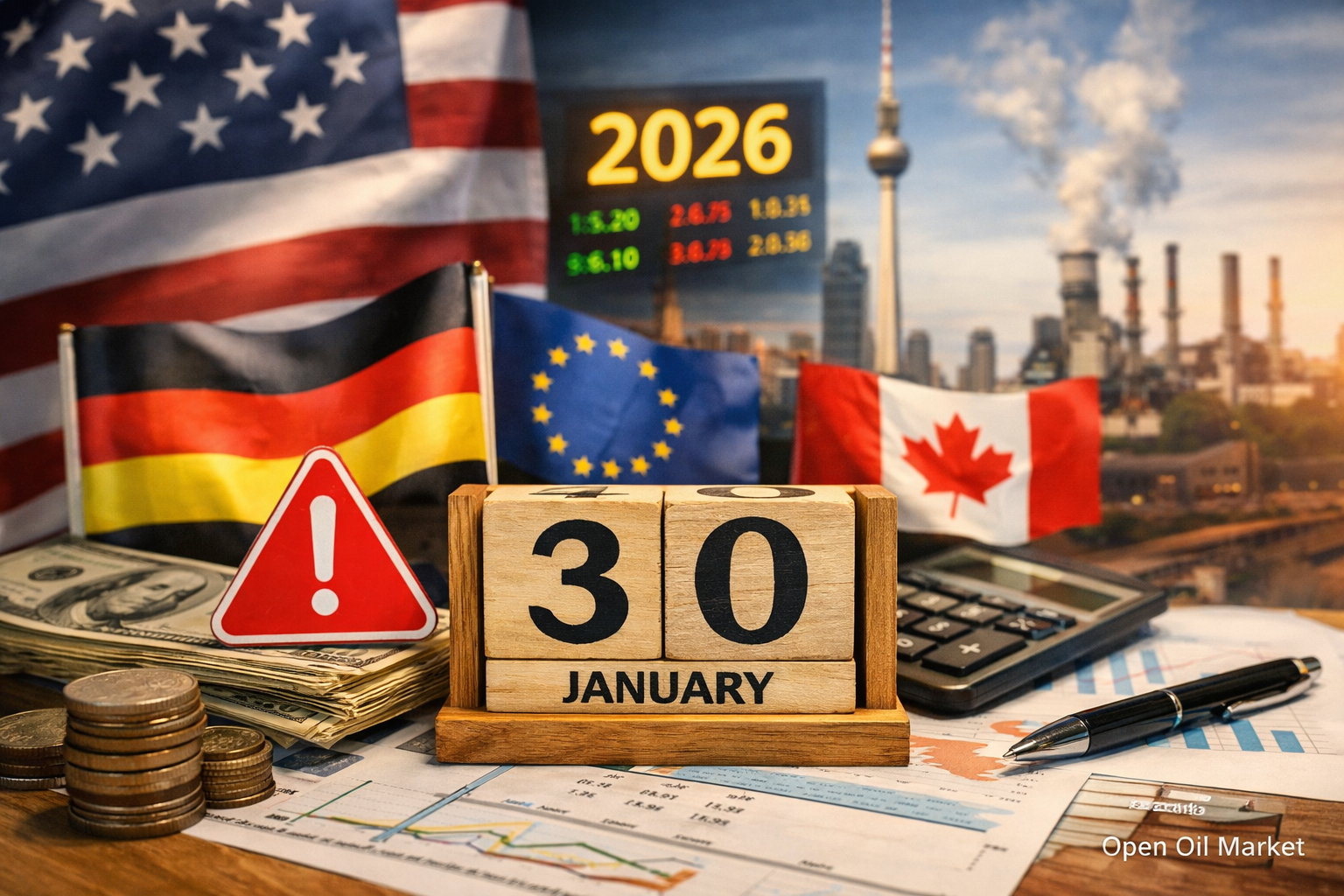
Key Economic Events and Corporate Reports on Friday, January 30, 2026: Germany and Eurozone GDP, U.S. Producer Inflation, Shutdown Risks, and Reports from Major Public Companies
Shutdown Threat in the U.S.
The United States faces the possibility of a partial shutdown of the federal government. The current temporary budget, adopted by Congress earlier, expires on January 30, and if lawmakers fail to agree on new funding, a suspension of government operations will commence at midnight. Political disagreements over spending, particularly in terms of funding certain departments, maintain uncertainty. Investors are closely monitoring the negotiations in Washington, as a shutdown could adversely impact U.S. economic growth and lead to increased volatility in financial markets.
Germany GDP (Q4 2025)
Today, the preliminary estimate of Germany's GDP for the fourth quarter of 2025 will be released. Analysts expect a modest growth rate for Europe's largest economy of around +0.2% q/q following stagnation in the third quarter. This will indicate whether Germany has managed to avoid a recession amid energy issues and a decline in industrial output. On an annual basis, Germany's economic growth for 2025 is estimated to be minimal. The results of Germany's GDP will set the tone for the entire Eurozone: unexpectedly strong data could buoy European markets, while weak figures would heighten concerns about the sustainability of economic recovery.
Eurozone GDP: Preliminary Data Q4 2025
Following this, aggregate data on Eurozone GDP for the fourth quarter will be released. A slowdown in economic growth in the currency bloc is expected, roughly estimated at 0.0–0.1% q/q, which is close to stagnation, after a slight increase of 0.2% in the previous quarter. The annual GDP growth for the Eurozone may amount to around 1.2% (down from 1.4% in the third quarter). These figures will reveal how well the region's economy is coping with rising interest rates and external risks. For the European Central Bank, weak statistics will provide additional arguments for a restrained policy, whereas stronger data may intensify discussions regarding the need for further measures to combat inflation.
Canada GDP for November 2025
In the afternoon, the assessment of Canada’s GDP for November 2025 (monthly figure) will be released. Preliminary data indicated modest growth of around +0.1% m/m, but official statistics will clarify the true dynamics. Canada's economy showed mixed signals in the second half of 2025: following a decline in the second quarter, there was a rebound in the third. The November figures will allow for evaluating the growth trajectory in the fourth quarter. If it turns out that economic activity slowed down or decreased at the end of the year, this could affect the Bank of Canada's plans regarding the interest rate, diminishing expectations for possible tightening of policy.
U.S. Producer Price Index (PPI) for December
The U.S. Department of Labor will publish the December Producer Price Index (PPI). This indicator reflects wholesale price dynamics and serves as a leading signal of inflation trends. In November, PPI in the U.S. rose by 3% year-on-year, and the market anticipates a similar figure for December. It is expected that the growth of producer prices will remain moderate, around 2.9–3.1% y/y. A slight acceleration compared to the previous month may indicate continued inflationary pressure in the production segment, although the overall level remains significantly below last year's peaks. Investors and economists will consider this data when assessing the Federal Reserve’s next steps: stable PPI will reinforce the view that inflation is under control, while an unexpectedly high jump could amplify discussions about the risk of a resurgence in consumer price growth.
Chicago PMI (January)
Closer to the evening, the January Chicago Purchasing Managers’ Index (Chicago PMI) will be released. This regional leading indicator will allow an evaluation of the state of the U.S. manufacturing sector at the beginning of the year. In December, business activity in the Chicago area saw a notable recovery—the index rose to about 43–44 points after a plummet to 36.3 in November (values below 50 indicate contraction). The consensus forecast for January suggests further slight improvement in the indicator, though it is expected to remain in the contraction zone (<50). Continued recovery of the Chicago PMI may signal a gradual revival of industrial production after a weak autumn. However, values significantly below 50 indicate that the U.S. manufacturing sector is still facing difficulties and sustainable growth has yet to be achieved.
U.S. Companies Reports
In addition to macroeconomic statistics, investors will receive a wave of corporate news. Today, several major companies from the S&P 500 and Dow Jones indices will present their financial results for the fourth quarter of 2025:
- ExxonMobil – one of the global leaders in the oil and gas sector. ExxonMobil's results will reflect how fluctuations in oil and gas prices affected the company's profits at the end of 2025.
- Chevron – another major U.S. oil and gas corporation. Investors will compare the reports of Chevron and ExxonMobil to assess the state of the energy resources sector and the prospects for dividend payments amid stable oil prices.
- American Express – a leading financial company in the payments sector. Its quarterly report will become an indicator of consumer spending and demand for credit services in the U.S. during the holiday season of the fourth quarter.
- Colgate-Palmolive – a multinational company producing consumer goods. Investors will analyze sales dynamics and profitability at Colgate-Palmolive to understand the impact of cost inflation on the consumer sector.
- Verizon Communications – one of the largest American telecommunications operators. Verizon's report will provide insights into the state of the communications market, subscriber base growth, and monetization of 5G services.
In addition to those mentioned, quarterly reports will also be released today by pharmaceutical company Regeneron Pharmaceuticals, insurance broker Aon, consumer goods manufacturer Church & Dwight, and other firms. The cumulative results of these reports will help evaluate the financial health of various sectors of the American economy—from energy and finance to healthcare and high technology.
European and Asian Companies Reports
In Europe and Asia, several corporate reports will also be released on January 30, attracting attention from global investors. Among the most notable international companies reporting today are:
- CaixaBank (Spain) – one of the largest banks in Spain. Its fourth-quarter results will show trends in the Eurozone banking sector, including demand for loans and asset quality amid changing interest rates.
- Raiffeisen Bank International (Austria) – a significant Austrian banking holding with a presence in Eastern Europe. Investors from the CIS region traditionally monitor its performance, considering the bank's operations in the developing markets of Europe.
- Electrolux AB (Sweden) – a well-known household appliance manufacturer. Electrolux’s report will provide information about consumer demand in Europe and North America, as well as how the company is coping with rising costs and supply chain issues.
- Sumitomo Mitsui Financial Group (Japan) – one of Japan's largest banking conglomerates. Its financial results reflect the state of the Japanese financial sector and may indirectly indicate trends in the Asian economy.
- State Bank of India (India) – the largest public bank in India. SBI's quarterly report is of interest against the backdrop of rapid growth in the Indian economy; it will showcase lending dynamics and asset quality in one of the key emerging markets.
Reports from several Scandinavian companies (such as the industrial conglomerate SKF and packaging manufacturer Billerud in Sweden) and other Asian firms (including high-tech companies in Japan) will also be published. While these issuers may be less known to a broader audience of CIS investors, their results contribute to the overall picture of the financial health of the corporate sector in different parts of the world.
What Investors Should Pay Attention To
The last trading day of the week combines several diverse events—from politics to macroeconomics and corporate news. In these circumstances, it is important for investors to focus on the most significant factors:
- Budget Crisis in the U.S.: stay updated on news from Washington regarding the progress of budget negotiations. Any signs of progress (or lack thereof) could immediately impact markets and the dollar's exchange rate.
- GDP Statistics in Europe: analyze the GDP data of Germany and the Eurozone. Unexpectedly strong growth will support European stocks and the euro, while weak figures will heighten recession concerns in the region.
- U.S. Inflation Indicators: pay attention to the PPI report. Moderate inflation in producer prices will calm markets, while a spike in PPI may increase volatility due to a reassessment of Fed rate expectations.
- Quarterly Reports from Market Leaders: by assessing results from giants like ExxonMobil, Chevron, American Express, and others, investors will obtain benchmarks regarding company earnings from various sectors. This will aid in adjusting strategies regarding respective stocks and sectors.
Overall, Friday, January 30, promises to be active on the exchanges. The reactions of indices S&P 500, Euro Stoxx 50, Nikkei 225, and Moscow Exchange Index will depend on whether expectations for key statistics and corporate earnings are met. Investors from the CIS countries should consider the global news backdrop when making decisions, as the international events of this day could set the tone for market dynamics in the near term. As the week concludes, participants will strive to assess the comprehensive incoming information to enter the following week with the most complete picture of the economic situation.