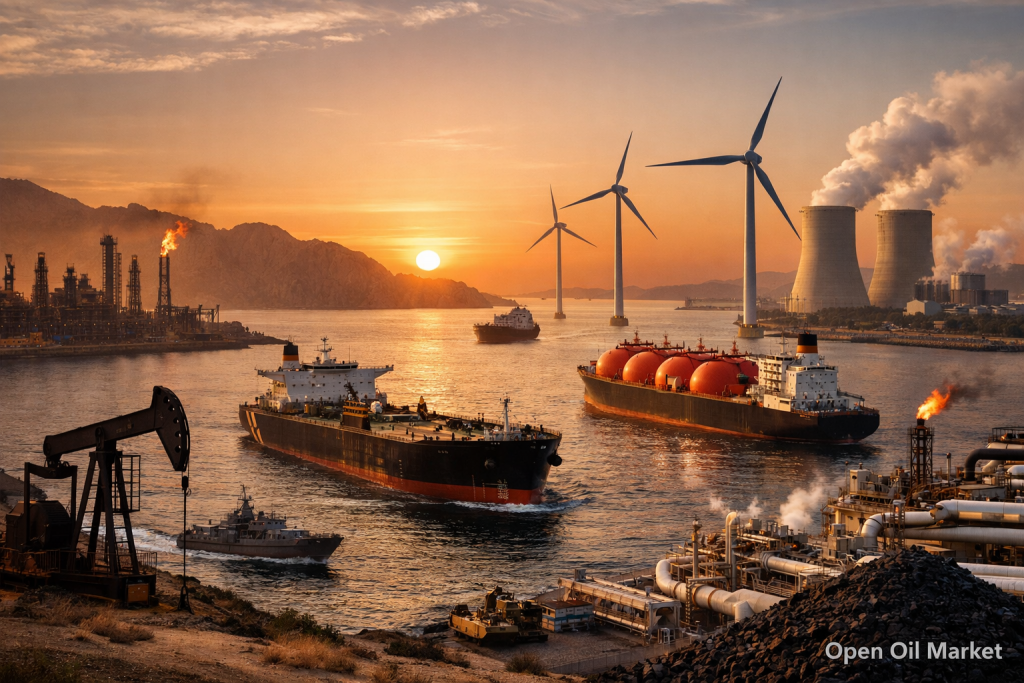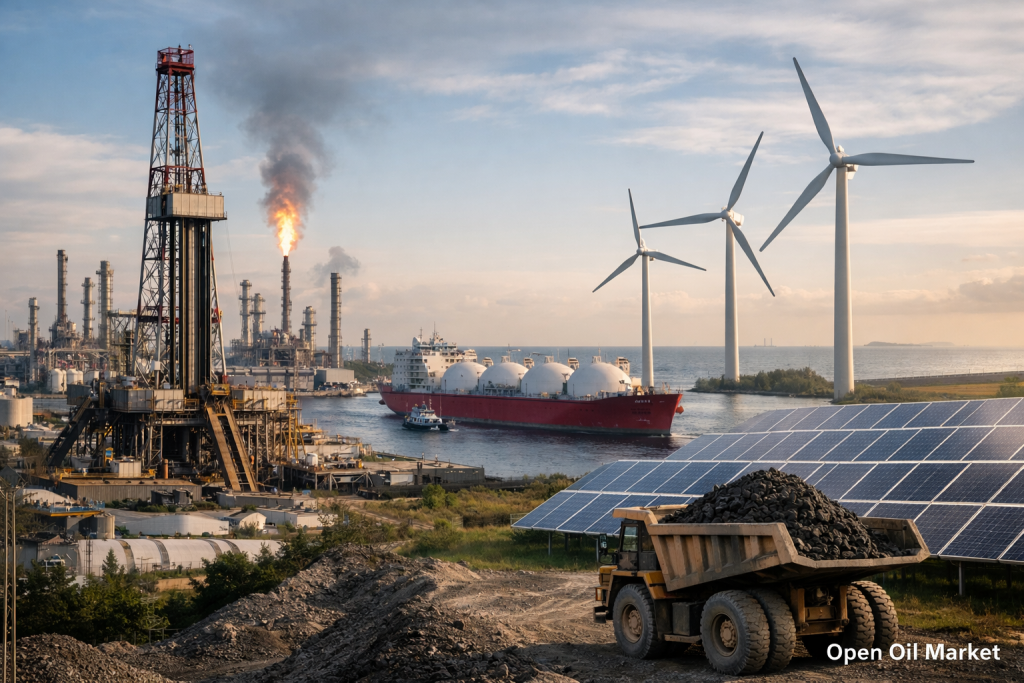
Key news from the oil, gas, and energy sector for Sunday, December 21, 2025: oil and gas market, energy, renewable energy sources, coal, petroleum products, and global trends in the fuel and energy complex.
The current events in the fuel and energy complex (FEC) on December 21, 2025, attract the attention of investors and market participants with their contradictory signals. On the diplomatic front, shifts have emerged: negotiations involving the USA, the EU, and Ukraine took place in Berlin, instilling cautious optimism regarding a potential cessation of the prolonged conflict – Washington proposed unprecedented security guarantees to Kyiv in exchange for a ceasefire. However, no specific agreements have yet been reached, and the stringent sanctions regime in the energy sector remains intact. The global oil market continues to face pressure due to an oversupply and weakening demand: Brent prices have fallen to approximately $60 per barrel – the lowest level since 2021 – reflecting a market surplus. The European gas market demonstrates resilience: even at the peak of winter demand, underground gas storage facilities in the EU are nearly 69% full, and steady supplies of LNG and pipeline gas maintain prices at a moderate level.
Meanwhile, the global energy transition continues to gain momentum. Many countries are setting new records for generation from renewable sources, although traditional coal and gas power plants still play a significant role in ensuring energy system reliability. In Russia, after a summer spike in prices, authorities implemented stringent measures (including extending the ban on fuel exports), which stabilized the situation in the domestic petroleum products market. Below is a detailed overview of key news and trends in the oil, gas, electricity, and raw materials sectors as of this date.
Oil Market: Oversupply and Weak Demand Pressure Prices
Global oil prices remain under downward pressure, reaching multi-year lows due to fundamental factors. The North Sea benchmark Brent is trading around $59–60 per barrel, while American WTI is in the range of $55–57. Current levels are about 15–20% lower than a year ago, reflecting a gradual market correction following the peak prices during the energy crisis of 2022–2023. Several key factors are influencing pricing dynamics:
- OPEC+ Supply: The oil alliance has generally maintained significant supply volumes in the market. Earlier voluntary production cuts were partially rolled back, and at the beginning of 2026, OPEC+ decided to keep current production levels without further increases. Participants in the agreement declared their commitment to market stability and readiness to reduce production again if the oil surplus increases. The upcoming OPEC+ meeting scheduled for January 4, 2026, is drawing analysts' attention, with expectations of signals regarding potential cartel interventions to support prices.
- Demand Slowdown: Global oil consumption growth has noticeably weakened. According to updated forecasts from the International Energy Agency (IEA), global demand for oil will increase by only ~0.7 million barrels per day in 2025 (compared to +2.5 million in 2023). OPEC estimates the demand growth at around +1.2–1.3 million b/d. The reasons include a slowing global economy and the prior period of high prices that incentivized energy conservation. China plays a significant role in curbing demand: growth in industry and fuel consumption in the second half of 2025 fell short of expectations due to a general economic slowdown (industrial production growth dropped to its lowest levels in the past 15 months).
- Geopolitics and Sanctions: Growing expectations for a peaceful resolution in Ukraine add a "bearish" factor to the oil market, as they imply the complete return of Russian volumes to the global market in the foreseeable future. At the same time, the West's sanctions standoff with oil exporters has intensified: the US imposed the strictest sanctions on Russian oil companies in the fourth quarter in years (including restrictions on transactions with major producers), which has already forced some Asian buyers to reduce imports from Russia. Additionally, Washington took the unprecedented step of declaring a "blockade" on tankers carrying sanctioned oil destined for and from Venezuela, trying to close off alternative sales channels. Although these measures temporarily reduce the availability of certain supplies, a significant portion of sanctioned oil continues to enter the market through shadow schemes, accumulating in floating storage and being sold at steep discounts.
The cumulative impact of these factors creates a steady supply overhang that keeps the oil market in a state of moderate surplus. Prices remain near the lower boundary of recent years and are not receiving momentum towards either growth or sharp declines. Market participants await further signals – both from negotiations regarding Ukraine and from OPEC+ actions – which may change the risk balance in oil prices.
Gas Market: Winter Demand Rises, but Large Stocks Hold Prices Down
In the European gas market, attention is focused on the peak of the winter season. Cold weather in December has led to increased gas consumption; however, a high level of stocks and stable supplies helped avoid sharp price spikes. According to Gas Infrastructure Europe, underground gas storage in the EU is currently approximately 68–69% full – this is below last year's level (around 77% on the same date) but still provides a significant reserve of stability. Thanks to this, along with record LNG imports and steady flows of gas through pipelines from Norway, current demand is being met without difficulty. The European benchmark index (TTF) hovers around €25–30 per MWh, remaining significantly below the crisis levels of 2022.
A slight price increase in gas observed at the beginning of December was linked to the initial strong cold weather; however, the market quickly stabilized. The loading of LNG terminals remains high – also due to the full resumption of the American Freeport LNG facility – compensating for the seasonal demand increase. At the same time, major traders have taken the largest short positions in gas futures since 2020, effectively betting on continued price stability. This reflects confidence that there will be sufficient stocks and supplies, although experts warn that in the event of a sudden import disruption or unusual cold snap, the situation could change. As overall stock levels this winter are somewhat lower than last year, any unexpected shock (for example, a technical failure or geopolitical incident) could quickly increase price volatility. Overall, the European gas market currently demonstrates balance: stable LNG and pipeline supplies help keep prices down, and authorities and energy companies have intensified monitoring to respond swiftly to potential energy security threats.
International Politics: Dialogue on Peace Inspires Hope, Sanction Pressure Persists
In the second decade of December, diplomatic efforts to resolve the conflict in Eastern Europe significantly intensified. On December 15-16, negotiations took place in Berlin involving special representatives from the US (from the administration of President Donald Trump), Ukrainian leadership, and leaders from key EU countries. The US side proposed an unprecedented scheme of security guarantees for Ukraine, comparable to NATO principles, in exchange for a ceasefire – a step that had not been openly considered before. For the first time since the beginning of the war in 2022, several European leaders cautiously welcomed such a shift: they spoke about the perspective of at least a temporary ceasefire becoming "conceptually feasible." German Chancellor Friedrich Merz noted the emergence of "a real chance for a ceasefire," while Polish Prime Minister Donald Tusk stated that he heard from American negotiators about the US's willingness to provide Ukraine with clear military guarantees in case of new aggression. These signals became the first rays of hope for a peaceful resolution to the largest conflict in Europe since World War II.
However, the path to a durable peace remains complex. Moscow has yet to show readiness to make concessions: Russian officials indicate that fundamental demands (including Ukraine's neutral status and territorial issues) remain in place. Kyiv, under intense pressure from Washington, is considering painful compromises but publicly excludes any recognition of territorial loss. Thus, negotiations continue, but there is no final agreement – meaning the current sanctions regime remains unchanged. Moreover, in the absence of significant progress, the West is not easing its pressure: the US and allies imposed new sanctions on the Russian oil and gas sector in the fall, and the European Union extended restrictions at the last summit, declaring its intention to adhere to price caps on Russian oil and petroleum products. Simultaneously, Washington significantly increased its military-political presence in the Caribbean, accompanied by sanctions against shipping linked to Venezuela, which effectively complicates the export of Venezuelan oil (a key ally of Moscow).
Markets are closely monitoring the unfolding of this dual situation. On the one hand, the success of peace negotiations could eventually lead to a relaxation of sanctions and the return of significant volumes of Russian energy resources to the global market, improving global supply. On the other hand, a prolonged or failed dialogue threatens new rounds of sanctions standoff, sustaining uncertainty and risk premiums in oil and gas prices. In the coming weeks, investors’ attention will be focused on whether the parties can turn the current diplomatic initiatives into a concrete plan for peaceful resolution or if the rhetoric surrounding sanctions will again escalate. Regardless, the outcome of the Berlin meetings and subsequent consultations will have long-term implications for the global energy landscape, determining the trajectory of relations between major powers and the operating conditions of the global FEC in the new geopolitical reality.
Asia: India under Sanction Pressure, China Increases Production and Imports
- India: Facing mounting sanctions pressure from the West, India is compelled to adjust its oil strategy. In the fall, the US imposed direct restrictions on several major Russian oil companies, and by December, some Indian refiners scaled back Russian oil purchases to avoid secondary sanctions. Notably, Reliance Industries, India's largest private oil refining company, suspended imports of Russian oil to its Jamnagar plants starting November 20. This marks a sharp decrease in Russia's share in India's imports, which had been significant since 2023. Nevertheless, New Delhi is not ready to completely abandon accessible Russian crude: supplies from Russia remain an important factor for energy security, especially considering the discounts offered (it is estimated that Russian Urals blend is sold to India at $5–7 less than Brent). The Indian government is striving to balance compliance with sanctions and meeting domestic demand: payment schemes using national currencies and attracting non-sanctioned traders are being explored. Meanwhile, India continues its long-term goal of reducing imports. Following Prime Minister Narendra Modi's bold announcement on Independence Day to launch a large-scale deepwater exploration program, initial results are already visible: the state-owned ONGC has drilled ultra-deep wells in the Andaman Sea, with discovered hydrocarbon reserves deemed promising. The country is also actively investing in expanding refining and alternative energy sources. All these steps aim over time to reduce India's critical dependence on oil and gas imports.
- China: Asia's largest economy continues to boost both its energy resource imports and domestic production, adapting to changing market conditions. Chinese companies remain leading buyers of Russian oil and gas – Beijing has not joined Western sanctions and is using the opportunity to import raw materials under favorable conditions. According to China's customs statistics, in 2024, the country imported approximately 212.8 million tons of oil and 246.4 billion cubic meters of natural gas, increasing volumes by 1.8% and 6.2%, respectively, compared to the previous year. In 2025, imports continued to rise, although at a more moderate pace due to a high baseline and economic slowdown. Simultaneously, China is actively stimulating domestic oil and gas production: in the first three quarters of 2025, national companies produced about 180 million tons of oil (up about 1% year-on-year) and over 200 billion cubic meters of gas (+5% year-on-year). The expansion of its resource base partly offsets demand growth, but does not eliminate dependence on foreign supplies – analysts note that China still imports about 70% of its necessary oil and around 40% of gas. The slowdown in the Chinese economy in the second half of 2025 led to a deceleration in energy consumption growth (demand for petroleum products and electricity grew more slowly than expected), which somewhat alleviated pressure on global commodity markets. At the same time, Chinese authorities, seeking to balance the domestic market, increased export quotas for petroleum products for their refineries as the year draws to a close, allowing the overflow of fuel (in particular, diesel and gasoline) to be directed to the external market. Thus, the two largest Asian consumers – India and China – continue to play a key role in global commodity markets, balancing import security strategies with their own production and infrastructure development.
Energy Transition: Growth of Renewable Energy and the Role of Traditional Generation
The global shift to clean energy has made further strides in 2025, marked by new records in the renewable energy sector. In Europe, total generation from solar and wind power plants has once again increased, exceeding electricity generation from coal and gas power plants, as it did in 2024. The commissioning of new renewable energy capacities continued at a rapid pace, particularly in solar and wind energy, with EU countries investing significant resources in green generation while also accelerating the development of grid infrastructure to integrate renewable sources. The share of coal in Europe's energy balance, which temporarily increased during the crisis of 2022–2023, is once again decreasing, thanks to the normalization of gas supplies and environmental policies. In the USA, renewable energy also reached historic levels: preliminary data shows that over 30% of all electricity generated in 2025 came from renewables. The combined volume of wind and solar generation in America for the first time over the year surpassed coal-fired electricity generation, reflecting a continuation of the trend that emerged at the beginning of the decade. This was made possible even despite efforts by authorities to support the coal industry – the inertia growth of previously planned renewable projects and market factors (relatively low gas prices for most of the year) contributed to further "greening" of the US energy system.
China remains a leader in renewable energy development: the country annually commissions dozens of gigawatts of new solar panels and wind turbines, continuously breaking its own generation records. In 2025, China once again increased installed renewable energy capacity to unprecedented levels – investments in the sector reached hundreds of billions of yuan. Simultaneously, Beijing is actively developing energy storage technologies and modernizing the energy grid to accommodate unstable generation. Nevertheless, given the enormous volumes of energy consumption, China still heavily relies on coal and gas for covering base load – making it the world's largest carbon emitter but also the primary market for clean technology deployment. Analysts estimate that global investments in clean energy (renewables, storage, electric vehicles, etc.) in 2025 for the first time exceeded $1.5 trillion, outpacing investments in the fossil fuel sector. The trend towards decarbonization is becoming one of the defining aspects of the global FEC: more companies and financial institutions are committing to reducing emissions while redirecting capital to low-carbon energy development projects. At the same time, the transition period requires balancing – traditional energy sources continue to ensure the base reliability of energy systems. Thus, the growth of renewables goes hand in hand with maintaining sufficient traditional generation capacity to guarantee stable energy supply as the sector undergoes reform.
Coal: Global Demand at Record Levels, Market Remains an Important Part of Energy Balance
Despite the acceleration of the energy transition, the global coal market in 2025 shows sustained strength. According to the International Energy Agency (IEA), global coal demand increased by another 0.5% this year, reaching around 8.85 billion tonnes – a new historical record. Coal remains the largest single source of electricity generation on the planet, significantly influencing the energy systems of several Asian countries. At the same time, the IEA expects that coal demand will stabilize at a plateau in the coming years and will begin to gradually decline by 2030, as renewable energy, nuclear power, and natural gas gradually displace coal from the energy balance. To achieve global climate goals, phasing out coal is considered a critically important step – it currently accounts for about 40% of global CO2 emissions from fuel combustion. However, implementing these plans faces objective challenges, as the coal industry continues to ensure the functioning of industries and electricity grids in many regions.
An important feature of 2025 has been the diverging trends in key coal-consuming countries. In India, for example, coal usage unexpectedly decreased (only the third time in the past 50 years) – this was aided by exceptionally abundant monsoon rains, which enabled record hydropower generation and reduced strain on coal power plants. In contrast, in the US, coal consumption has increased: due to higher gas prices and actions by the Trump administration to support coal power plants (including delaying their closures), coal has once again captured a larger share of electricity generation. Nevertheless, China plays a decisive role in global figures, accounting for about 55% of world coal consumption. In 2025, demand in China remained close to record highs, although the commissioning of new renewable capacities has been sufficient to temper further growth in coal burning – forecasts indicate that coal consumption in China will begin to gradually decline by the end of the decade. Overall, the coal market is currently in a state of relative equilibrium: production and export from major supplying countries (Australia, Indonesia, Russia, South Africa) consistently meet high demand, and prices remain at moderate levels without sharp spikes. The industry continues to be one of the pillars of the global energy sector, although it is under increasing pressure from the environmental agenda.
Russian Petroleum Products Market: Situation Stabilizes After Summer Crisis
In the domestic fuel market in Russia, signs of normalization are observed by the end of the year following the emergency situation last summer. Recall that in August-September 2025, wholesale exchange prices for gasoline and diesel reached record highs triggered by supply shortages due to peak agricultural work and repairs at refineries. The government had to intervene quickly by implementing stringent restriction measures. In particular, a complete ban on the export of motor gasoline and diesel fuel was introduced, initially planned until the end of September, and then extended several times. The last extension applied the embargo for the entire fourth quarter and until December 31, 2025. This measure ensured the redirection of approximately 200–300 thousand tonnes of motor fuel monthly to the domestic market that had previously been exported abroad. Simultaneously, authorities tightened control over the distribution of petroleum products within the country: oil companies are instructed to prioritize domestic market needs and eliminate the practice of reselling fuel to each other through the exchange. The retention of damping mechanisms (reverse excise tax) and direct subsidies from the budget continue to compensate producers for losses from selling fuel on the domestic market, encouraging them to retain sufficient volumes for Russian consumers.
The comprehensive set of measures has already yielded results – the fuel crisis has been localized. By the beginning of winter, wholesale gasoline prices have retreated from their peaks, and retail prices at gas stations have increased by less than 5% nationwide since the beginning of the year (which corresponds to the overall inflation level). Fuel stations are supplied with fuel, and there are no supply disruptions in the regions. The government states that it is ready to act preventively: if the situation deteriorates again, restrictions on petroleum product exports could be swiftly reintroduced or extended, and necessary fuel volumes will be quickly redirected to the domestic market from reserves. Currently, the situation has stabilized – the domestic market has entered winter without shortages, and prices for end consumers are maintained within acceptable ranges. Authorities continue to monitor the situation at the highest level to prevent a recurrence of last year’s sharp fuel price spikes and to ensure predictability for businesses and the public.
Telegram Channel OPEN OIL MARKET – Daily Analytics on the FEC Market
To stay updated on the latest events and trends in the fuel and energy market, subscribe to our Telegram channel @open_oil_market. There, you will find daily overviews, industry insights, and only verified facts without unnecessary informational noise – all that is essential for investors and FEC professionals in a convenient format.