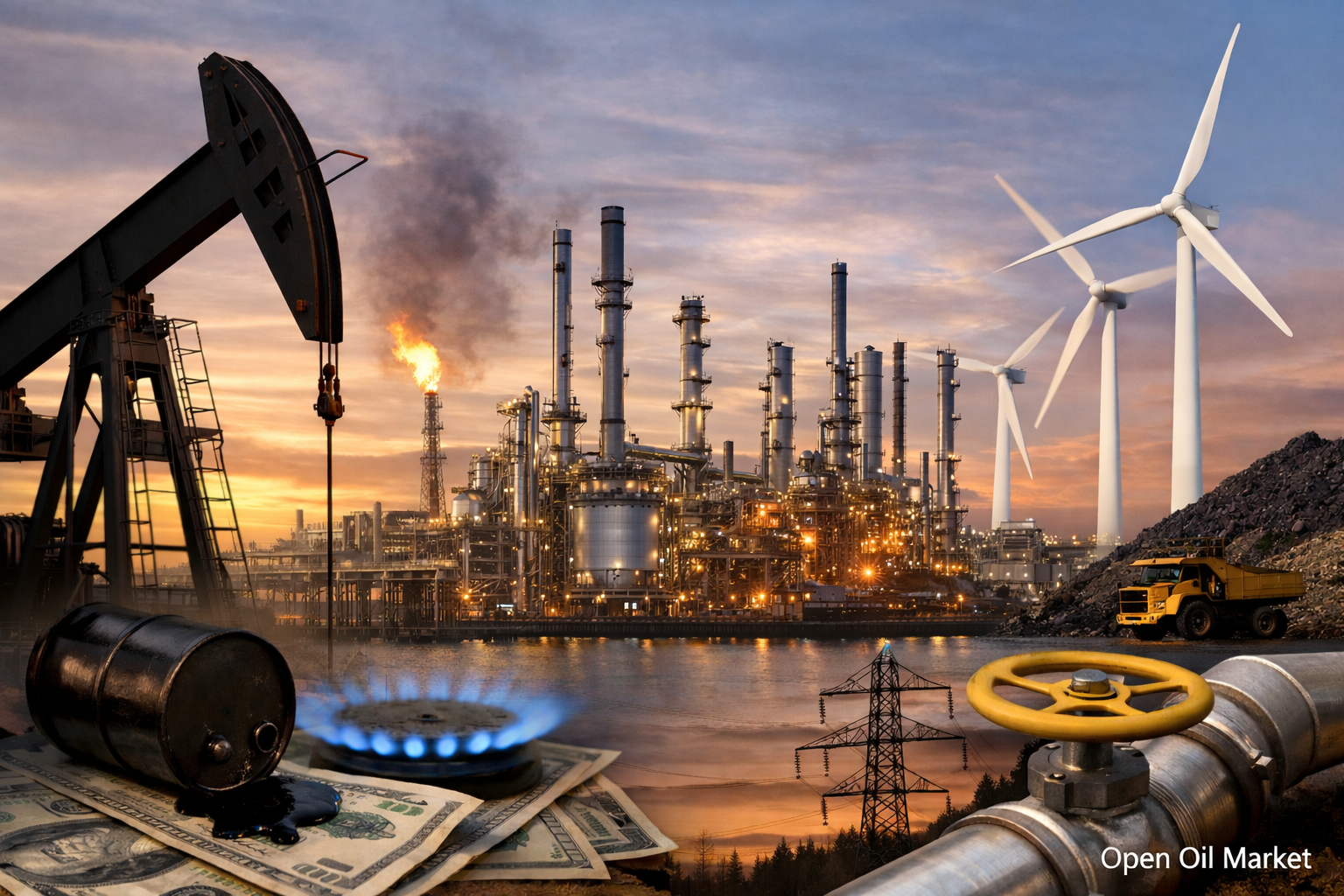
Global News of the Oil, Gas, and Energy Sector for Sunday, February 8, 2026: Oil, Gas, Refineries, Electricity, Renewable Energy Sources, and Key Events in the Global Energy Market for Investors and Industry Participants.
At the beginning of February 2026, global oil prices remain volatile, balancing in the high $60 range per barrel (Brent around $68–70, WTI in the $64–66 range). Following a dip at the end of 2025, prices have partially rebounded due to coordinated actions by OPEC+ and various geopolitical factors. However, overall pressure on the market persists due to oversupply and uncertainty in the global economy. The European Union announced its 20th sanctions package against Russia this week, which includes a complete ban on servicing maritime transport of Russian oil and lists dozens of vessels from the 'shadow fleet' in the sanctions. These measures intensify the pressure on hydrocarbon exports from the Russian Federation. Simultaneously, India is experiencing a sharp decline in Russian oil purchases - data from January shows imports have dropped by more than three times, signaling a possible reorientation of trade flows.
On the domestic market in Russia, the government continues to closely monitor fuel prices: the Federal Antimonopoly Service has initiated unplanned inspections of oil companies in response to the risks of accelerating inflation in this sector. The winter season has brought extreme cold and new records for energy consumption: peak loads on the energy system and historical maximums in gas demand have been recorded in several regions. Meanwhile, the global energy transition shows no signs of slowing down – investments in renewable energy are reaching record levels, and in the European Union, by the end of 2025, the share of 'green' generation for the first time exceeded that of fossil fuel electricity production. In this review, we examine current trends in oil and gas markets, analyze the situation in Russia’s fuel and energy complex, and highlight relevant developments in the coal, electricity, and renewable energy segments.
Oil Market
At the beginning of February, oil prices are showing cautious growth after a decline in the second half of 2025. Brent quotes are holding around $68–70 per barrel, having moved away from recent lows near $60, largely due to signals from OPEC+ regarding market support. The alliance of major exporters suspended planned production increases at the end of 2025 and confirmed its intention to maintain existing production limits at least until the end of the first quarter of 2026. This decision is linked to seasonally weaker winter demand and an effort to prevent oversupply amid a fragile balance of supply and demand.
- OPEC+ Policy: participants in the alliance continue to maintain significant production cuts (about 3.7 million barrels per day) instead of previously planned increases, citing uncertainty in the global economy. OPEC expects global oil demand to grow by approximately +1.2 million barrels per day in 2026 (to over 105 million barrels per day), although it acknowledges that a slowdown in the Chinese economy and high-interest rates in the US and Europe could adjust these forecasts. Short-term geopolitical incidents (such as recent events in the Persian Gulf) temporarily support prices, and the alliance confirms its readiness to respond quickly to external shocks.
- Geopolitics and Sanctions: the sanctions confrontation around Russian oil continues to impact the market. The 20th EU sanctions package includes a ban on servicing maritime oil transport from Russia: European companies are prohibited from insuring and financing tankers carrying Russian crude, and the 'black lists' of violating vessels are expanding. These restrictions complicate export logistics and heighten uncertainty for Russian suppliers. At the same time, key importers are seeking alternatives: India, which had previously become the largest buyer of Russian oil at a discount, has reduced purchase volumes to about one-third of last year's levels in January. Russian officials state that there are no fundamental changes in India’s approach to Russian crude, yet the fact of import diversification signals flexibility among Asian consumers and increased competition for markets.
The combination of these factors is preventing oil prices from collapsing but also limiting their growth potential. The market is factoring in both the risks of economic slowdown and the possibility of a supply shortage in the second half of the year if sanctions significantly reduce supply. As a result, quotes remain relatively stable, and volatility is limited by historical standards.
Natural Gas Market
The winter period traditionally brings increased demand for natural gas, and the start of 2026 is no exception. Abnormal cold in Eurasia has led to a rise in gas consumption for heating and electricity generation. In Russia, daily gas withdrawals from the network reached historical highs for two consecutive days in early February – increased demand is being noted from both the residential and industrial sectors. Despite this, gas prices on the European market remain comfortable. TTF quotes are fluctuating around $10–12 per million BTU, significantly lower than the crisis peaks of 2022. Record LNG imports from the US, Qatar, and other countries have compensated for the sharp decline in pipeline supplies from Russia, while relatively mild weather in the second half of January eased pressure on storage facilities.
At the same time, Russia is reorienting its gas exports to the East. Gas flows to China via the Power of Siberia pipeline continue to grow, while new LNG production capacities for the global market are being launched. East Asian economies, particularly China, are increasing gas consumption as industrial recovery progresses, although competition from cheap coal and expanding renewable energy sources is restraining faster demand growth.
Overall, the gas market has entered 2026 without the previous turbulence: prices have stabilized, and volatility has decreased to its lowest level in recent years.
Domestic Fuel Market in Russia
Russian authorities continue to control fuel prices. After a spike in gasoline and diesel prices in the fall of 2025, the government has heightened oversight: since January, the Federal Antimonopoly Service has been inspecting oil companies for collusion. In the event of signs of a shortage, authorities are prepared to limit fuel exports and subsidize oil refiners – these steps have already helped stabilize the situation at gas stations, and fuel remains accessible to consumers.
State Policy and Cooperation
Strategic planning for the development of Russia's fuel and energy complex has come to the forefront amid new challenges. The Ministry of Energy of the Russian Federation is updating programs and strategies for the development of the fuel and energy complex for 2026, taking into account sanctions and the global energy transition. A key emphasis is on energy security and export diversification, with the development of ties to countries in Asia, the Middle East, and Africa.
The international agenda also remains active. Disputes surrounding energy sanctions continue in the European Union: for instance, Hungary is openly declaring its intention to block restrictions against the Russian nuclear industry, considering cooperation in peaceful nuclear energy critically important for its energy system. This illustrates that consensus within the EU is not easily achieved. Meanwhile, dialogue among key players in the global energy sector remains intact. OPEC+ and Russia maintain mutual understanding regarding measures to stabilize the oil market. Rosatom continues to construct nuclear power plants abroad under previously signed contracts.
Coal Sector
The Russian coal industry continues to reorient towards Asian markets amid declining demand in Europe. There remains strong demand for thermal coal in Asian countries (China, India, etc.), which partially compensates for the sanctions-related losses to Russian companies. The Russian government supports exporters with subsidies for coal transportation and encourages the improvement of product quality for competitive positioning in eastern markets.
Electric Power Sector
Extreme cold in early 2026 has led to record peaks in winter energy consumption. In Russia, load has reached historical maximums, but the energy system has managed without disruptions by utilizing reserves. Europe also experienced no outages: reduced generation at hydroelectric plants due to a snow-poor winter was compensated by increased generation at gas and renewable facilities. Energy modernization continues: new gas and coal capacities with environmental improvements are being introduced, large solar and wind parks are being constructed, and energy storage systems and smart grids are being developed to enhance the reliability of energy supply and reduce carbon emissions.
Renewable Energy
The renewable energy sector continues to grow rapidly worldwide, reinforcing the irreversibility of the energy transition. According to the latest report from the International Renewable Energy Agency (IRENA), global installed renewable capacity rose by a record 585 GW (+15%) in 2024, accounting for over 90% of total generation growth. Preliminary data for 2025 indicate that this trend is likely to continue: investment booms and declining technology costs allow for increasingly large volumes of solar and wind power plants to be commissioned annually. In several countries, 'green' energy has reached leading positions. In the European Union, the share of renewable generation reached 48% in 2025, for the first time exceeding the contribution from fossil fuels. A significant role was played by the rapid growth of solar energy (over 20% year-on-year).
Many countries have raised their targets for the share of renewable energy by 2030 and are launching additional incentives for the sector. Concurrently, interest in energy storage technologies, carbon capture, and 'green' hydrogen is rising – indicating a more comprehensive approach to decarbonization. Although the pace of transformation must still increase to meet climate commitments, the trends of 2024–2025 inspire cautious optimism. Renewable energy has already become one of the main drivers of investment and innovation in the global energy sector, determining the long-term direction of industry development.